A couple of weeks ago, I introduced the concept of a mirror world as a viable option for dark matter. I would like to push this concept further, and discuss how mirror stars made of dark matter (i.e. dark stars) could send us detectable cosmic ray signals.
 [image credits: @pab.ink]
 Crossing the mirror…
Crossing the mirror…
Hidden worlds refer to setups in which the matter content of the universe is split into two sets. The first set (* i.e.* the visible world) consists in all known particles, whilst the second set (i.e. the hidden world) contains new hypothetical particles, the lightest one being dark matter.
In the visible world, the fundamental particles of the Standard Model interact through electromagnetism, the weak and the strong interactions. On the other hand, the hidden particles interact through new interactions (to which the visible particles are insensitive to).
 [image credits: new 1lluminati (CC BY 2.0)]
 In a mirror world configuration, the hidden world includes copies of each known particle: mirror quarks, mirror electrons, etc.
The mirror particles moreover undergo mirror versions of the Standard Model interactions: mirror electromagnetism, mirror weak and mirror strong interactions.
We hence end up with two independent copies of the Standard Model: a visible one and a mirror one.
As in the visible sector, mirror composite objects (like mirror neutrons and protons, but also mirror stars) can be formed.
The bright and dark side of electromagnetism
The bright and dark side of electromagnetism
 [image credits: NASA]
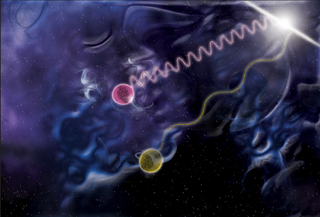
 Electromagnetism is a special force: a photon (the mediator of the electromagnetic interactions) does not interact with itself, in contrast with the other interactions.
The same holds for the mirror (or dark) photon.
This has a deep consequence: usual and dark photons mix. On very rare occasions, a visible photon can hence be converted into a dark photon, and vice versa.
A mirror star cosmic ray signal
A mirror star cosmic ray signal
This photon/dark photon mixing provides a way to the mirror and the visible worlds to communicate. This has many consequences. In particular, visible matter can be captured by a mirror star, which leads to the formation of a nugget of visible matter within the mirror star. Such a nugget could then further collide with mirror objects.
This results in the emission of an X-ray signal that could be detected in space observatories like Gaia or Chandra, as illustrated below.
 [image credits: arxiv]
This figure shows the luminosity of the X-ray signature of the mirror star (y-axis) as a function of its temperature (x-axis).
Each colour (orange, red, purple) corresponds to a specific mirror star mass, the orange being a mirror sun. The results for a strong (but not experimentally excluded) photon mixing are represented by dashed lines, and the dotted lines correspond to a 100 times weaker mixing.
The solid lines estimate the distance at which a signal of a given luminosity and temperature could be detected by Gaia (blue) and Chandra (green). In order to understand this figure, let us focus on few examples.
A mirror sun with a large mixing emitting a signal of 10.000.000 degrees could be observed by Chandra if it lies at 50 light years or closer: the top left orange dot stands between the 100 and 10 lightyear green lines.
If the signal temperature is colder (10.000 degrees), then it is up to Gaia to see it, even if it lies much further away: the top right orange dot is much above the 100 lightyear blue line.
Take-home message: mirror star signals
Take-home message: mirror star signals
In a mirror world theory, there exists a copy of all Standard Model particles and interactions. Whilst initially secluded from each other, the two copies can communicate by virtue of the properties of the visible and mirror electromagnetism.
As a consequence, mirror stars (the mirror counterpart of our visible stars) can emit X-rays that could be detected by existing space observatories, which could provide a way to detect clear signs of the mirror world (and thus of dark matter that is part of it).
PS: This article has been formatted for the steemstem.io front-end. Please see here for a better reading.
SteemSTEM
SteemSTEM aims to make Steem a better place for Science, Technology, Engineering and Mathematics (STEM) and to build a science communication platform on the blockchain. SteemSTEM
Make sure to follow SteemSTEM on steemstem.io, Steemit, Facebook, Twitter and Instagram. Please also consider supporting our witness (@stem.witness).


