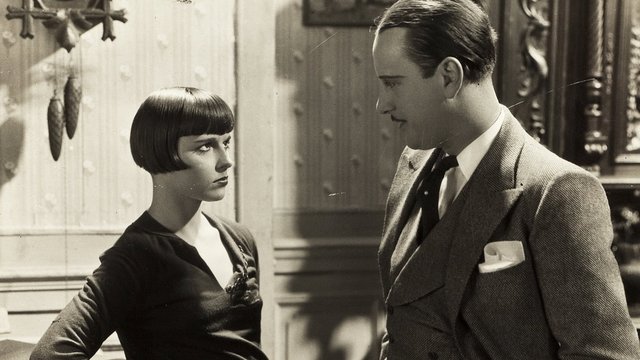
The transition from silent to sound cinema in Europe occurred roughly a year or two later than in Hollywood, but this delay was not indicative of a lack of progress; rather, it signalled a period of intense adjustment. European filmmakers faced a uniquely difficult landscape compared to their American colleagues, who largely operated within a unified market. Here, they had to contend with fractured national markets and the insurmountable issue of language barriers. Despite these profound challenges, some films made during this transitional period look very impressive and are rather comparable to Hollywood standards of the time. One such example is Prix de beauté, which is the third earliest French sound film, and it stands as a notable achievement of its era. The title literally translates to "Beauty Prize" in French, and the film is also known by its English title, Miss Europe.
At the centre of the narrative is the protagonist Lucienne "Lulu" Garnier, played by the legendary Louise Brooks. She is a Parisian typist who harbours dreams of grandeur that lie far beyond the mundane confines of her office job. Unbeknownst to her boyfriend André (Georges Charlia), Lulu mails her photographs to the Globe newspaper with the hope of entering a beauty contest. André, who has recently proposed to her, treats her aspirations with indifference, viewing them as frivolous. However, Lulu's tenacity pays off; against all odds, she wins the title of Miss France and qualifies for the grand international contest scheduled to be held in San Sebastian. She goes on to win the title, earning the attention of many rich and powerful men. The tension between love and ambition reaches its boiling point when André arrives at her hotel and issues an ultimatum: she must return with him to Paris or they will break up. Lulu, torn between her relationship and her newfound fame, agrees. They return to Paris, living in a simple, ordinary apartment. Yet, the simple life proves unsustainable. Lulu continues to receive a torrent of fan mail and, eventually, receives an offer to return to the limelight and launch a career as a film actress in the burgeoning sound era. After some hesitation, she relents to the allure of the screen. André, consumed by jealousy, decides to end her aspiring stardom in the most brutal and tragic way possible.
Like many of the earliest sound films, Prix de beauté was originally conceived as a silent motion picture, a fact that grants it an excellent pedigree. The original story was written by the celebrated French filmmaker René Clair, while the script was co-written by Georg W. Pabst, the Austrian titan of Weimar silent cinema. This collaboration is significant, given that Pabst was responsible for two silent films that made American actress Louise Brooks a global star: Pandora's Box and Diary of a Lost Girl, both released in Germany a year prior. Prix de beauté is, on account of Brooks' modern bob hairstyle and her portrayal of strong, independent women, sometimes considered the third part of a "feminist" trilogy. However, the collaborative vision was not to be fully realised; René Clair was originally slated to direct, but a dispute with studio SOFAR led to the job being handed to the Italian filmmaker Augusto Genina.
The final result is an interesting, very accomplished film that handled certain technical limitations of the new sound medium relatively well. A significant portion of the film occurs outdoors, featuring semi-documentary footage of people enjoying time at the beach. Furthermore, Genina seamlessly edited in real-life footage of the Miss Europe contest that took place in San Sebastian in front of thousands of spectators in September 1929. This documentary-style approach removed much of the need for actual dialogue within the narrative structure. However, this reliance on real events came at a cost; dialogue was largely replaced by an overwhelming music soundtrack. At times, this musical accompaniment is distracting and disrupts the narrative flow, drawing attention away from the performances.
Louise Brooks, arguably one of the most iconic actresses of the era, eats the role of Lucienne for breakfast. She plays the character with a complex mix of femininity, vulnerability, but also a self-confidence that defines her screen persona. The issue of language barriers was neatly solved through simple French dubbing by the French actress Hélène Regelly, as Brooks did not speak French. The result is solid for its era, but the film is ultimately ruined by Lucienne breaking into songs that aren't actually that good. These musical interludes are often poorly timed and frequently ruin the suspension of disbelief, pulling the viewer out of the otherwise grounded drama.
Despite these shortcomings, Genina acquits himself to a degree in the strong melodramatic finale. The climax takes place in a projection room, a setting that allows for a poignant juxtaposition. Louise, after being shot by André, dies, while her character on the screen lives on. It was quite an interesting visual device, highlighting the separation between the reality of the actress and the fantasy of the character.
The film's production history is marred by personal unhappiness. Brooks apparently wasn't happy with the film or the European film industry in general, so she returned to Hollywood, where she would quickly sink into oblivion, only to rediscover herself as a film writer and accomplished memoirist in the 1950s.
At the end of the day, while an accomplished film for its time, Prix de beauté lacks the directorial talent of Pabst and the simple, stark power of the silent cinema that characterised Brooks' previous two iconic roles.
RATING: 6/10 (++)
==
Blog in Croatian https://draxblog.com Blog in English https://draxreview.wordpress.com/ InLeo blog https://inleo.io/@drax.leo Substack https://draxster.substack.com/
InLeo: https://inleo.io/signup?referral=drax.leo Leodex: https://leodex.io/?ref=drax Hiveonboard: https://hiveonboard.com?ref=drax Rising Star game: https://www.risingstargame.com?referrer=drax 1Inch: https://1inch.exchange/#/r/0x83823d8CCB74F828148258BB4457642124b1328e
BTC donations: 1EWxiMiP6iiG9rger3NuUSd6HByaxQWafG ETH donations: 0xB305F144323b99e6f8b1d66f5D7DE78B498C32A7 BCH donations: qpvxw0jax79lhmvlgcldkzpqanf03r9cjv8y6gtmk9


