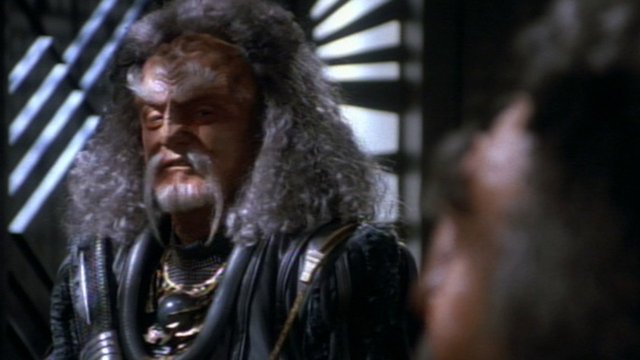
Blood Oath (S20E19)
Airdate: 27 March 1994
Written by: Peter Allan Fields Directed by: Gates McFadden
Running Time: 46 minutes
If there exists any facet of the fictional tapestry woven by Star Trek that has been crafted with unwavering consistency and supreme talent across the decades—one that has allowed each subsequent chapter to peel back layers of complexity and reveal deeper, richer lore—it is undoubtedly the Klingon race. Once relegated to the role of simplistic antagonists, they have evolved into one of science fiction’s most fascinating and engrossing cultures, a transformation so profound that they are now credited with inspiring the creation of the world’s most popular artificial language, Klingonese. This race grew more intricate with every passing incarnation throughout the franchise's Golden Age, transforming from angry men in rubber foreheads into a civilisation defined by rigid honour, complex politics, and a distinct philosophy of death. Blood Oath, the nineteenth episode of the second season of Deep Space Nine, is a grand exemplar of such world-building, a masterclass in utilising nostalgia to drive narrative forward. However, it serves an even more significant function: it acts as an excellent, poignant tribute to where Star Trek—and the Klingons, specifically—originated, bridging the gap between Gene Roddenberry’s optimistic utopian vision and the grittier, more morally ambiguous landscape of the 1990s.
The episode commences with a classic Deep Space Nine setup, dropping the viewer directly into the station’s underbelly where Quark summons Odo to extract a particularly unruly patron from the holosuite. This individual, perpetually drunk and refusing to vacate his virtual space, is reliving the Battle of Klach D'kel Brakt—the glorious Klingon victory over the Romulans fought a century prior. This patron is none other than Kor (John Colicos), an elderly Klingon commander and Dahar Master, one of the most revered warriors in the Empire. He is ultimately deposited into the station's drunk tank, where he is soon visited by his old comrade Kang (Michael Ansara), another highly respected commander and warrior. Overhearing their conversation, Jadzia Dax immediately recognises both men and is thrilled by the reunion; she is also joined by the third Klingon commander, Koloth (William Campbell). Decades ago, while Dax was still hosted by Curzon and served as Federation diplomat, she was friends with all three of them, even becoming godson to Kang's firstborn son, who shared the name "Dax".
Jadzia soon learns that the reason for this reunion is far from a social call. After decades of searching, the Klingon trio has managed to locate the whereabouts of an infamous pirate known under the pseudonym "The Albino" (Bill Bolender). Eight decades ago, Kor, Kang, and Koloth managed to destroy Albino's fleet, but he took terrible vengeance upon them by infecting all of their firstborn sons with a deadly virus. Consequently, Kor, Kang, and Koloth took a blood oath to avenge their deaths. Curzon Dax took the oath as well, out of his friendship for the Klingons and his affection for their son. All three Klingons now want to find and finally kill The Albino, even if it means that some—or all—of them will not return from the mission.
Kang arrives at the station with the specific intention of formally absolving Jadzia of the blood oath, arguing that it was made by a previous host and cannot possibly bind her to a new life. Jadzia, however, thinks differently. She attempts to deflect his scepticism by displaying superior bat'leth skills, proving that she is more than capable of holding her own in Klingon combat. Before setting out to join her old friends on their mission of vengeance, she consults with Kira about what it truly means to take a life, and Kira tries to dissuade her by telling with each killing she loses part of herself. Sisko, apparently aware of what is going on, allows her to leave, though his reluctance is palpable.
During the journey to Secarus IV, where The Albino has constructed his fortress and manned it with a large contingent of elite mercenaries, it becomes increasingly apparent that the old Klingons are motivated less by a desire for vengeance and more by a desperate need to achieve a glorious death in battle. Having outlived their era, they prefer the honour of a warrior's end to a quiet, uneventful retirement. Jadzia talks them out of what would essentially be a suicide mission and devises a tactical plan that could actually work. They manage to penetrate Albino's compound, take out the majority of his guard, and confront him directly. In the ensuing fight, Koloth dies, and Kang is mortally wounded. Jadzia manages to overpower Albino and, just before she is to deliver the final blow, it is Kang who stabs him in the back. His final act is clearly designed to clear Jadzia's conscience, sparing her the burden of the final killing. Kor mourns his slain friends by song. Later, when Jadzia returns to the station, the silent treatment and the looks she receives from Sisko and Kira suggest that their professional relationship will never be quite the same again.
Blood Oath is one of the most highly regarded episodes of Deep Space Nine, though it has its detractors who consider it nothing more than one big piece of fan service to Star Trek: The Original Series aficionados. The script, originally written by Peter Allan Fields, one of the most celebrated Star Trek authors, initially featured three newly introduced Klingon characters, but Robert Alan Hewitt suggested that those three could actually be the Klingons who debuted in TOS—Kor, featured in the episode Errand of Mercy which actually introduced the Klingons to the franchise, Koloth from The Trouble with Tribbles, and Kang from Day of the Dove. This creative decision to reach back into the past proved to be a stroke of genius, allowing the episode to breathe with the credibility of decades of continuity.
While the idea of Klingons having a significantly longer lifespan than humans allowed these characters to appear nearly a century after their introduction, the producers of Blood Oath faced significant difficulties. Gathering the old cast after almost three decades wasn't a simple task, particularly because William Campbell had retired from acting by that time and was working on Star Trek convention cruises. The decision to unite these three veteran actors lent the episode an almost poetic quality—a celebration of three old guest stars who each contributed a lot to the franchise in their own way. Another issue was the Klingon appearance in the 24th century being quite different from the more human-looking Klingons in the mid-23rd century, as depicted in TOS. This visual discrepancy, caused by the financial issues that barred elaborate makeup in the original series but allowed it in TNG, made initially recognising John Colicos, Michael Ansara, and William Campbell somewhat difficult, though the makeup team eventually found a compromise.
Once all three actors were gathered, they approached their task with gusto. They all play three very different and distinct characters; Kang is the most responsible and leader-like, Kor is almost bufoonish but oddly endearing, and Koloth fills the bridge between them. Nevertheless, all three actors made a tremendous impression. Colicos would repeat his role twice in Deep Space Nine, while Ansara would play Kang again in flashback scenes of Star Trek: Voyager's episode "Flashback". Their performances lend the episode a weight and authenticity that fan service rarely achieves.
What makes this episode truly great, however, is the actual plot, which utilises a simple, almost Western-like story about vengeance. This narrative structure serves both for character exposition and world-building, blending the old with the new seamlessly. The world as depicted in Deep Space Nine is much more complex than in Gene Roddenberry’s original utopian vision, which is only briefly given a nod when Sisko expresses his disapproval of Jadzia's actions. Here, it is shown that high Federation officials, who were supposed to adhere to noble principles, can actually accept foreign concepts like vengeance and honour, effectively "going native" when they immerse themselves in other cultures. Yet, Jadzia is not a blind follower of the oath; she still has doubts and recognises that her old friends might have agendas different from her own. At the end of the battle, Kor's words "it's a good day to die" are answered with Jadzia's "it's a terrible day to lose a friend", and the final scene with Jadzia getting silent treatment is one of the most powerful scenes in the history of Deep Space Nine.
Terry Farrell delivered one of the most powerful performances of her career, allowing her character—which at first looked like a pretty face and technobabble exposition machine—to finally grow into someone more complex and memorable. We learn not only of her deep knowledge and respect for Klingon ways but also her own skill as a warrior. Farrell has often stated that this was her favourite episode, and, considering what she delivered, it is easy to understand why.
Winrich Kolbe, one of the most experienced Star Trek directors, delivered a great job, especially in the scenes that take place on the station. The final showdown was partially shot on location in Pasadena, with Millard House, designed by famed architect Frank Lloyd Wright, serving as the exteriors of Albino's fortress. This choice of location added a layer of architectural grandeur that complemented the Klingon aesthetic. The actual showdown was well-made, although some might complain about the lack of actual graphic violence, which can be best explained by Deep Space Nine still adhering to the family-friendly standards of 1990s broadcast televisions.
Blood Oath represents a willingness on the part of Deep Space Nine to play with the history of the classic show and to engage with it, embracing aspects of it that don't necessarily fit comfortably with the rest of the broad Star Trek canon. Kor would go on to become a recurring character over the run of the show, and the mere presence of John Colicos in the show’s expansive recurring roster seemed to give the series a bit of weight and prestige. While it may not be perfect, Blood Oath is one of the better and more memorable episodes in the entire history of Deep Space Nine and Star Trek in general.
RATING: 8/10 (+++)
Blog in Croatian https://draxblog.com Blog in English https://draxreview.wordpress.com/ InLeo blog https://inleo.io/@drax.leo Substack https://draxster.substack.com
LeoDex: https://leodex.io/?ref=drax InLeo: https://inleo.io/signup?referral=drax.leo Hiveonboard: https://hiveonboard.com?ref=drax 1Inch: https://1inch.exchange/#/r/0x83823d8CCB74F828148258BB4457642124b1328e
BTC donations: 1EWxiMiP6iiG9rger3NuUSd6HByaxQWafG ETH donations: 0xB305F144323b99e6f8b1d66f5D7DE78B498C32A7 BCH donations: qpvxw0jax79lhmvlgcldkzpqanf03r9cjv8y6gtmk9


