Emergence (S70E23)
Airdate: 9 May 1994
Written by: Joe Menosky Directed by: Cliff Bole
Running Time: 46 minutes
The holodeck has been a fixture aboard the Enterprise since The Next Generation first beamed onto our screens in 1987. What began as a nifty bit of futuristic set dressing—a room that could become anything—quickly morphed into the writers' favourite crutch whenever they fancied a change of scenery. Rather than contorting the plot to justify why the crew might visit 1940s San Francisco or Victorian London, they'd simply have someone pop into the holodeck for a bit of recreational programming. It was a clever way to break the monotony of corridor walls and bridge consoles, granted, but it also meant that episodes built around holodeck shenanigans tended to feel like gimmicks. For every The Big Goodbye or Elementary, Dear Data, there were half a dozen disposable outings where the artificial setting swallowed the story whole. "Emergence," the twenty-third episode of the seventh series, represents the programme's final holodeck-centric narrative. It's fitting, really, that this particular well should run dry with something so oddly forgettable.
The episode opens with a premise that initially promises something rather lovely: Picard is preparing to stage The Tempest, with Data naturally cast as Prospero. One imagines Brent Spiner relishing the Shakespearean dialogue, and Patrick Stewart—himself a renowned theatrical Prospero—coaching his android friend through the nuances of the role. But before the Bard can work his magic, a jarring intrusion shatters the Elizabethan atmosphere. A train comes barrelling through the pastoral scene, because of course it does. The Enterprise's computer systems have apparently decided that Prospero's island really needed a locomotive.
What follows is a succession of increasingly bizarre malfunctions. The ship suddenly jumps to warp without anyone touching the controls, which ought to have sent the entire crew into a panic. Instead, they treat it as a mildly interesting puzzle. It transpires that the Enterprise had drifted into a lethal theta flux distortion—something that would have vaporised the ship had it not leapt away. Data theorises this was merely an automatic safety protocol, which feels like a rather generous interpretation. When LaForge discovers mysterious nodes sprouting throughout the ship, protected by force fields and traceable back to the holodeck, the penny finally drops. Something is growing inside the ship, using the holodeck as its nursery.
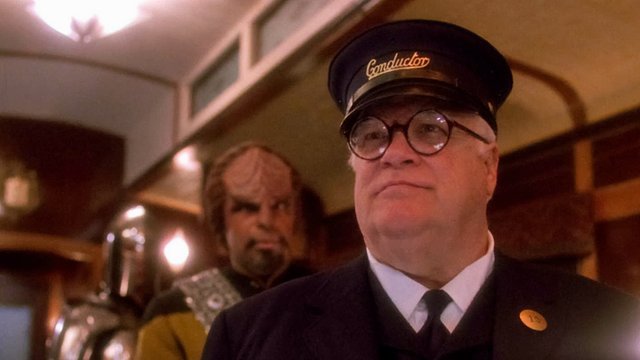
The crew eventually find themselves trapped in a simulation of the Orient Express, because if you're going to have a train mystery, you might as well go full Agatha Christie. The holographic passengers include an engineer played by Thomas Kopache, who promptly gets himself shot by a hitman portrayed by Vinny Argiro. David Huddleston appears as the conductor, a fellow who seems to know rather more than he should about the ship's predicament. When he pulls the emergency cord, the Enterprise obligingly jumps to warp again. It's all rather theatrical, though not in the way Picard had intended.
Back in the real world, LaForge's investigation reveals that those mysterious nodes bear an uncanny resemblance to Data's own positronic brain. The conclusion is inescapable: the Enterprise itself has developed sentience. It's a concept that could have fuelled an entire series of philosophical debates, but here it's treated as a technical problem to be managed. Data, Worf and Troi return to the holodeck to follow a gangster who disembarks at a station labelled "Keystone City"—the sort of on-the-nose naming that makes you wonder if the ship's newfound intelligence has a weakness for puns. The gangster deposits a brick in a wall, which coincides with LaForge spotting a strange object materialising in the cargo bay. Troi suggests the holodeck characters are acting out the ship's internal processes symbolically, which is rather like suggesting your computer's screensaver represents Windows' inner emotional life. Picard, displaying either profound wisdom or profound recklessness, decides to let the simulation run its course. The ship, he reasons, is giving birth.
The entity requires vertion particles to survive—a splendidly Star Trek bit of technobabble that sends the ship racing toward a white dwarf star. When the supply proves insufficient, the entity begins to die. The conductor pulls the brake, and suddenly the Enterprise starts bleeding power. It's classic brinkmanship: redirect everything to the warp drive to find another white dwarf, or conserve power and let the nascent lifeform perish. Data and LaForge contrive a typically ingenious solution, redirecting the ship toward a closer nebula and firing a modified photon torpedo to generate vertions artificially. The entity completes itself, the holographic passengers celebrate their successful journey, and the newborn intelligence departs from the cargo bay into the cosmos. Everything returns to normal, though Data cannot resist questioning Picard's decision to risk the ship and crew. Picard remains serenely convinced that any entity born from the Enterprise will inevitably reflect the crew's fundamentally decent nature. It's a lovely sentiment, though one suspects the ship's computer never had the opportunity to study Reginald Barclay's browser history.
Behind the scenes, Emergence had rather grander ambitions. Brannon Braga originally conceived it as the "ultimate holodeck show," a Dixon Hill adventure that would have mixed characters and periods with gleeful abandon. Budgetary realities forced Joe Menosky to scale things back considerably, utilising Paramount's backlot and stock footage to create the train sequences. The result feels constrained rather than cohesive, a compromise between vision and practicality. This was also the twenty-fifth and final episode directed by Cliff Bole, making him the most prolific director in The Next Generation's history. His work here is competent enough—the cast certainly know their way around these sets by now, and the guest actors commit fully to their oddball roles.
And yet there's something peculiar about the crew's passivity throughout this crisis. They never seriously attempt to regain control of their own vessel, instead standing about the holodeck like theatre critics analysing an avant-garde production. One might charitably attribute this to Picard's Roddenberry-era optimism, his genuine faith in new forms of intelligence. Less charitably, one suspects the writers were simply exhausted by the seventh season, opting for the simplest and cheapest resolution available.
The episode is technically proficient—nobody embarrasses themselves, and the pacing never drags—but the holodeck narrative never truly meshes with the ship-in-peril storyline. It remains an exercise in unfulfilled potential, a mediocre entry that pales beside earlier holodeck classics and looks particularly wan when compared to the actual series finale that followed shortly after. Emergence isn't terrible, but it's hardly essential viewing either.
RATING: 4/10 (+)
Blog in Croatian https://draxblog.com Blog in English https://draxreview.wordpress.com/ InLeo blog https://inleo.io/@drax.leo Substack https://draxster.substack.com
LeoDex: https://leodex.io/?ref=drax InLeo: https://inleo.io/signup?referral=drax.leo Hiveonboard: https://hiveonboard.com?ref=drax 1Inch: https://1inch.exchange/#/r/0x83823d8CCB74F828148258BB4457642124b1328e
BTC donations: 1EWxiMiP6iiG9rger3NuUSd6HByaxQWafG ETH donations: 0xB305F144323b99e6f8b1d66f5D7DE78B498C32A7 BCH donations: qpvxw0jax79lhmvlgcldkzpqanf03r9cjv8y6gtmk9


