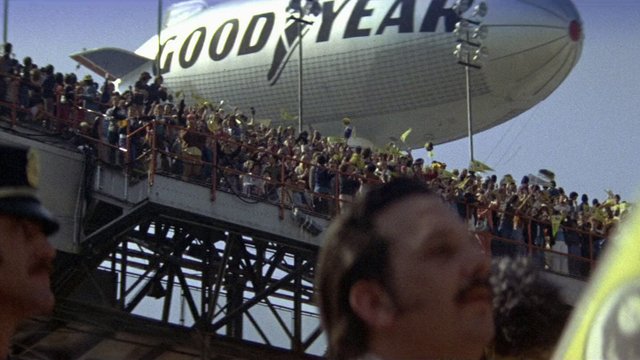
The 1970s were a very difficult time for America. Its citizens were, however, unlike those in many Western countries during the Years of Lead, mostly spared international terrorism. Legendary producer Robert Evans, on the other hand, recognised a spectacular terrorist act as an excellent way to combine two popular trends in 1970s Hollywood – complicated spy thrillers and disaster epics. The result was Black Sunday, a 1977 film directed by John Frankenheimer, a piece of cinema that was mostly ignored and misunderstood after its premiere only to become disturbingly prophetic in light of certain traumatic events that occurred in 2001.
The plot begins in Beirut where a group of top Israeli covert operatives led by Major David Kabakov (played by Robert Shaw) attacks the headquarters of the radical Palestinian group Black September. Most of its leadership is killed, but Dahlia Iyad (played by Marthe Keller) escapes and comes to America to carry out an ambitious terrorist attack which could result in the deaths of thousands of innocent people. Kabakov informs US authorities about it and begins working with FBI agent Corley (played by Fritz Weaver) in order to catch Dahlia and stop her plans. In the meantime, she prepares her act with the help of her lover Michael Lander (played by Bruce Dern), a former US Navy pilot who had spent years as a prisoner during the Vietnam War and, embittered by the way his wife and the military bureaucracy treated him after his return home, decides to take revenge through one memorable and murderous act. Lander works as a blimp pilot carrying TV crews during football games and this is an opportunity that he and Dahlia would use to attack spectators during the Super Bowl.
Black Sunday originated as a novel by Thomas Harris, an author later known as the creator of Hannibal Lecter. Its plot was inspired by the infamous 1972 Munich Massacre and the film itself begins with a scene very much like one of the events that were part of its aftermath (later recreated in Spielberg’s Munich). The script, however, tends to avoid Hollywood’s usually simplistic and one-dimensional treatment of the Arab-Israeli conflict by adding complexities and depth to various characters. The character of Dahlia, very well played by Swiss actress Marthe Keller, is portrayed as both a vulnerable and resourceful woman, and the determination with which she tries to carry out her monstrous plan is explained by some very personal reasons for hating Israelis. Even her adversary and the film’s nominal protagonist is more complex. Robert Shaw plays Kabakov as a character who is quite aware and openly admits that he became some sort of monster in trying to protect his country and even allows himself to doubt whether assassinations, torture and other acts that cause so much discomfort for his rule-abiding American colleague Corley might serve no purpose but to perpetuate the endless cycle of violence. But the best acting job is undoubtedly carried out by Bruce Dern, an actor who in the 1970s became specialised in the roles of psychotic villains. He portrays Lander as mentally unstable and clearly dangerous, but also allows the audience to find reasons why he became that way and why he would, after years of torture followed by personal and institutional betrayal, find the purpose of his life in a single suicidal act.
The script was written by Ernest Lehmann, Ivan Moffat and Kenneth Ross, the latter known for his work The Day of the Jackal, one of the best thrillers of all time. Comparisons between that film and Black Sunday point towards similarities in structure and plot that slowly build tension before the exciting finale, but Frankenheimer disappoints with his underwhelming direction and desire to have as many action scenes as possible. Many of those scenes are either unnecessary or overlong, and the problems with pacing and poor editing escalate in the finale that looks boring despite many of the scenes having actually been made during the real Super Bowl game. Black Sunday is almost destroyed in the end where the potentially exciting race between the blimp and the helicopters also disappoints due to poor and unconvincing special effects.
Black Sunday fared very poorly at the box-office, which could be explained by its disappointing finale, but also by the American audience seeing the plot about terrorists who try to murder thousands of their countrymen on live television as preposterous. Now that we know that such plots can actually exist and, unlike this film, be carried out successfully, Black Sunday has its dark prophetic dimension. It is also reflected in a scene during which Kabakov is forced to seek help from his colleague and lifelong adversary, Egyptian Colonel Raif (played by Walter Gottel), and argues that the terrorist plot, if carried out successfully, would bring American attention to the Middle East as well as a lot of misery for both Israelis and Arabs, but more so to the Arabs. Now, after decades of endless wars and continuous bloodshed in that part of the world, it is difficult not to feel sorry about such warnings not being heeded in real life.
RATING: 5/10 (++)
Blog in Croatian https://draxblog.com Blog in English https://draxreview.wordpress.com/ Leofinance blog https://leofinance.io/@drax.leo Cent profile https://beta.cent.co/@drax Minds profile https://www.minds.com/drax_rp_nc Uptrennd profile https://www.uptrennd.com/user/MTYzNA
Hiveonboard: https://hiveonboard.com?ref=drax Rising Star game: https://www.risingstargame.com?referrer=drax 1Inch: https://1inch.exchange/#/r/0x83823d8CCB74F828148258BB4457642124b1328e
BTC donations: 1EWxiMiP6iiG9rger3NuUSd6HByaxQWafG ETH donations: 0xB305F144323b99e6f8b1d66f5D7DE78B498C32A7



