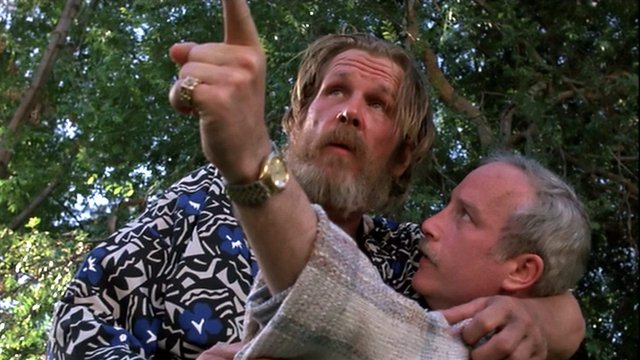
One of the more universal themes in the world of comedy is the difference between Haves and Have Nots, and the mayhem that can come when those two groups interact in unexpected ways. Good film maker is going to use that theme effectively even when burdened with lack of originality. Paul Mazursky did exactly that with his surprisingly successful 1986 film Down and Out in Beverly Hills.
Film is based on Boudou Saved from Drowning, 1919 stage play by French author René Fauchois, which in 1932 served as basis for classic eponymous film directed by Jean Renoir and starring Michel Simon. New version, as the title suggests, is set in modern-day Beverly Hills and it introduces nominal protagonist, homeless man Jerry Baskin (played by Nick Nolte) whose downward spiral apparently hits bottom when his only companion, a starving dog, abandons him for the sake of new and wealthier owner. After fruitless search, Jerry stumbles into Beverly Hills mansion and decides to end it all by drowning in a pool. He is rescued by mansion owner, wire hanger manufacturer Paul Whiteman (played by Richard Dreyfuss) who insists that Jerry stays at his place before he lands on his feet. Jerry is given food, new clothes and haircut and, without need to engage in everyday struggle for street survival, can apply his power of perception to discover that Paul and his family, despite their spectacular wealth, aren’t as happy as try to present himself. Paul doesn’t sleep with his New Age philosophy-obsessed wife Barbara (played by Bette Midler) and prefers intimate company of Mexican maid Carmen (played by Elizabeth Peña). Max, Whiteman’s teenage son, is obsessed with videography while at the same time confused about his gender identity. The older daughter Jenny (played by Tracey Nelson) suffers from anorexia and tried to found escape by going to college. Jerry decides to use his street wisdom and charm to change his benefactors’ lives.
Paul Mazursky became famous for his comedies in which chronicled the changes in social and sexual mores from 1960s onwards. Down and Out in Beverly Hills, despite being based on much older source, touches those subjects. Jerry is in many ways portrayed as former 1960s radical, a person who failed to adapt to non-revolutionary reality and became part of society’s margin; Paul, on the other hand, owes his wealth to set of fortunate accidents, but he nevertheless adapted perfectly to ultra-materialistic world of Reagan’s 1980s America. His social standing, nevertheless, isn’t compensation for more personal woes, partly made with the desire to flaunt his wealth to friends and neighbours, often at expense of his or his family’s mental well-being. Jerry reminds Paul of what true priorities should be and changes his life for the better. This might looks like a plenty of cliches, and Down and Out in Beverly Hills indeed indulges in them, adding strong dosage of sentimentality as well as adorable family pet, a dog named Matisse. But, despite all that and rather predictable ending, the film works. This is mostly due to Mazursky using his satirical observations on the world he knows very well from the first hand. Like Whitemans, Mazursky too lived on Beverly Hills and, although Paul worked in manufacturing sector, his family didn’t look that different from often dysfunctional Hollywood elite. Mazursky allowed himself even some broader social commentary – Whiteman’s next door neighbour, played by famous African American musician Little Richard, complains on inferior treatment by police at the account of his skin; Carmen, exposed to Jerry’s radicalism, transforms from telenovela-obsessed airhead into far left revolutionary who hangs posters of Latin American Communists in her room, bringing the Reagan’s ultimate nightmare to the heart of American capitalism. And, in the end, Whiteman hosts Chinese delegation as his future business partner, making this film prophetic in light of what next decades would bring through “Chimerica”.
While social, economic and political observations are interesting, they couldn’t help film without diverse and inspired cast. Nick Nolte is great as always, confidently portraying transformation from pathetic loser into clever manipulator. Richard Dreyfuss is also very good in his role, as well as Bette Midler. Film isn’t too funny, but the pace is well-made and Mazursky succeeds in creating sympathy for the characters. The audience will probably be happy with the ending. And the ending was happy for the producers, as well as Disney, which had used this project to launch Touchstone Pictures, label specialised for films intended for mature audiences.
RATING: 6/10 (++)
Blog in Croatian https://draxblog.com Blog in English https://draxreview.wordpress.com/ Leofinance blog https://leofinance.io/@drax.leo Cent profile https://beta.cent.co/@drax Minds profile https://www.minds.com/drax_rp_nc Uptrennd profile https://www.uptrennd.com/user/MTYzNA
Unstoppable Domains: https://unstoppabledomains.com/?ref=3fc23fc42c1b417 Hiveonboard: https://hiveonboard.com?ref=drax Rising Star game: https://www.risingstargame.com?referrer=drax 1Inch: https://1inch.exchange/#/r/0x83823d8CCB74F828148258BB4457642124b1328e
BTC donations: 1EWxiMiP6iiG9rger3NuUSd6HByaxQWafG ETH donations: 0xB305F144323b99e6f8b1d66f5D7DE78B498C32A7



