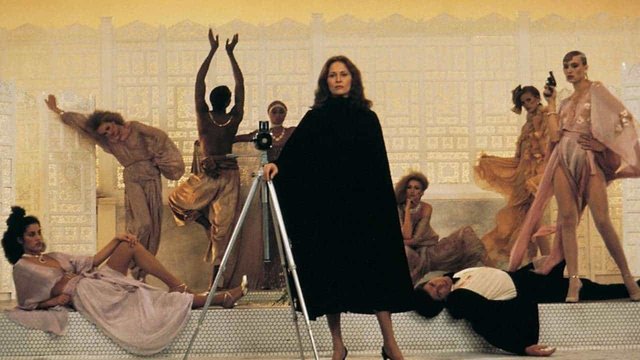
For many New Yorkers, at least until the latest pandemic, the 1970s were the worst era in living memory. However, for those who lived in that city while being young, beautiful and talented enough to earn their living in more glamorous branches of show business, those times were quite exciting. That included even people who provided crucial services to that elite world, like the protagonist of Eyes of Laura Mars, a 1978 thriller directed by Irvin Kershner.
Laura Mars (played by Faye Dunaway) is an elite fashion photographer, whose work brought her fame and fortune, but also a great deal of controversy, because she likes to use motives of death and violence in her photos. She is partly inspired by brief, unexplained visions, but they suddenly become more vivid and include gruesome murders which she witnesses as if watching through the killer’s eyes. One such vision coincides with the actual murder of her book editor and Laura quickly becomes convinced that she has a psychic connection with the killer. The police are initially sceptical of her claims, but when her friends and associates begin to die at the hands of an unknown killer, NYPD detective Lt. John Neville (played by Tommy Lee Jones) fears that she might be next and decides to serve as her unofficial bodyguard, leaving them plenty of opportunity to discover an attraction to each other.
Eyes of Laura Mars, although made with a relatively high budget and with Faye Dunaway, then at the zenith of her stardom, in the title role, is these days best known for launching some prominent Hollywood careers. The script was originally written by John Carpenter and later sold, with the proceeds used to make Halloween, one of the greatest hits of the time. Kershner’s direction left a strong impression on George Lucas, who would later hire him to direct The Empire Strikes Back, the best film in the Star Wars saga. The film began production as a vehicle for Barbra Streisand, girlfriend of producer Jon Peters, who would later become one of the most powerful and influential names in Hollywood.
For the audience at the time, Eyes of Laura Mars represented a flawed but adequate piece of genre cinema, which was rewarded with decent results at the box office. The film works today, despite the scriptwriters not bothering to give any kind of explanation for the protagonist’s “gift”, problems with pacing in the second part, a mishandled romantic subplot, a somewhat too obvious “red herring” (such as the character of Laura’s driver and possible suspect being played by delightfully creepy Brad Dourif), and the weak and not particularly convincing “twist” ending. The achievement is even more remarkable in light of troubled production, which was marked by creative differences on set and constant script rewrites that made Kershner shoot the film without actually knowing the ending. The cast is very good, even when lacking experience – such as real-life models Lisa Taylor and Darlane Fleugel – or when faced with a thankless role like that of a young Tommy Lee Jones. The most interesting aspect of Eyes of Laura Mars, at least from today’s perspective, is the insight into 1970s decadence, brought by the use of disco music and erotic photography by Rebecca Black and Helmut Newton. The decade perhaps didn’t bring too much fun to people living through it, but films like this might provide fun for today’s audience.
RATING: 6/10 (++)
Blog in Croatian https://draxblog.com Blog in English https://draxreview.wordpress.com/ Leofinance blog https://leofinance.io/@drax.leo Cent profile https://beta.cent.co/@drax Minds profile https://www.minds.com/drax_rp_nc Uptrennd profile https://www.uptrennd.com/user/MTYzNA
Hiveonboard: https://hiveonboard.com?ref=drax Rising Star game: https://www.risingstargame.com?referrer=drax 1Inch: https://1inch.exchange/#/r/0x83823d8CCB74F828148258BB4457642124b1328e
BTC donations: 1EWxiMiP6iiG9rger3NuUSd6HByaxQWafG ETH donations: 0xB305F144323b99e6f8b1d66f5D7DE78B498C32A7



