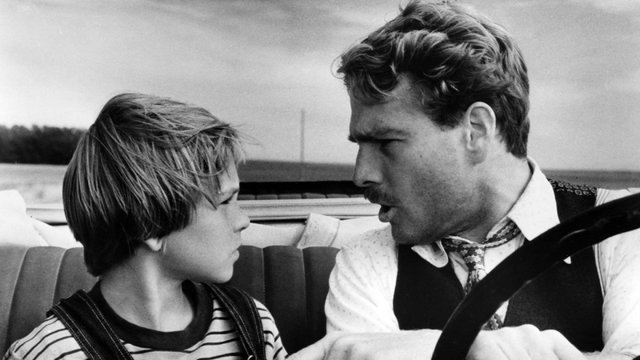
In the early 1970s, a time when the post-WWII prosperity in many countries began to crumble, film-makers became interested in the 1930s, the last era with economic woes of a similar magnitude. Some sought disturbing parallels with their own time, while others approached that period with unhidden nostalgia. One such film was Paper Moon, the 1973 comedy directed by Peter Bogdanovich.
The plot, based on the novel Addie Pray by Joe David, begins in 1936 Kansas, a place still ravaged by the effects of the Great Depression. Nine-year-old Addie Loggins (played by Tatum O’Neal) is faring even worse than most impoverished Americans because she has recently lost her mother. Moses Pray (played by Ryan O’Neal), a wandering man rumoured to be her father, agrees to escort her to her relatives in Missouri. Along the way, Addie discovers that Moses earns his living as a con man and that she shares his talent for various confidence tricks. She pretends to be his daughter, and the two of them make a formidable team, financing their journey. Before they reach their destination, their partnership is endangered after Moses meets exotic dancer Trixie Delight (played by Madeline Kahn) and becomes enchanted with her, spending a large amount of the pair’s money.
Peter Bogdanovich, one of the most iconic New Hollywood auteurs, approached Paper Moon with a combination of the new style characteristic of his generation and his deep knowledge and admiration for Classic Hollywood. The film uses the then very fashionable format of a road movie, with a relatively weak plot serving as a frame for a series of vignettes. Some of these work, and some look too “clever” for such a simple story, like the characters of twins being on opposite sides of the law, played by the great character actor John Hillerman. Paper Moon is also notable as one of Hollywood’s last major film productions to be made in black-and-white, motivated less by Bogdanovich’s desire to give the film “artsy” credentials and more by the idea of bringing the audience back to the 1930s by making Paper Moon look like Hollywood films of the period. The use of 1930s pop music standards instead of a conventional soundtrack also represents a good compromise between the new and the old.
Paper Moon isn’t a particularly deep or important film, but its depiction of the Great Depression as a time that was challenging, yet simpler, kinder, and gentler, worked very well for an audience seeking some sort of escape from the troubles of the early 1970s. It isn’t a profound film, but it provided solid entertainment then and could provide solid entertainment now. This is mostly due to the excellent cast. Ryan O’Neal and his daughter Tatum, in her screen debut, make a very effective team, and the latter was recognised for her talent and effort by becoming the youngest nominee in the history of the Academy Awards. Madeline Kahn, one of the greatest screen comediennes of her time, also delivers a memorable performance in a potentially thankless role. The most significant aspect of Paper Moon, however, is that it provided an effective template for many later “Oscar”-grabbing films through its combination of an adorable child, a roguish protagonist, and the road movie format.
RATING: 6/10 (++)
Blog in Croatian https://draxblog.com Blog in English https://draxreview.wordpress.com/ Leofinance blog https://leofinance.io/@drax.leo Cent profile https://beta.cent.co/@drax Minds profile https://www.minds.com/drax_rp_nc Uptrennd profile https://www.uptrennd.com/user/MTYzNA
Hiveonboard: https://hiveonboard.com?ref=drax Rising Star game: https://www.risingstargame.com?referrer=drax 1Inch: https://1inch.exchange/#/r/0x83823d8CCB74F828148258BB4457642124b1328e
BTC donations: 1EWxiMiP6iiG9rger3NuUSd6HByaxQWafG ETH donations: 0xB305F144323b99e6f8b1d66f5D7DE78B498C32A7



