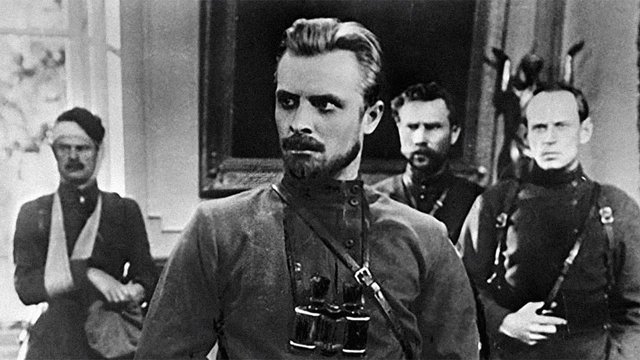
Ukraine has suffered greatly throughout the 20th century, facing devastating wars, famines, genocides, and environmental catastrophes. This tumultuous history left a lasting impact on Oleksandr (Alexander) Dovzhenko, the giant of Ukrainian cinema, whose films often grappled with these themes.
One of those works is the 1939 war biopic Shchors, though it remains relatively obscure in contemporary times. Set against the backdrop of the collapse of the Russian Empire and the establishment of the Soviet Union, the plot of Shchors unfolds during the turbulent period of the Ukrainian Civil War. This era was characterised by brutal conflicts, destructive upheavals, and chaotic power struggles involving various factions, often supported by opportunistic foreign powers. The city of Kiev changed hands multiple times, and individuals, like Dovzhenko himself, had to shift allegiances amidst the chaos. Ultimately, the Ukrainian Bolsheviks emerged victorious, establishing Soviet Ukraine. The film pays homage to Mykola (Nikolai) Shchors, a key figure in these events, who rose to prominence as a Bolshevik military commander and later became a celebrated hero of the Soviet Union.
The plot commences in 1918, just a few months after the Treaty of Brest-Litovsk had granted Ukraine nominal independence. In reality, Ukraine became a client state of the German Empire, which mercilessly plundered grain and other resources to sustain its WW1 effort. This exploitation sparked discontent among Ukrainian peasants, leading to armed resistance. Among the partisan leaders was Shchors (played by Yevgeniy Samoilov), portrayed as a courageous, skilled, and charismatic commander who rallied a significant following. His strategic prowess and leadership culminated in the disarmament of German forces through a clever appeal to their common soldiers. This victory enabled him to defeat Ukrainian nationalists under Petlyura (played by Georgi Polezhaev) and enter Kiev. However, this triumph was short-lived as Soviet Ukraine faced new threats from the White Russian army under Denikin from the south and Polish invaders from the west.
Shchors was reportedly commissioned by Stalin himself, who admired Dovzhenko's previous work on Aerograd. The film aimed to create a Ukrainian counterpart to Chapaev, giving Soviet Ukraine its own larger-than-life figure of revolutionary hero and martyr. Despite a generous budget, the production faced numerous challenges, exacerbated by the tumultuous era of the Great Purge. Dovzhenko encountered constant script revisions due to the purging of key figures from Ukrainian Bolshevik history, leading to delays and disruptions. The oppressive atmosphere of the time took a toll on the cast and crew, with Dovzhenko himself allegedly suffering a heart attack following a frightening encounter with NKVD agents.
Dovzhenko, a pioneering figure in Soviet cinema alongside Eisenstein and Pudovkin, is renowned for his innovative contributions to film language. However, you couldn’t tell that if you watch Shchors. The film looks like a textbook example of cold, unimaginative, and rigid description of history and adherence to Socialist Realist dogma. The film's heavy-handed ideological approach and lack of emotional depth has drawn comparisons to propaganda pieces, overshadowing its technical merits. While the battle scenes offer some visual spectacle, they fail to sustain interest beyond their initial impact.
Shchors looks even worse in comparison to other Soviet films of the period, including Dovzhenko’s own Aerograd, which transcended ideological limitations through exotic setting and toying with the western genre. Comparison with Chapaev makes the 1934 film, despite its relative lack of spectacle, look tighter, more comprehensive, and, ultimately, more entertaining. Another issue is its focus on propaganda needs in the 1930s Soviet Union, which makes it difficult to comprehend for audiences unfamiliar with the historical context of World War I, the Russian Revolution, and the subsequent civil war. Dovzhenko doesn’t bother with exposition through dialogue or intertitles that might have solved that problem.
Despite enormous challenges over four years of production, Shchors was ultimately finished and achieved a measure of success in Soviet cinemas. However, this triumph was short-lived due to the Molotov-Ribbentrop Treaty, which suddenly made scenes of the protagonist fighting Germans inconvenient for the new Soviet ally. The film was temporarily withdrawn from theatres, only to be reintroduced after the outbreak of Operation Barbarossa to help rally support against foreign invaders. The tumultuous production and reception of Shchors took a toll on Dovzhenko, who struggled to regain his creative momentum in the aftermath, producing only a single feature film in 1948. Based on what we can see in Shchors today, we might conclude that those sacrifices weren't justified.
RATING: 4/10 (+)
Blog in Croatian https://draxblog.com Blog in English https://draxreview.wordpress.com/ InLeo blog https://inleo.io/@drax.leo
Hiveonboard: https://hiveonboard.com?ref=drax Rising Star game: https://www.risingstargame.com?referrer=drax 1Inch: https://1inch.exchange/#/r/0x83823d8CCB74F828148258BB4457642124b1328e
BTC donations: 1EWxiMiP6iiG9rger3NuUSd6HByaxQWafG ETH donations: 0xB305F144323b99e6f8b1d66f5D7DE78B498C32A7 BCH donations: qpvxw0jax79lhmvlgcldkzpqanf03r9cjv8y6gtmk9
Posted Using InLeo Alpha


