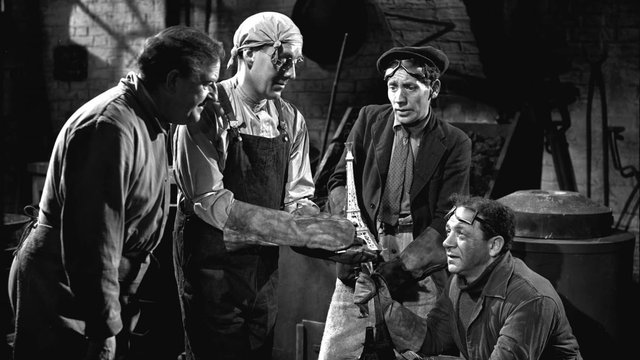
Britain emerged from the Second World War victorious, but the price of that victory was high. Britons, among other things, had to endure war-related deprivations for almost a decade after the war ended, while other countries, including those that had lost the war, recovered. One of the things that made life in such bleak circumstances more tolerable were comedies, including those made at the famous Ealing Film Studios, many of which would later become classics. One of the best was The Lavender Hill Mob, a 1951 film directed by Charles Crichton.
The plot begins in Rio de Janeiro, where the protagonist, English expatriate Henry Holland (played by Alec Guinness), explains how he got there. Through flashbacks we are brought to London, where Holland used to work as a bank clerk in charge of transporting gold bullion. He had spent twenty years in the same post and, lacking promotion, he began to ponder eventually taking some of that gold for himself. His plan, however, had one fatal flaw – he couldn’t sell such a great quantity of gold in Britain without attracting attention, while he didn’t know how to smuggle it abroad.
The solution comes in the form of Alfred Pendlebury (played by Stanley Holloway), an eccentric artist who produces paperweights in the form of the Eiffel Tower, which are, among other things, sold as souvenirs in Paris. Pendlebury lives in the same boarding house on Lavender Hill as Holland, and the bank clerk recruits him into his scheme, which would involve having gold smuggled by being melted into paperweights. Two professional criminals – Lackery Wood (played by Sid James) and Shorty Fisher (played by Alfie Bass) – are recruited to help with the actual robbery which, although not going exactly as planned, succeeds. It is only in France, where Holland and Pendlebury are to convert the last batch of paperweights into cash, that their plan begins to go awry following mixed shipments in a souvenir shop.
Ealing comedies were light, and The Lavender Hill Mob is no exception. The film is also light in a different sense – it is very short, barely 80 minutes in running time, but experienced director Charles Crichton (who would, decades later, close his career with another comedy classic A Fish Called Wanda) manages to keep it quick, comprehensible and digestible. Much of the credit should go to T. E. B. Clarke, the screenwriter who won an Oscar for Best Original Screenplay.
The basic plot of the film is actually very simple and it could easily serve as the basis for a straight crime thriller or heist film. What makes it funny are the eccentric characters and a series of bizarre coincidences that lead to absurd and comical situations, while at the same time being realistic. Clarke, in order to make his film as close to real life as possible, actually consulted with experts from the Bank of England who worked out a scenario for how the gold bullion heist would be best conducted. Realism can be seen in the use of London locations which still bore marks of wartime bombing, and which represent a sharp contrast to the locations of Paris, including the Eiffel Tower, which is used in a scene rumoured to have inspired Hitchcock’s Vertigo.
The main characters in The Lavender Hill Mob might be criminals, but they are portrayed as generally kind-hearted, soft-spoken and likeable, so it is easy for the audience to start rooting for them and hoping that they get away with their crime. It doesn’t happen because the producers knew that such an ending was contrary to the principles of the MPAA Production Code and to keep it would have barred the film from being distributed in the lucrative American market.
Another important ingredient for this film’s success is the cast. Alec Guinness is nowadays best known as Obi-Wan Kenobi in the original Star Wars trilogy, a role that he actually hated, and, perhaps, noble characters in David Lean’s epics. But Guinness actually excelled in Ealing comedies and the role of Henry Holland, during which he plays a rich bon vivant, a meek pencil-pusher and a criminal mastermind, is one of the best in his career. Veteran Stanley Holloway, who would later play Alfred P. Doolittle in My Fair Lady, is also quite effective as a flamboyant artist. Sid James, who would later earn fame as part of the Carry On films cast, is memorable as one of the criminals. Fans of the legendary Audrey Hepburn might spot the actress, uncredited in the film, as a Brazilian girl in the scene at the beginning, which represented one of the first notable film roles of the iconic actress.
The Lavender Hill Mob is a very good film that represents British humour and Ealing comedies at their best.
RATING: 8/10 (+++)
Blog in Croatian https://draxblog.com Blog in English https://draxreview.wordpress.com/ InLeo blog https://inleo.io/@drax.leo
InLeo: https://inleo.io/signup?referral=drax.leo Unstoppable Domains: https://unstoppabledomains.com/?ref=3fc23fRc42c1b417 Hiveonboard: https://hiveonboard.com?ref=drax y Bitcoin Lightning HIVE donations: https://v4v.app/v1/lnurlp/qrcode/drax Rising Star game: https://www.risingstargame.com?referrer=drax 1Inch: https://1inch.exchange/#/r/0x83823d8CCB74F828148258BB4457642124b1328e
BTC donations: 1EWxiMiP6iiG9rger3NuUSd6HByaxQWafG ETH donations: 0xB305F144323b99e6f8b1d66f5D7DE78B498C32A7
Posted using CineTV


