If the current US war against Iraq is to be compared with any previous conflict, the most suitable example would be the Boer War. In 1899, the British Empire, the most powerful state in the world at the time, went to war with the Transvaal and the Orange Free State, two independent republics in South Africa ruled by the Boers, descendants of Dutch settlers. The reasons for the war were complicated, but they mostly concerned the rich mineral deposits in those two countries and British plans to strengthen their hegemony over the African continent. The British had expected the war to be nothing more than a colonial police action, but the Boers proved to be much tougher opponents than anyone had anticipated. Due to stiff and skilful Boer resistance, the war lasted for years and forced the Empire to station half a million soldiers in South Africa; at the same time, some of the details of that war created a huge backlash in non-British parts of the world, almost resulting in a grand anti-British coalition between France, Germany and Russia. For many military historians, the Boer War is often seen as the first true "modern" war, not because the opposing sides used advanced weaponry like bolt-action rifles, machine guns and modern artillery, but because it had a more sinister dimension, best described by two phrases that entered popular vocabulary at the time – "commandos" and "concentration camps".
The Boer War was also the first war to be captured on film. Ironically, it was also the war that captured relatively little interest from filmmakers in later decades. This could be explained by the fact that subsequent conflicts – grander and bloodier – were much more interesting. It was also difficult to find sympathy for the opposing sides, especially in the later decades of the 20th century – evil British imperialists were hardly better than apartheid-loving Boer rednecks. Yet one of the best (and least known) war films in recent memory has dealt with the Boer War. It was Breaker Morant, a 1980 Australian drama directed by Bruce Beresford.
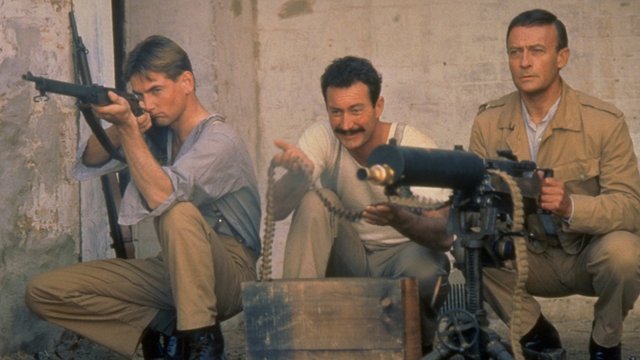
The plot of the film is based on true events that inspired a stage play by Kenneth Ross. In 1901, the Boer War had entered its third year. British forces had managed to defeat the Boer armies in the field and occupy Boer lands, only to find themselves faced with a vicious guerrilla campaign conducted by small but effective bands of Boer "commandos". As casualties and the cost of the war mounted, and conventional methods of warfare yielded no results, Lord Kitchener (played by Alan Cassell), the British commander in South Africa, was forced to devise innovative counter-insurgency strategies. These included building an extensive network of "blockhouses", the forced removal of the guerrilla-friendly Boer population into "concentration camps" and, finally, the creation of special units that would fight the "commandos" with their own irregular tactics. One such unit was the Bushveldt Carbineers, commanded by Captain Simon Hunt (played by Timothy Hunt) and mostly manned by Australian volunteers, famed for their skill with horses and outdoor survival. A series of incidents resulting from Captain Hunt's death in a Boer ambush led to charges being brought against three Bushveldt Carbineers – Lieutenant Harry "Breaker" Morant (played by Edward Woodward), Lieutenant Peter Handcock (played by Bryan Brown) and Lieutenant George Witton (played by Lewis Fitz-Gerald). The three men were accused of murdering captured Boers and a German missionary who might have witnessed the massacre. Major J.F. Thomas (played by Jack Thompson), an inexperienced country lawyer who must represent the defence in court-martial proceedings, soon finds evidence pointing to the fact that the men executed prisoners with their superiors' sanction. But his attempt to use this fact in their defence is fruitless – the trial has been staged to provide only one result. The three men are to be found guilty and executed in order to prevent a backlash from the European public and to aid Kitchener's efforts to talk the remaining Boers into a negotiated surrender.
Breaker Morant is often mentioned as a film that in many ways predates Peter Weir's Gallipoli. Both films deal with traumatic events from Australian military history – events in which Australians paid a horrible price for being loyal to the British Empire. George Miller, in his documentary about the history of Australian cinema, takes these two films as an example of Australia finally discovering its own separate identity in opposition to its British-dominated past. But it would be too simple to describe Breaker Morant as simplistic anti-British or anti-Commonwealth/Empire propaganda. The script by Beresford, Jonathan Hardy and David Stevens is too complex and intelligent to be wasted on such a petty purpose. In fact, Breaker Morant deals with subjects that are universal and still relevant in today's world.
The most obvious of these subjects is war and its effect on the fragile foundations of human civilisation and morality. The title protagonist is a poet and refined intellectual; yet war turned him into a savage monster capable of committing barbarous acts. Not only individuals but institutions are also affected – the British Army, arguably the most professional military in the early 20th century (made exclusively of volunteers in an era when other armies used conscription), known for its tight discipline and chivalrous conduct, is forced to use methods worthy of Huns, Mongols and other barbaric hordes in order to win the war. Yet this institution, just like the protagonists, is incapable of facing this reality; for the British military brass, the concept of a "gentlemanly war" suddenly becomes relevant again when they have to sacrifice a few individuals to cover their crimes. Beresford also wisely chooses not to portray the protagonists as saints – they are not innocent of their crimes; they might have only "followed orders", but some of those orders were followed with zeal, and some acts weren't even sanctioned by their superiors at all. Things aren't simple even with the villains – Lord Kitchener is allowed to explain some of his morally repugnant acts with valid arguments. Major Thomas is the only character who could be described as the film's moral anchor and whose poignant speech at the end makes an interesting argument – it is absurd to accuse individuals of murder while at the same time requiring them to kill people as their duty.
The interesting thing about this speech is that it is, for the most part, based on actual court recordings. In fact, Breaker Morant is a very accurate film, much more so than usual films based on true events. Even the most Hollywood-like and surreal incidents have their foundation in historical fact. Beresford manages not only to find the perfect balance between historical accuracy and the filmability of the material – he transcends the stage play origins of the script through very extensive but effective use of flashbacks. The huge open spaces of South Australia provide the perfect setting for the story, while music by Phil Cunneen and the extensive use of popular military marches and period songs offer a semi-ironic commentary on the events in the film.
The acting is superb. Beresford used his old associates from Money Movers, but the strongest performance is given by Edward Woodward who, just as in The Wicker Man, displays great talent in playing tragic protagonists. Woodward in this film manages to maintain a charismatic presence despite his character being burdened by internal conflicts and morally dubious choices. Bryan Brown is also good as his comrade from a working-class background, whose motive for going to war is simply financial. Lewis Fitz-Gerald gives an equally impressive performance in the role of the youngest and most idealistic member of the tragic trio. Jack Thompson is very good as the strong-willed attorney who fights a losing battle, while Alan Cassell gives a creepy but convincing portrayal of Kitchener.
Incredibly accurate, thought-provoking and very relevant to the current state of world affairs, Breaker Morant is definitely a film that should be watched in our times.
RATING: 9/10 (++++)
(Note: The text in its original form was posted in Usenet newsgroup rec.arts.movies.reviews on March 27th 2003)
==
Blog in Croatian https://draxblog.com Blog in English https://draxreview.wordpress.com/ Cent profile https://beta.cent.co/@drax Minds profile https://www.minds.com/drax_rp_nc Uptrennd profile https://www.uptrennd.com/user/MTYzNA
Brave browser: https://brave.com/dra011
BTC donations: 1EWxiMiP6iiG9rger3NuUSd6HByaxQWafG ETH donations: 0xB305F144323b99e6f8b1d66f5D7DE78B498C32A7


