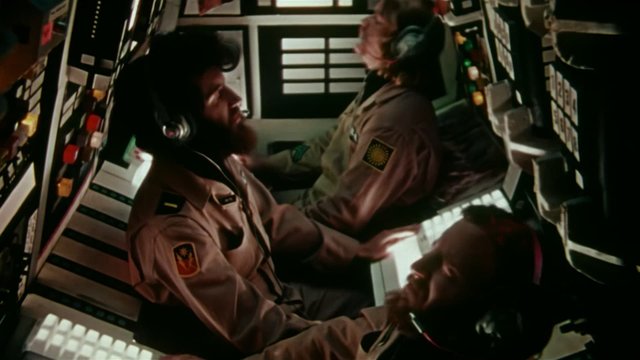
In recent summers, Hollywood's most commercial films have tended to belong to the science fiction genre. A few decades ago, that wasn't the case; science fiction wasn't part of the mainstream, not only in Hollywood but also in other areas of popular culture. Science fiction writers and fans lived in a sort of self-imposed 'ghetto', and that explains why most cult films belong to the science fiction genre. Cult films, by definition, enjoy a small but dedicated following, and science fiction fans used to fit this description. Few films show as clear a connection between science fiction and cult status as Dark Star, the 1974 science fiction comedy directed by John Carpenter.
The protagonists of this film, set in the distant future, have spent the last twenty years or so as the crew of the 'Dark Star' interstellar spaceship. Their mission is to destroy unstable planets and thus clear a path for future human colonisation. Although they have aged only three years, the astronauts, led by Lt. Doolittle (played by David Narelle), aren't particularly happy with that state of affairs – they are bored senseless, can't stand each other and, to make things even worse, the ship seems to be slowly falling apart following an incident that left Commander Powell (played by Joe Saunders), the former mission leader, electrocuted. Doolittle and the rest of the crew occasionally try to solve the increasing number of technical problems, but most of the time they succumb to their own bizarre eccentricities. Their skills and characters are finally going to be put to the test when the latest computer malfunction causes one of the ship's thermostellar bombs to develop ideas of its own about exploding.
Dark Star is best known as John Carpenter's first film. Both those who like and those who don't like Carpenter can use Dark Star to make various points about his entire career. Those who like Carpenter would point out that this was a student film made with a ridiculously low budget; yet Carpenter showed great ingenuity in tackling budget limitations, and the quasi-futuristic sets, costumes and special effects are more than satisfying for 1970s standards. Those who don't particularly like Carpenter would point towards poor characterisation, lame humour, problems with pacing and the amateur level of acting – something that would at times plague Carpenter's films, especially his later ones. However, the name that should be associated with Dark Star belongs to its scriptwriter Dan O'Bannon, a man who would earn legendary status in the world of science fiction cinema thanks to his later work on such genre classics like Alien. O'Bannon also appears in this film in the role of the neurotic crewman Pinback and does the best of all the acting jobs. His script for the film, however, is much better than the acting – Dark Star, despite its simplicity and 83-minute running time (68 minutes in the original version), has many layers, and fans of science fiction might discover something new with each subsequent viewing.
On the surface, Dark Star looks like nothing more than a cheap parody of 2001: A Space Odyssey. Others would find the plot and depressive atmosphere to be nothing more than a reflection of the pessimism and nihilism that dominated people's minds in the 1970s – a decade marked by great disillusionment in government, big progress and big ideas in general. A spaceship that is slowly falling apart thanks to budget cuts and a lack of maintenance is in some way a reflection of NASA having its wings clipped after the successful Apollo landing; and the sad fate of the ship and its crew looks prophetic after real life provided tragic examples of the 'Challenger' and 'Columbia'. The major themes of the film are also those very popular in works of science fiction – human inability to cope with the physical and psychological demands of space travel and human inability to successfully interact with modern technology. These themes had been explored in science fiction literary classics, and Dark Star pays homage to the works of Philip K. Dick and Ray Bradbury.
The theme of human frailty in space is something that O'Bannon would explore later in Alien. All those who like Ridley Scott's classic would appreciate the scene in which O'Bannon's character has to deal with a pet alien going bad. This time, however, those themes are given a humorous treatment. Unavoidable comparisons with Alien, on the other hand, would probably do few favours to Dark Star – only five years later, 1970s special effects and film-making technology would result in a movie which is different in tone, but definitely better than John Carpenter's debut. But those comparisons are also unfair towards Dark Star; this little cult classic, even from the distance of nearly three decades and even with all the limitations of its budget and age, looks much brighter than its title would indicate.
RATING: 7/10 (+++)
(Note: The text in its original form was posted in Usenet newsgroup rec.arts.movies.reviews on July 1st 2003)
==
Blog in Croatian https://draxblog.com Blog in English https://draxreview.wordpress.com/ Cent profile https://beta.cent.co/@drax Minds profile https://www.minds.com/drax_rp_nc Uptrennd profile https://www.uptrennd.com/user/MTYzNA
Brave browser: https://brave.com/dra011
BTC donations: 1EWxiMiP6iiG9rger3NuUSd6HByaxQWafG ETH donations: 0xB305F144323b99e6f8b1d66f5D7DE78B498C32A7


