Some scholars view history as a perpetual but predetermined process, guided by easily predictable and irresistible forces, either natural or social. Others see history as nothing more than a series of chaotic, unpredictable events. Somewhere in the middle between those two extremes exist individuals, who either have or have not a decisive role in shaping world history. Those who believe that individuals can make a difference believe in the Great Man Theory, often using examples of historical personalities that changed the destiny of nations because of their unusual political or military talents. However, individuals can play important roles not only through their great achievements, but also because they just happen to be in the wrong place at the wrong time. French director Alain Resnais used one such historical personality for Stavisky..., his 1974 drama.
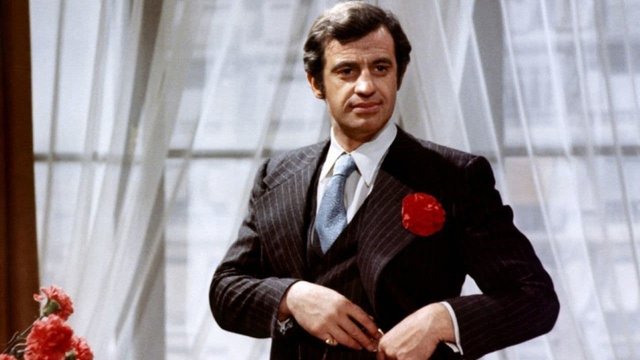
The plot of the film begins in 1933, when the French government reluctantly gives political asylum to former Bolshevik leader Leon Trotsky, exiled from the USSR after his conflict with Stalin. At the same time, another Russian Jew receives much more favourable treatment by the same institution. He is Serge Alexandre Stavisky (played by Jean-Paul Belmondo), a market speculator whose irresistible charm and audacity enchanted and fascinated almost every part of the French establishment – industrialists, aristocrats, politicians, bureaucrats and members of the cultural elite. Stavisky used his powerful friends to turn himself into a financial tycoon and start building a business empire, enjoying a life of luxury in the process. There are some people immune to Stavisky's charm, like policemen familiar with his previous career as a petty con man and holding evidence that could put him in jail. Stavisky is, however, shielded from prosecution and convinced that he has the government in his pocket. But when his latest scheme collapses, so does his business empire and his powerful friends not only abandon him, but instead try to make him a convenient scapegoat for one of the greatest scandals in French history.
History does not lack colourful personalities able to cheat their way into the impenetrable corridors of power and the establishment, but few of them left such an impact as Stavisky. After the scandal, France barely avoided civil war, only to be left with weakened finances, loss of faith in democratic institutions and a population deeply divided on ideological lines – and, above all, tragically unable to halt the rise of fascism in Europe which made the Second World War inevitable. It is understandable why this case intrigued Jorge Semprun, a screenwriter who had built his reputation on exciting political films based on true stories. The relatively simple story of Stavisky was used for a much broader picture – few films like this one capture the atmosphere of Europe in the early 1930s, when names like Hitler, Stalin or Mussolini were actually viewed as an excellent alternative to ailing, corrupt and incompetent democratic governments. Unfortunately, director Alain Resnais seems totally disinterested in politics and concentrates solely on the individual destiny of Stavisky at the expense of the general picture. What began as an interesting history lesson turns into a personal drama about an over-ambitious man who pays the ultimate price for challenging the establishment. Such stories have been seen a thousand times before in much better and more compelling films, and Resnais makes things even worse with bad editing at the end, when scenes set in the past, present and future mix without any particular sense. All those who want to learn something about Stavisky through this film are going to be disappointed, and only those viewers who are more familiar with French politics in the early 1930s would not have problems understanding the plot. What actually saves this film is its superb visual style and great work on props and costumes, which give it a strong and convincing period feel, especially the haunting musical score by Stephen Sondheim. The acting is top-notch – Jean-Paul Belmondo was perfect for the leading role, using the charisma of the charming rascal from his earlier films to become a quite convincing con man. The period feel is strengthened with the appearance of the old but still effective Charles Boyer, who plays Stavisky's old aristocratic friend; the link between new and old generations in French acting is established with a small role played by the young Gérard Depardieu. Stavisky... is definitely a failed film, but attractive and interesting enough to earn the attention of all lovers of non-conventional cinema.
RATING: 6/10 (++)
(Note: The text in its original form was posted in Usenet newsgroup rec.arts.movies.reviews on March 23rd 2000)
==
Blog in Croatian https://draxblog.com Blog in English https://draxreview.wordpress.com/ Cent profile https://beta.cent.co/@drax Minds profile https://www.minds.com/drax_rp_nc
Brave browser: https://brave.com/dra011
BTC donations: 1EWxiMiP6iiG9rger3NuUSd6HByaxQWafG ETH donations: 0xB305F144323b99e6f8b1d66f5D7DE78B498C32A7
Movie URL: https://www.themoviedb.org/movie/61296-stavisky Critic: AA


