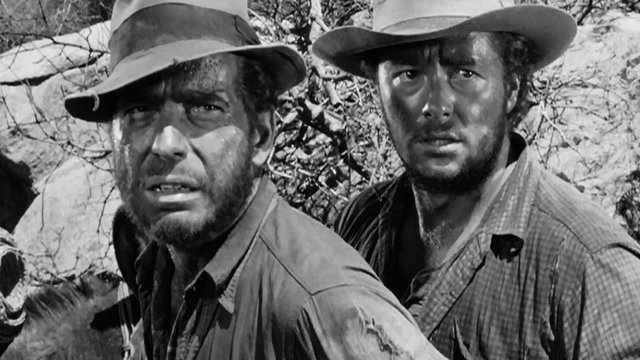
Undisputed classics of the Seventh Art are difficult to put in the same sentence with the phrase ‘exploitation movie’, but, ironically, there is at least one title that could be characterised as such – The Treasure of the Sierra Madre, the 1948 adventure drama directed by John Huston. Of course, Huston’s film is not an exploitation film in the strict sense, but exploitation is nevertheless very present on the screen, albeit more as an object of the filmmaker’s attention and less as the film’s very purpose.
The plot, based on the best-selling novel by B. Traven, begins in February 1925 in the Mexican coastal town of Tampico. Frank C. Dobbs (played by Humphrey Bogart) is an American who came to Mexico looking for easy money and turned into a street bum instead. Forced to take any job, he becomes easy prey for con man Pat McCormick (played by Barton MacLane), who hires such people as cheap labour only to keep their wages for himself. During this, Dobbs befriends a fellow countryman and bum, Bob Curtin (played by Tim Holt), and when the two of them finally manage to get their well-deserved pay, they decide to invest it in a project that would get them out of the endless cycle of poverty in Tampico.
They had encountered an old and eccentric gold prospector, Howard (played by Walter Huston), who stirred their imagination with tales of undiscovered gold deposits in the mountains of the Sierra Madre. Dobbs and Curtin decide to use his expertise, and the newly formed trio begins a long and perilous journey toward the gold-laden mountains. After many months of hardship, they finally manage to find gold, but they would soon realise how difficult it is to keep that new treasure. Roaming bandits, competing prospectors and the harsh nature, however, prove less challenging than the greed and paranoia growing between them.
There are plenty of reasons why The Treasure of the Sierra Madre is considered one of the fundamental Hollywood classics. One of them is the fact that this film functions on more than one level – it can be viewed both as a straightforward adventure film and as a drama that explores some dark aspects of human psychology and society, often telling viewers truths they do not like to be reminded of. The pursuit of material wealth – the very essence of human civilisation – is here presented as a force capable of tearing apart the delicate fabric of that very civilisation, here presented in the form of a trio of gold prospectors.
To show the destructive potential of greed and to be as faithful to the source material as possible, Huston decided to make this film as realistic as possible. The result of these efforts can be appreciated today, when The Treasure of the Sierra Madre looks surprisingly modern compared with other products of Old Hollywood. The film is shot on location, Mexican actors are employed and most of the dialogue is in Spanish. Furthermore, additional authenticity is provided by the naturalistic portrayal of the characters – they look like real blue-collar bums instead of Hollywood actors; they sweat, they grow month-old beards and their skin is darkened after many months of heavy labour under the Mexican sun. In such conditions, the story progresses naturally; the situations and dilemmas that face our protagonists seem normal, as do their reactions. The only thing that shatters the illusion and reminds us that we are watching a Hollywood film is the rather uninspired and routine musical score by Max Steiner, probably the only reason why this film is a step away from perfection.
As on many other occasions, Huston was fortunate to have great acting talent at his disposal. The most impressive of all is his own father, Walter Huston, who later received an Oscar for his supporting role. His portrayal of an experienced yet mildly eccentric gold prospector is both ‘larger than life’ yet profoundly humane and convincing. But the most important thing about this role is its likability, and this is why Walter Huston managed to outshine the charisma of the film’s nominal star, Humphrey Bogart. All those who like to imagine Bogart as the slick hero of films like Casablanca or The Maltese Falcon would probably wince at the job he did here, and this is the probable reason why The Treasure of the Sierra Madre is not considered ‘Bogart’s film’ in the strict sense. Bogart here plays a completely anti-heroic and atypical role – an average and, for most of the time, rather pathetic man who succumbs to his baser instincts and ends in homicidal madness. Bogart was great here, as usual, and many could argue that this was the best role of his career.
The other players were good too – Tim Holt is very effective as the most down-to-earth of the trio; Bruce Bennett, as a rival gold prospector, shines in one of the film’s most dramatically intense scenes; and Alfonso Bedoya brings some humanity to his role as a brutal Mexican bandit leader. Finally, John Huston gave himself a couple of cameos – those scenes in which he appears together with Bogart function as a Hollywood in-joke, a reference to the professional relationship between actor and director in their earlier years.
The Treasure of the Sierra Madre had another dimension that was missed when it mattered most. Huston was thus spared a lot of unpleasantness, because few people in late-1940s and 1950s America would have recognised the obviously leftist overtones in his film. Those elements probably came from the author of the novel, B. Traven (the pseudonym of the German writer Ret Marut, who had taken part in post-WWI communist uprisings before emigrating to Mexico). The film therefore features some very explicit scenes of working-class exploitation, and its underlying motive – the corrupting influence of material wealth – might be seen as a metaphor for private property as the source of all social conflict, a thesis which happens to be one of the fundamentals of Marxist ideology.
The leftist criticism of modern capitalist society and its destructive influence on individual ethics is followed by alternatives provided by Traven and Huston – communities that abandoned individual wealth in favour of collectivist solidarity. Those communities appear twice in the film – first as Curtin’s nostalgic remembrance of his fruit-picking days, and then in reality as an idyllic Indian village. However, this hidden Marxist dimension is only one of the layers of The Treasure of the Sierra Madre, and many of those layers still wait to be discovered by new generations of viewers who would find this true treasure of cinema.
RATING: 8/10 (+++)
(Note: The text in its original form was posted in Usenet newsgroup rec.arts.movies.reviews on June 21st 2001)
==Blog in Croatian https://draxblog.com Blog in English https://draxreview.wordpress.com/ Cent profile https://beta.cent.co/@drax Minds profile https://www.minds.com/drax_rp_nc
Brave browser: https://brave.com/dra011
BTC donations: 1EWxiMiP6iiG9rger3NuUSd6HByaxQWafG ETH donations: 0xB305F144323b99e6f8b1d66f5D7DE78B498C32A7
Movie URL: https://www.themoviedb.org/movie/10705-henry-v?language=en-US Critic: AAA


