For many scientific purists, the concept of time travel is so preposterous that they tend to ban time travel films and novels from the science fiction domain. According to them, time travel books, comics and films should be branded as fantasy instead. That position might find its justification in the way that Hollywood usually treated time travel. Most of the time, that concept was nothing more than a convenient excuse for exotic, but standard, adventures and films without any ambitions of seriousness. But every once in a while, there comes a time travel film with brains. George Pal's classic adaptation of the equally classic H.G. Wells's novel The Time Machine is one of them. Time After Time, the 1979 film and directorial debut of Nicholas Meyer, is the perfect companion piece to it.
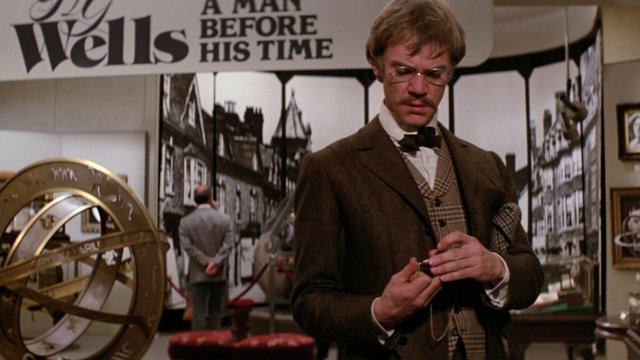
In George Pal's film, by naming the hero – a Victorian time traveller – "George", the authors hinted that the real hero of the novel might be H.G. Wells himself. Meyer, who had already played with mixing fiction with real historical personalities in his novel Seven Per Cent Solution, goes even further – the time traveller in his film is really H.G. Wells (played by Malcolm McDowell). As with his "George" incarnation, he invites his friends in London 1893 to present to them his new innovation – the time machine. The presentation is, however, interrupted when Scotland Yard arrives. It turns out that one of the guests, Dr John Leslie Stevenson (played by David Warner), happens to be Jack the Ripper. While Wells and his friends struggle with the shocking revelation, Stevenson uses the confusion and, out of desperation, decides to test this new machine. Examining Stevenson's mysterious disappearance, Wells concludes that the killer managed to travel to the year 1979. Feeling responsible for allowing a bloodthirsty maniac to roam in a future Utopia, Wells goes to the future too in order to bring him to justice. His travel brings him to San Francisco in 1979, a strange new megalopolis that at first sight looks like a utopian society. But soon he discovers that the Utopia has a bad side, and, most of all, his quest for Stevenson is failing. Things change when he meets Amy Robbins (played by Mary Steenburgen), a bank teller and liberated woman, who decides to help him in his quest, mostly because she fancies the bizarre but charming Englishman.
Although it is actually not based on H.G. Wells's novel, this film is closer to its spirit than the 1960 version. When he wrote the novel, Wells was less interested in pure scientific speculation; instead, he saw science fiction as a way to talk about burning social issues of his time, as well as to offer some solutions. This film presents us with Wells as a man before his time, a socialist reformer who fought for free love, female emancipation, racial equality, people's rights, and many other things we now take for granted. Meyer uses time travel to confront Wells's ideals with reality – when he arrives in San Francisco during the zenith of an ultra-liberal, hedonistic era of sexual revolution and counterculture, he discovers that many of his ideals are a reality. But on the other hand, human nature hasn't improved, and all those ideals are paired with world wars, nuclear weapons, pollution, terrorism and other horrors Wells couldn't have imagined. While the poor idealistic reformer has trouble fitting into this fascinating but at the same time frightening world, the bloodthirsty yet cynical and practical Stevenson makes 1979 his home without any difficulty.
This clever commentary is reason enough to fend off all the critics of this film, who considered Time After Time to be nothing more than light-hearted fantasy. Their argument, of course, is valid only if we consider the film to be entertaining. The conflict between a Victorian gentleman and the modern environment provided an excellent opportunity for many subtle yet effective jokes. The humour in this film is really charming, and it is helped by Malcolm McDowell, who uses this film as a rare opportunity not just to play a good guy for a change, but also to express his comedic talents. His partner Mary Steenburgen shows her comedic talent too, and also the great skill that helps her in the transformation from a strong modern liberated woman into a classic damsel in distress. The romantic chemistry between the two is great, and it shouldn't surprise anyone that they continued their partnership in real life.
Unfortunately, David Warner didn't feel particularly inspired in the role of Jack the Ripper. He lacks the charisma of pure evil that is a necessary ingredient for any effective villain that the film required. A flaw in the characterisation is just one of the many flaws of this film – cheesy and totally unconvincing special effects, scientific plot holes and implausibilities, some rather uninspired lines – that culminate in a rather disappointing and ultra-conventional finale. The musical score of Hollywood veteran Miklós Rózsa, on the other hand, might have looked anachronistic in any other film of the period, but it was right on target in this story. But all in all, Time After Time is more than a good piece of science fiction cinema, that could outrank not only some of the time travel atrocities of its own time (The Final Countdown comes to mind), but also some of the future films with much more fame (The Terminator, Back to the Future).
(Special note to X-Philes: Charles Cioffi, who played the sceptical FBI official in the pilot episode of The X-Files, appears in this film in a similar role as a sceptical San Francisco police inspector.)
RATING: 8/10 (+++)
(Note: The text in its original form was posted in Usenet newsgroup rec.arts.movies.reviews on March 19th 1999)
==
Blog in Croatian https://draxblog.com Blog in English https://draxreview.wordpress.com/ Cent profile https://beta.cent.co/@drax Minds profile https://www.minds.com/drax_rp_nc
Brave browser: https://brave.com/dra011
BTC donations: 1EWxiMiP6iiG9rger3NuUSd6HByaxQWafG ETH donations: 0xB305F144323b99e6f8b1d66f5D7DE78B498C32A7


