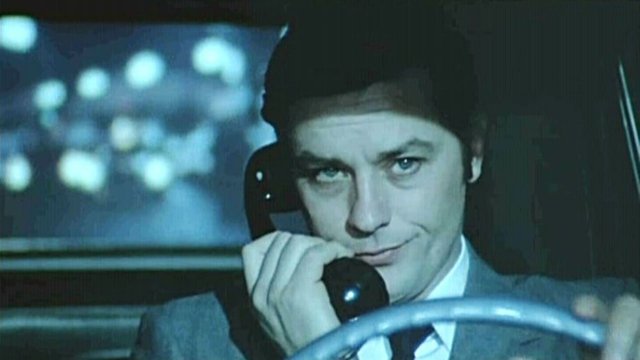
Among those who like to find the major influence on Tarantino's work, John Woo and his ultra-stylish gangster films from Hong Kong are the most obvious choice. However, Woo himself was influenced by another film maker, French director Jean-Pierre Melville, who had used to create cult following among some critics in 1960s and 1970s. Melville, the biggest fan of American culture among sometimes snobbish French filmmakers, built his reputation by making ultra-stylish gangster movies about cops and robbers as cold, detached professionals with highly personal codes of ethics. Many of those films are considered to be the classics. That includes Un Flic (originally titled “Un flic”, literally meaning “a cop”), Melville's last film, released in 1972, a year before his death.
The movie's nominal protagonist is Edouard Coleman (played by Alain Delon), police inspector whose character became emotionally numb after witnessing too many deaths, tragedies and human degradation in his everyday line of work. His friend Simon (played by Richard Crenna) owns a small night club in Paris and the friendship is unchallenged even by Coleman having affair with his wife Cathy (played by Catherine Deneuve). Two of them, however, belong to the opposite sides of the law, although Coleman doesn't know it yet. Simon has led violent bank robbery in small coastal town and the loot is going to finance another, even more daring and ambitious stunt. In the meantime, Coleman gets tipped off about huge shipment of drugs being smuggled on the train.
In his last film, Melville showed his strength and some weaknesses. The best thing about Melville is a sense of style, mostly evident in the beginning scene – brilliantly staged heist, with great atmosphere, pacing and superb acting. Actually, this film could be viewed as pure style accompanied with not so interesting content. Characters aren't fleshed out enough, although they are played by really superb actors. Alain Delon is excellent as extremely cold, with almost pathological inability to show emotions. On the other hand, Catherine Deneuve is used more like a pretty face than real character. For Melville, casting was opportunity to express his Americanophilia – Delon's opposite is played by very good Richard Crenna and Michael Conrad (of later Hill Street Blues fame) is more than fine as one of his crime partners. Melville was obviously more interested into making elaborate and very effective heist scenes, and they work splendidly (although the latter one, including train, suffers from too obvious use of poor special effects). Unfortunately, what connects those scenes is not so interesting, and, even more important, not that well-done. Script relies on too many coincidences, but it also gives interesting insight into Melville's contrasting view of those who break and enforce law. While gangsters in this film conduct painstakingly planed heists that require a lot of discipline and skill, policemen don't use much brain - cases are solved through informants or simply by roughing up suspects. On the other hand, flaws of the script and characters are compensated with well-done atmosphere, thanks to the grey overtones of Walter Wottiz's photography and suggestive soundtrack by Michel Colombier. All in all, Un Flic, despite being imperfect and far away from cult reputation of its creator, still represents very interesting piece of genre cinema.
RATING: 7/10 (+++)
(Note: The text in its original form was posted in Usenet newsgroup rec.arts.movies.reviews on January 13th 2000)
==
Blog in Croatian https://draxblog.com Blog in English https://draxreview.wordpress.com/ Cent profile https://beta.cent.co/@drax Minds profile https://www.minds.com/drax_rp_nc
Brave browser: https://brave.com/dra011
BTC donations: 1EWxiMiP6iiG9rger3NuUSd6HByaxQWafG ETH donations: 0xB305F144323b99e6f8b1d66f5D7DE78B498C32A7
Movie URL: https://www.themoviedb.org/movie/42741-un-flic Critic: AA


