scrobble.life
← All reviews
Movie

Film Review: Hereditary (2018)

Review by @janenightshade · 2839d · of Hereditary

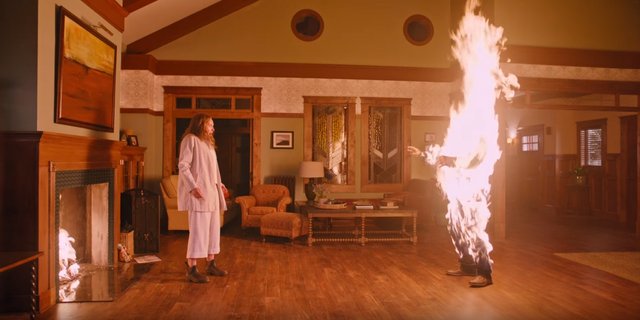
Hereditary.jpg

Hereditary (2018), directed by Ari Aster, starring Gabriel Byrne, Toni Collette, Alex Wolffe, Milly Shapiro and Ann Dowd.

NOTE: Mild spoilers ahead.

This film, Aster’s first full-length feature, attracted a lot of critical praise and buzz when it was released in June. I recently streamed it, and thought it was creepy, but I also found it somewhat disappointing after all the hype. Billed as a family drama with supernatural overtones, Hereditary doesn’t deliver in the first instance because the main characters are distant and simply not very likable. In the second instance, the unattractiveness of the family makes the horrific things that happen to them not all that scary, because the audience doesn't like them enough to care. There are horrific images and scares aplenty if the viewer hangs in until the last third of this rather long film, but they might as well be happening to department store mannequins for all the emotional involvement the flat characters wring from the audience.

The story focuses on a family headed by Steve and Annie Graham (Gabriel Byrne and Toni Collette) and their two children, 13-year-old Charlie (new comer Milly Shapiro) and an older teen, Peter (Alex Wolffe, from the recent Jumanji reboot.) Annie has an odd occupation as an artist who creates installations of miniature people and buildings, and she comes across as cold, self-absorbed and unapproachable. The talented Byrne is wasted as a weak and ineffective father, Steve. Charlie is a weird and unattractive adolescent girl who may be autistic and who also has a severe, frightening nut allergy. Only Wolffe as Peter is at all sympathetic, and then only toward the end, when his fate begins to turn extremely dark.

The family starts to unravel from the very beginning of the film, after Annie’s mother, Ellen, dies from a lingering battle with cancer. Ellen spent her last days at Annie’s house, but it’s clear that mother and daughter were estranged before that and that Annie didn’t know her mother very well in her later years. She joins a grief support group, but her participation is obviously more about Annie feeling guilty for not being close to her mother than it is about her actual grief.

Shortly after Ellen’s funeral, however, Annie experiences real grief when Charlie dies in a horrific freak accident (it’s very horrific—trust me on this one.) She goes back to the grief support group, but this time, she meets a friendly woman named Joan (Ann Dowd) who claims to be grieving for a lost son and grandchild. Joan befriends Annie and then shows her how to connect with the dead in a seance ritual. Eventually, Annie uses the ritual in an attempt to communicate with Charlie. Unfortunately, she inadvertently calls up something far, far worse than Charlie’s departed shade, and the entire Graham family pays a terrible price for this mistake.

While the awful thing that Annie summoned wrecks havoc on her household, she also discovers that her mother and Joan were members of a demon-worshipping cult together.( In a stroke of effective black humor, Annie discovers that the homey, hand-hooked rugs that Ellen made for her family are patterned in demonic occult symbols--the film needs more of this).

Ellen also had an even darker secret, but only poor Peter gets to discover what it was, in the last few minutes of the film, which are overly expository and ham-handed--there's no need to explain what's going on after it's already been made plain a few moments before.

Interestingly, I streamed this film not knowing much about it except for bits and pieces from non-spoiler reviews, but those bits and pieces reminded me instantly of the Stephen King short story, Gramma. This story was made into one of the more memorable episodes from the mid-80s reboot of the Twilight Zone; it was adapted for television by sci-fi/fantasy legend Harlan Ellison. Gramma concerns a 12-year-old boy who’s left alone one night with his dying grandmother, whom he fears greatly, while his parents are visiting his sick brother in the hospital.

Two-thirds or so into Hereditary, I found that my instincts were correct; the Aster film has virtually the same plot as Gramma—it’s just been expanded to include more characters. Judge for yourself: here's a quick-and-dirty YouTube link to the episode: https://www.youtube.com/watch?v=Q334-mUfvF8

This made me wonder whether Aster has ever read the story or seen the television adaptation of Gramma. Sadly, for horror fans, there usually is really nothing new under the sun.

Voted by
  • @hendrikdegrote
  • @curie
  • @youdontsay
  • @wackou
  • @liberosist
  • @vact
  • @markangeltrueman
  • @c-squared
  • @c-cubed
  • @steemcommunity
  • @jazzhero
  • @arcange
  • @polyphemus
  • @maxijgcomm
  • @birddroppings
  • @choogirl
  • @rival
  • @isaideureka
  • @misha
  • @lynncoyle1
  • @gibic
  • @dandays
  • @massivevibration
  • @musicvoter
and 142 others

Comments · 7

  • @noughtshayde(50)· 2822d

    Hello! I went and checked out your Hereditary review that you mentioned on my own article which briefly touched on it to see your points.

    While I agree with you that the family is certainly off-putting, I think that there was a definite reason they were written this way other than simply frightening the audience, and I also think that, although similar in some respects to King's work, there are major, major differences that set this movie apart from the concept put forward in "Gramma".

    Firstly, I think that the way the family acts is very interesting. I can see where you might be put off by their lack of warmth/familiarity, but keep in mind that the grandma died off-screen, and was mostly disliked by the vast majority of the family. The only one who seemed affected by any of this was the father character, which makes sense, as he serves as the "sane one" or the "straight man" in the madness to come.

    I mentioned in my article that there are a lot of beheadings in the film and allusions to the loss of heads. This is important to my theory.

    BUT, before I go into my theory, I need to slap a massive

    SPOILERS AHEAD

    tag on this, as I really think people should go see it before I talk about it in slightly more detail here.

    I think the movie is more about mental illness and family dysfunction than the supernatural.

    Now, before I go into my theory, I want to mention that this film, although similar in some aspects (it contains witches and possession and involves a boy), it is VERY different in others.

    Annie does not summon "something awful" in the seance, she summons King Paimon, AKA Charlie. This is very apparent, as Annie speaks in her voice. The reason things go very crazy from that point on has nothing to do with Charlie, but everything to do with the witch's coven's plans.

    You see, very early in the movie, if you had a quick eye, you could catch a glimpse of the ending in the book that Annie picked up and rifled through. There was a page, and on that page, it showed King Paimon carrying several heads- each of them female. One a young girl, one a woman, and one an older woman. This basically told you the ending if you were paying attention to the massive amounts of foreshadowing present thus far.

    King Paimon is a Lord of Hell, and, by default, represents madness, chaos, and greed. His preferred host is of a young male, and Peter just so happens to fit that description.

    The witch's coven's entire plan was to bring about the return of King Paimon to this mortal realm and offer him sacrifices so that they would reap the reward of eternal wealth, knowledge, and power.

    In that degree, I suppose summoning Charlie's spirit was, indeed, bringing something horrible into their house, but at that point, Charlie had no memory of being a Lord of Hell and was simply a frightened child.

    Now that I have effectively explained the admittedly cleverly hidden plot, allow me to explain my theory.

    From the get-go, you get the feeling that the family dynamic is very wrong. Everyone except maybe Peter and his father is entirely insane to some degree. His mother projects her problems into her strange and creepy career, even to the extent of constructing the horrific event of Charlie's decapitation, all without showing a scrap of emotion. She was upset at the event, of course, but once she miniaturized and compartmentalized it, made herself seem more powerful and big compared to it, she calmed down.

    This, of course, is a very unhealthy way to deal with issues, and this is never more apparent than when the story of her "sleepwalking" issues come about.

    That is not sleepwalking, as anyone should know, but a form of psychosis that has been found in mentally unstable mothers. There was a famous case where a mother put her infant in a swing and pushed him, incessantly, for two days straight. The infant died of dehydration, but she continued pushing him in a dazed state until someone woke her up. She had no idea she did anything and was horrified once she found out.

    This family, for the most part, is composed of the mentally unstable, psycopathic, and sociopathic. Peter and his father are the only ones who, for most of the movie, aren't.

    Think about it. Why is it that whenever characters start acting horrendously erratic and/or borderline psychotic, they LOSE THEIR HEADS? Sure, if you want to be literal, it's because it fits into the occult ritual they want to perform, but on a metaphorical level, it makes sense, too.

    Charlie loses her head due to her autistic naivete, Annie loses her head in a psychotic (shown as supernatural) rage, before which, also in a very deranged state, she indirectly killed her sane husband by burning him alive, and Peter, after all this happens, gets possessed by Charlie's spirit and becomes eerily calm, his eyes wide and seemingly traumatized by the horrors he had to go through in order to reach this conclusion.

    The more you think about it, the more this theory makes sense...why was the family almost entirely apathetic when Ellen died? The infamous dinner scene, where Annie glares at her own son with so much unbridled hatred and contempt, you swear she's about to stab him in the eye with her fork?

    We aren't meant to sympathize with these characters because they are relatable, we are meant to sympathize with them because they are SICK, and we are watching what happens when nothing is done about it.

    That, I believe is where the true horror of Hereditary comes from.

    Oh, and I just realized...Hereditary. That title. Many mental illnesses such as chronic depression, schizophrenia, and psychopathy have been noted to possibly be hereditary. Title makes a lot more sense now.

    Anyway, I still think you made a great case for this movie in your article, I just respectfully disagree, most likely because I'm overthinking things. I typically tend to do that with these films, being a writer myself.

  • @delishtreats(74)· 2836d

    Thank you for the extensive review. I like your review style - honest, unbiased and very easy to read. I love that you didn't say anything important about the movie - you didn't go into details of these horrific situations. Overall it doesn't sound like a movie that I would like to see :) This is why I enjoy the reviews. I don't have to waste time watching a movie that I wouldn't enjoy anyway :D Thank you for sharing!

  • @melinda010100(80)· 2837d

    A wonderfully written and well thought out review! You covered it all very well! Do you review all film genres, or mostly horror?

  • @maxijgcomm(55)· 2838d

    I think Aster has read the story.

  • @janton(71)· 2838d

    howdy there janenightshade! I really like your review of this film, especially the way you compare it to the similar one, Gramma. Your points and explanations are very detailed and well thought out so I thank you for that! You sound like an experienced reviewer, I'm assuming you do many movie reviews?

  • @c-squared(61)· 2838d

    This post was shared in the Curation Collective Discord community for curators, and upvoted and resteemed by the @c-squared community account after manual review.
  • @birddroppings(55)· 2838d

    This is a great review and I really enjoy your writing. Good eye on that connection to the Twilight Zone episode-- I'd never seen that one before and you're definitely right that they're similar. I disagree with you slightly though on the idea that the characters were flat or uninteresting. With the exception of Charlie, a character that was really just carried along by her oddness/ creepiness, I found the family really believable, and I thought the actors (especially the mother and son) did a really great job. I think the ending scared the hell out of me precisely because I'd grown invested with the characters, but I can see why it would lose its effect if I had found them less convincing. Anyway, that's just one opinion, and I'll look forward to seeing more of your reviews in the future!