
Persona is the black and white film by the great Swedish director Ingmar Bergman, with Bibi Andersson and Liv Ullmann in the lead roles. It is considered one of the best films of the 20th century and Bergman's masterpiece. Filming started at the Svensk Filmindustri Studio in Stockholm. It turns out that everything that was recorded there was a failure, and Bergman decides to move the shooting to a real location - into his summer house on the island of Faro.
Persona became a minimalist film; The scene from the hospital was filmed in a local museum whose premises were almost completely empty: there was only a hospital bed, TV, and radio. (Zhenko, 2014: 226). According to Bergman, Persona emerged from the director's own crisis and illness. The film saved his life, both literally and in the metaphysical sense of his life as an artist (227).
The story follows two women, a young nurse Alma (Bibi Andersson) and a famous actress Elisabeth Vogler (Liv Ullmann) on their way of questioning their identity.
Elizabeth, in the middle of the second act of "Elektra", was languishing and, under the care of her husband, came to the hospital, in which Alma works, as a special case: she refuses to speak.
At the suggestion of the main doctor, Alma and Elizabeth go to the summer hut. Due to compulsive intimacy, Alma is increasingly starting to open up Elizabeth, sharing her fears, secrets and relationships with men, while she refuses to speak.
The relationship between them is aggravated when Alma, from Elizabeth's letter, finds out that this is useful as a study object. The roles have been replaced and their personality is intermingled, leading us to the question: are there two people at all? (Susan Sontag, in her famous essay "Bergman Persona", speaks of Alma and Elizabeth as one person, that is, about one person and her duplicate (1967)). The plot ends with Alma leaving home.
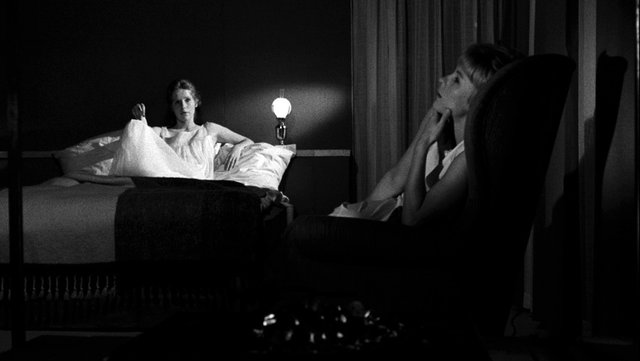
It was not until the Second World War, more precisely in the sixties, that modernism flourished in cinema. Persona (1966), according to many critics, is regarded as one of the best examples of modernism in cinema.
Film critic Ernest Zhenko in this film sees an example of media and technological determinism, pointing out that technology has deeply infiltrated into the prevailing framework of the mind, so deeply that the psyche can best be understood through the film itself. (Zhenko, 2014: 219).
One of the reasons why Bergman's masterpiece manages to preserve the status of an enigma, avoiding any definitions, undoubtedly lies in what Bertolt Brecht called the alienation effect, which is associated with film reflexive or self-referential structure (metaphysics). Persona urges the audience to give up belief in the story, to the media, and to look more critically. Bergman plays with viewers, introducing moments of film self-reflection as a medium, problematizing the relationship between artists and works.
Persona possesses a double layered structure: one part of the film is presented at the "narrative level", while the other is "material". About a quarter of the film is dedicated to the material level, which is represented three times: at the beginning, in the middle, and finally, establishing some form of formal framework.
With radio, film, photography, literature and theater, Persona covers a whole range of contemporary media, pointing to their role and performance in the modern world.
Looking at the film we can not but ask ourselves what is true and what is illusion, what is real and what a mere presentation. Any kind of interpretation seems weak and insufficient. We have never been able to read the text that we have before us. In this sense, we are talking about a certain experience or act of a particular way of reading. This is a deconstructive methodology, which Derrida sees as a process that suggests the decomposition of the established hierarchies.

Derrida explored the world by examining the language as a structure that needs to be carefully measured, according to the possibilities that the language itself requires. The language, for Deride, is the system of differences, where the meanings are established in relationships, ie, in difference to other terms (33).
His criticism concerned the privilege of de Sausarre's view of the assumption of speech in relation to the written language. He wanted to show that no statement can clearly cut off what he intended and that, as such, he was always permeated with metaphysics, although he wanted to appear non - metaphysical (Alihodzhi, 2014: 36).
On the other side of the established norms (logos, ratia) there is silence, and madness. Derrida's critique of Foucault's analysis of the history of insanity finds the point precisely in the fact that the history of insanity itself, and not the history of the appropriation of insanity by the warriors, which is the declarative purpose of Foucault, can not be written in any language, since the gesture of such an attempt falls into the violent appropriation of madness in frames of reason.
Namely, the philosophical discourse by definition has to remove the madness. By making the right to understand the meaning of discourse, it is actually normalized. Everything is a dream, a metaphor, a symbol, an outcry, a theater, a lie, although it can all look real. The film itself is a scam: for every hour of the movie, the viewer actually spent twenty minutes in total darkness (Coates, 2010: 191).
"Filming a movie is not so much as making the idea visible, or interpreting a story, or translating one's life into a film story, how much is it to shoot / take pictures with the goal of doing the tricks." (Bergman, 2014: 228).
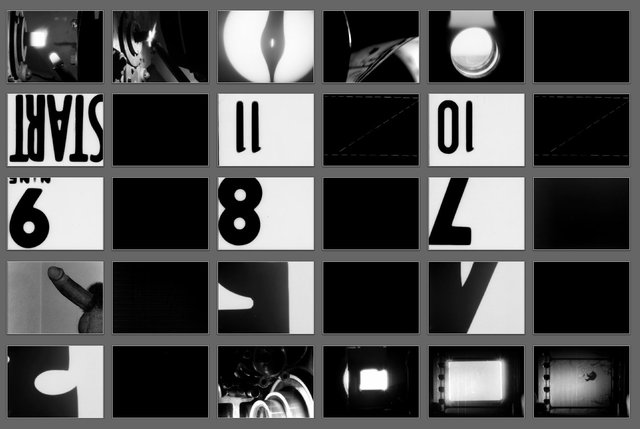
Bergman uses the film space as a medium to speak about the current topic of identity questioning by trying to write himself, but not in language, but silence. It means writing on the margin, in a third place that is the place of monstrosity, the place of a seductive song of mermaids, who want to tear you apart.
This is a new dimension of aesthetics, an indication of the new way of thinking that destabilizes dogmatism.
It's manifested in insanity or oblivion, in the loss of one's own identity, as a "human wonder" that, through the trace of new thinkers (such as Derrida, Foucault and Lacan) becomes a new paradigm of novels as a literary type, but also of art in general.
Writer, who, in particular, belongs to his own work, but is also distanced from it, enumerating both between reality and text. Paradox lies in the impossibility of equalizing art and life, which produces the effect of another trick.
This was my translation from Serbian to English from part of PULSE article ''Bergsona-Persona kao metafilm i vrisak'' by I.Selimovic


