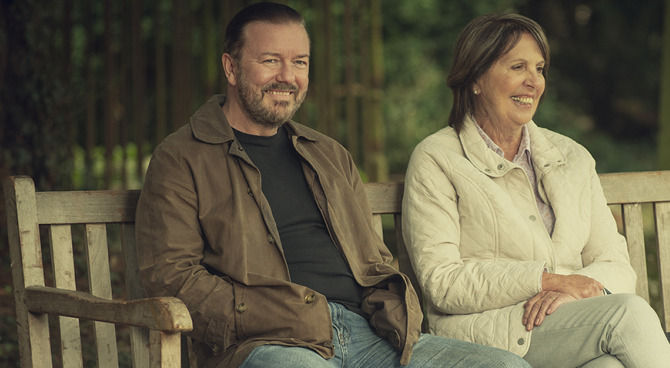


For those who were already in "tune" with the British comedian it will still be a big surprise.
After Life is the series that we needed at this point of the season, at this point in the serial life of every self-respecting addict, suffocated by the avalanche of products raining down from every broadcaster and platform.
It 's the perfect series because it manages in 6 very short episodes to leave its mark without forcing us to watch long episodes and long seasons to get to grips with the narrative.
2 and a half hours of vision to enter the world of Tony, interpreted by a sensational Gervais, and in his weary desire for self-destruction.
Tony lost his wife about a year ago. Breast cancer took her early on. His love for her was something unique, fairy-tale, that in normal, routine drew strength and inspiration from the day they met.
And here is the first great merit of the series. It focuses on a normal love, but no less fairy-tale and romantic than what we are used to seeing in the great genre films, in the tear-jerker ones or in those that invent miraculous situations in which to reflect a great love. No epic gestures, no screams of desperate love but a constant admiration and exaltation of the other in small everyday gestures. As Tony will say:
Every day of my life I couldn't wait to finish my work so I could go home to her. Sit on this couch, watch a movie with her and our dog and party. And it was a real party every day we lived together. That's testified to by the many archive footage that Tony never stops watching. Amateur films that portrayed him and his wife Lisa in exhilarating, liberating moments lived within the walls of the house or by the sea or in the garden.
A true love, lived at most by 2 people who simply got along well together, managing to complete each other. The loss of that person, of that shoulder, constitutes for Tony too great a mourning, a gigantic loss that will make him wish only for death. And it's precisely on death and suicide that most of the series with Tony revolves that he doesn't hide this desire, he doesn't hide this instinct, he doesn't shadow this instinct, but he turns it over to everyone whenever he can, whenever someone asks him how he is or someone asks him to cheer him up.
There would be no death without life and then these two concepts often intertwine and do so in a masterful and unexpected way. The dialogue between Tony and his pusher is exemplary in this sense. 2 men who have lost their soul mate and now cannot survive the loss.
Whenever I'm lucid and conscious, all I do is think about drugs. It is the only way to not be lucid, not be conscious and choke the pain I feel every time I am able to think about how much I miss it. Another great merit of the series is what you can see from these words. A reversal of conventions, a redemption of socially mistreated figures like junkies or prostitutes or simply lost people.
Rejects of society that often show themselves much more sensitive to the life of those who manage to carve a place for themselves in the world.
A junkie is therefore not just a junkie, but is perhaps a person who is unable to sustain life, pain, loss and therefore takes refuge in a place that represents relief and a kind of limbo for him.
A prostitute is not a lecherous and nymphomaniac but can be a beautiful, beautiful, lovable and kind person who ended up doing the only thing that life offers her.
Tony works as a reporter for a free local newspaper that publishes pictures and frivolous news about people in the community. Inhabitants who will do anything to make the front page. The encounter with some of them shows all the loneliness of contemporary man, often abandoned to himself by an increasingly anaffective and illiterate society in terms of feelings.
In the editorial staff Tony will find comfort in his brother-in-law and colleagues, weird but always ready to be there for him.
Tony's parable will be as self-destructive as it is therapeutic. Therapy that will not be served by specialists and shrinks but by meeting an elderly widow at the cemetery or by Tony's Alzheimer's father's assistant, a prostitute or a child. It will be the actors of the great theatre of life who will give Tony strength in a completely unconscious way.
You might think this is a "heavy" and undigestible series.
You are so wrong. This is a sarcastic, pungent, ironic and very, very light series. The merit of Gervais, the further merit of Gervais, is to have given the series a very, very very style and tone.

Per chi non conoscesse Ricky Gervais After Life, la nuova serie di Netflix da lui creata, diretta e interpretata, sarà una rivelazione.
Per chi già fosse in "sintonia" con il comico britannico essa sarà comunque una grandissima sorpresa.
After Life è la serie che ci voleva a questo punto della stagione, a questo punto della vita seriale di ogni addicted che si rispetti, soffocato oramai dalla valanga di prodotti che piovono da ogni emittente e piattaforma.
E' la serie perfetta perchè riesce in 6 puntate brevissime a lasciare il segno senza obbligarci alla visione di episodi lunghi e stagioni lunghe per poter venire a capo alla narrazione.
2 ore e mezza di visione per entrare nel mondo di Tony, interpretato da un clamoroso Gervais, e nella sua logorante voglia di autodistruzione.
Tony ha perso la moglie da circa un anno. Un cancro al seno l'ha portata via precocemente. Il suo amore per lei era qualcosa di unico, di fiabesco, che nella normalità, nella routine traeva forza e ispirazione fin dal giorno in cui si sono incontrati.
E qui c'è il primo grande merito della serie. Essa mette al centro un amore normale ma non per questo meno fiabesco e romantico di quello che siamo abituati a vedere nei grandi film di genere, in quelli strappalacrime o in quelli che inventano situazioni mirabolanti nelle quali riflettere un grande amore. Nessun gesto epico, nessun urlo d'amore disperato ma una costante ammirazione ed esaltazione dell'altro nei piccoli gesti di tutti i giorni. Come Tony dirà:
Ogni giorno della mia vita non vedevo l'ora di terminare il mio lavoro per poter tornare a casa da lei. Sedermi su questo divano, guardare un film con lei ed il nostro cane e fare festa. Ed era davvero festa ogni giorno vissuto insieme. A testimoniarlo sono i tanti filmati di repertorio che Tony non smette di guardare. Filmati amatoriali che ritraevano lui e sua moglie Lisa in momenti esaltanti, liberatori vissuti tra le mura di casa o al mare o in giardino.
Un vero amore, vissuto al massimo da 2 persone che semplicemente stavano bene insieme, riuscendo a completarsi l'un l'altra. La perdita di quella persona, di quella spalla costituisce per Tony un lutto troppo grande, una perdita gigantesca che gli farà desiderare solo la morte. Ed è proprio sulla morte e sul suicidio che ruota gran parte della serie con Tony che non nasconde questa sua voglia, non si fa ombra di questo istinto ma lo spiattella a tutti ogni volta che può, ogni volta che qualcuno gli chiede come sta o qualcuno lo interpella per tirarlo su di morale.
Non esisterebbe la morte senza la vita e allora spesso questi 2 concetti si intrecciano e lo fanno in maniera magistrale e inaspettata. Il dialogo tra Tony e il suo pusher è esemplare in tal senso. 2 uomini che hanno perso la propria anima gemella ed ora non riescono a sopravvivere alla perdita.
Tutte le volte che sono lucido e cosciente non faccio altro che pensare alla droga. Essa è l'unico modo per non essere lucido, non essere cosciente e soffocare il dolore che provo ogni volta che sono in grado di pensare a quanto mi manca. Altro grande merito della serie è quello che si nota da queste parole. Un ribaltamento delle convenzioni, un riscatto di figure socialmente bistrattate come tossici o prostitute o semplicemente persone smarrite.
Reietti della società che spesso si mostrano molto più sensibili alla vita di chi riesce a ritagliarsi un posto nel mondo.
Un tossico non è dunque solo un tossico ma è forse una persona che non riesce a sostenere la vita, il dolore, la perdita e che dunque si rifugia in un luogo che rappresenta per lui sollievo ed una sorta di limbo.
Una prostituta non è una lussuriosa e strafottente ninfomane ma può essere una bella, bellissima persona, amabile e gentile che è finita per fare l'unica cosa che la vita le offrisse.
Tony lavora come giornalista ad un giornale locale gratuito che pubblica immagini e notizie frivole che riguardano gli abitanti della comunità. Abitanti che faranno di tutto per finire in prima pagina. L'incontro con alcuni di loro manifesta tutta la solitudine dell'uomo contemporaneo, spesso abbandonato a se stesso da una società sempre più anaffettiva e analfabeta in termini di sentimenti.
Nella redazione Tony troverà conforto nel cognato e nei colleghi, strambi ma sempre pronti ad essere li per lui.
La parabola di Tony sarà tanto autodistruttiva quanto terapeutica. Terapia che non sarà servita da specialisti e strizzacervelli ma dall'incontro con un'anziana vedova al cimitero o dall'assistente del padre di Tony malato di Alzheimer, da una prostituta o da un bambino. Saranno gli attori del grande teatro della vita a dare forza a Tony in maniera del tutto inconsapevole.
Potreste pensare che questa sia una serie "pesante" e poco digeribile.
Vi sbagliate di grosso. Questa è una serie sarcastica, pungente, ironica e molto molto leggera. Il merito di Gervais, l'ulteriore merito di Gervais, è quello di aver dato alla serie uno stile ed un tono molto molto leggiadro senza spingere la serie verso il drammone pedante.
Il personaggio di Tony è buono, buonissimo come spesso dirà la moglie defunta in un video postumo a lui dedicato. Tony diventa però cinico e libero da ogni convenzione, confezionando battute superbe ogni volta che può seppure velate da una tristezza e da una malinconia enormi da parte di chi non crede di aver alcun motivo per vivere.
E allora perchè vivere? Perchè non suicidarsi?
Se ti dicessero di andare a vedere un bel film del tuo attore preferito e ti dicessero che esso avrà una fine cosa faresti? Non andresti più a vederlo perchè tanto finirà? La fine è inevitabile. Il percorso anche. Allora forse meglio vivere e vedere come va a finire che rinunciare a godersi lo spettacolo.
