I discuss today a specific class of models of particle physics featuring WIMPzillas, a potential explanation to the problematics of dark matter.
 [image credits: @pab.ink]
 WIMPzillas are super-heavy particles that could feature dark matter. The cool name is related to their huge mass. Typically, one single WIMPzilla would be a particle weighting as much as 1.000.000.000.000.000 hydrogen atoms.
Their huge mass makes WIMPzillas very hard to detect with standard dark matter search methods. One option is to rely on their decay into ultra-highly energetic cosmic rays.
This is what the authors of this scientific article have investigated. They determine the constraints that can be imposed on the WIMPzilla dark matter hypothesis from the searches for super-energetic cosmic rays on Earth.
Dark matter and WIMPs
Dark matter and WIMPs
As I already discussed it in many articles on my blog, dark matter is favored by many observations.
 [image credits: Maxwell Hamilton (CC BY 2.0)]
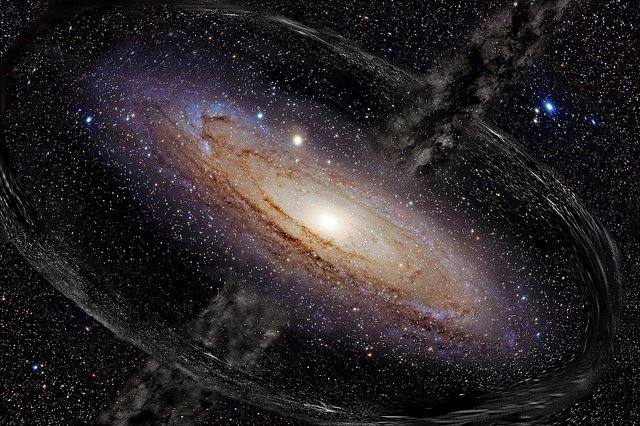
 Without entering into details, dark matter is indirectly evidenced, for instance, by the velocity of the stars in the galaxies, the properties of the fossil radiation remnant of the early universe or the formation of the galaxies.
However, we have no idea about the true nature of dark matter. It has to interact gravitationally. But for the rest, who knows?
Consequently, there is a lot of dark matter models on the market. One very popular of them involves particles called WIMPs that consist in weakly-interacting and quite massive dark particles.
All about WIMPs
All about WIMPs
In the early universe and at very high temperature, the WIMP paradigm considers that two reactions occur at equal rates: pairs of dark matter particles are created from the annihilation of highly-energetic Standard Model particles, and pairs of dark matter particles annihilate into Standard Model particles. The amount of created and annihilated dark matter is hence equal.
The universe however expands and the temperature drops. The Standard Model particles are thus less and less energetic with time and at some point, dark matter cannot be created anymore. Later on, dark matter becomes too diluted in the expanding universe to continue annihilating. Its density is said to freeze out.
 [image credits: NASA / ESA]
 The amount of dark matter present in the universe today is well measured. We can thus see under which conditions the WIMP paradigm works.
First, one needs a dark matter particle with a mass close to the mass of the weak bosons, i.e., the particles responsible for the mediation of the weak interactions.
Second, the production and annihilation rates related to the above-mentioned processes must be similar to those of typical processes mediated by the weak interactions.
This is the so-called WIMP-miracle and the explanation for the WI part of the acronym (Weakly-Interacting). In addition, WIMPs naturally arise in many extensions of the Standard Model.
For these reasons, most experimental search efforts to detect dark matter have been focused on WIMPs. Despite these efforts, no WIMP has however been found so far. It is therefore important to explore alternatives.
WIMPzillas and Auger
WIMPzillas and Auger
One potential alternative to WIMP consists in assuming that dark matter is made of super-weakly interacting supermassive particles traditionally coined WIMPzillas. In this case, we must forget about the equilibrium above-mentioned as dark matter is too weakly interacting. Only gravity matters, as could be motivated by the fluctuations in the cosmic microwave background (the fossil radiation left over from the epoch of the formation of the first atoms, in the universe history).
The WIMPzillas supermassive and super-weakly-interacting properties allow them to escape all searches. However, their properties imply that they (rarely) decay into ultra-highly energetic particles. The ultra-high-energy is connected to the large WIMPzilla mass (Einstein told us that mass is energy). Once produced, the decay products of the WIMPzillas are traveling into space under the form of ultra-highly energetic cosmic rays.
 [image credits: Roberto Fiadone (public domain)]
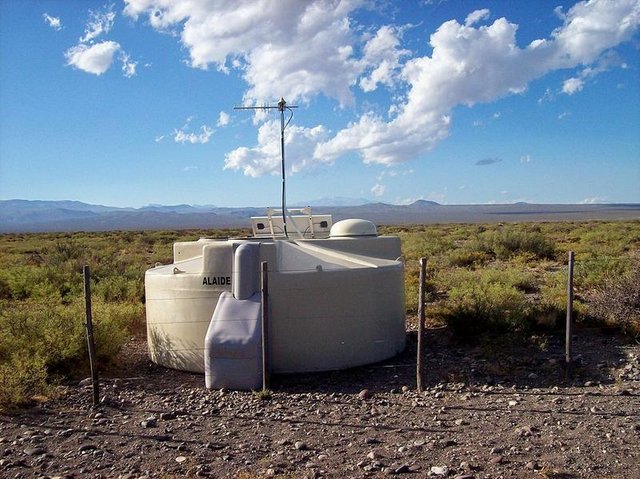
 This gives us hope to detect them, in particular with the Pierre Auger observatory based in Argentina and aiming to study ultra-highly energetic cosmic rays.
This observatory is a huge 3000 km2 array of detectors recording the interactions of any ultra-highly energetic cosmic ray with the atmosphere.
When a ultra-highly energetic cosmic ray enters the atmosphere, it quickly hits a particle of air, which gives rise to less energetic (but still very very energetic) secondary particles. The latter themselves interact later with the atmosphere, which gives more particles. And so on…
We hence end up with a spatially-spread shower of particles. The spread of this air shower implies that we need a huge detector to observe it. This is exactly what is Auger.
Take-home message: cornering WIMPzillas with cosmics
Take-home message: cornering WIMPzillas with cosmics
WIMPzillas are super-weakly-interacting super-massive particles and consist in an interesting idea to explain dark matter. Their main signatures rely on their potential decay into ultra-highly energetic cosmic rays. The latter can be detected with experiments like Auger, or with the future POEMMA satellite experiment scrutinizing the atmosphere for the above-mentioned air showers.
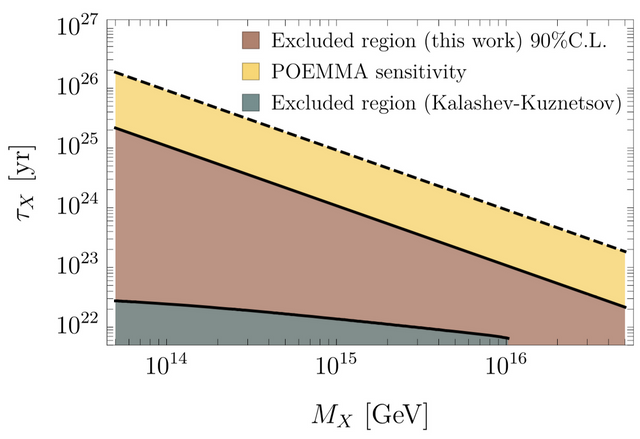
Taking the observations of Auger and the prospects of POEMMA, the authors of this scientific article have constrained the WIMPzilla paradigm as shown below.
 [image credits: arXiv:1903.05429]
 The x-axis corresponds to the WIMPzilla mass (given in GeV, 1 GeV being the mass of one proton). Those guys are indeed very heavy. On the y-axis, we have the lifetime of those particles. It must be large enough for preventing all dark matter to have decayed today. However, some dark matter is allowed to decay, so that we have a handle on the model.
The results of Auger (in brown) put a lower bound on the lifetime as a function of the WIMPzilla mass. In yellow, we can see the POEMMA prospects. The WIMPzilla hypothesis is thus more and more constrained, especially if it is lightish. The future will also allow to increase the senstivity to the model. This is crucial as detecting dark matter requires to cover all options as much as possible.
SteemSTEM
SteemSTEM
SteemSTEM aims to make Steem a better place for Science, Technology, Engineering and Mathematics (STEM) and to build a science communication platform on Steem.
Make sure to follow SteemSTEM on steemstem.io, Steemit, Facebook, Twitter and Instagram to always be up-to-date on our latest news and ideas. Please also consider to support the project by supporting our witness (@stem.witness) or by delegating to @steemstem for a ROI of 65% of our curation rewards (quick delegation links: 50SP | 100SP | 500SP | 1000SP | 5000SP | 10000SP).

)


