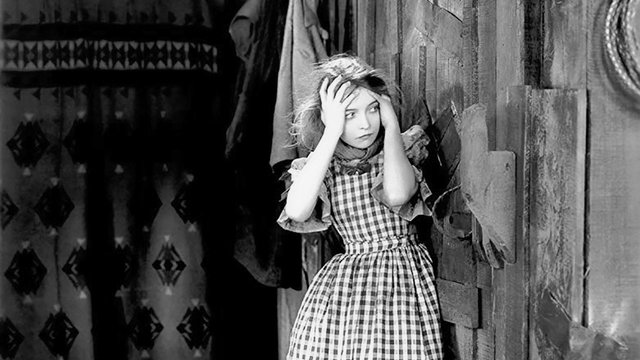
Among the many films throughout the history of cinema that suffered from the misfortune of being released in the worst possible time, a very special place belongs to Victor Sjöström’s The Wind, a silent Western melodrama released in 1928. If this film had arrived just one year earlier, in the halcyon days immediately preceding the dawn of sound, it would likely have been hailed as a masterpiece of the silent era, a triumph of visual storytelling that rivalled the works of D.W. Griffith or F.W. Murnau. Instead, its release in the immediate wake of The Jazz Singer meant that all the style, skill, and talents of those involved mattered little to a sound-hungry audience desperate to hear the human voice. Consequently, The Wind became a commercial flop and, for a time, a critical disappointment, taking several decades to have its qualities fully recognised by film historians and enthusiasts. It is a symbolic marker, representing the mournful end of an entire era of cinema history.
The film is an adaptation of Dorothy Scarborough’s 1925 novel of the same name, a work deeply rooted in the author’s own experiences growing up in the remote, unforgiving rural West Texas. Cummings drew from the stark realities of the region to craft a narrative that is as much about the human spirit as it is about the environment that seeks to break it. The plot is set in the late 1880s and centres on Letty Mason (Lilian Gish). Letty is an impoverished young woman, newly arrived from Virginia, who travels to Sweetwater, Texas, to live with her cousin Beverly (Edward Earle) and his wife Cora (Dorothy Cummings). Her arrival is immediately heralded not by a warm welcome, but by an ominous atmosphere and a relentless, physical force: the wind. This elemental power brings with it choking dust and sand, setting the stage for Letty’s psychological unraveling.
The narrative quickly establishes the social and environmental hostility that surrounds Letty. She is greeted by the cold hostility of Cora, whose jealousy of Letty’s youth and beauty fuels a simmering resentment. It is another matter entirely with the two men who escort Letty from the train station to the ranch: the older, weathered Sourdough (William Orlamond) and the younger, more handsome Lige (Lars Hanson). Both men vie for Letty’s favour. Letty, desperate for stability and affection, seriously considers their marriage proposals, particularly when Cora threatens to cast her out. However, her interest is piqued by the mysterious Wirt Roddy (Montagu Love), who hints that he can take her away from Sweetwater. Yet, when Letty discovers Wirt is married and only desires her as a mistress, she resolves to marry Lige.
The marriage, however, is doomed from the start. When Lige attempts to consummate their union, Letty refuses due to fear and inexperience. He promises to respect her wishes and earn enough money to help her settle elsewhere, eventually leaving to join a party rounding wild horses in the desert. Letty is left alone, terrified not only of the wind but of her solitude. Her torment peaks when Wirt Roddy, injured and desperate, is brought to her house. Seizing the opportunity presented by her vulnerability, he forces himself upon her. This act of violation, which was explicit in Cummings’ novel, is rendered implicit but unmistakably powerful through Sjöström’s visual direction and Gish’s expressive performance. It is the psychological breaking point that drives Letty to madness, a madness manifested through her hallucinations and eventual descent into violence.
The creative force behind The Wind was undoubtedly Lilian Gish, one of the greatest stars of Hollywood’s silent era. Recognising the potential of Cummings’ novel, she used her considerable clout to convince Irving Thalberg, the head of the recently formed MGM studio, to produce an adaptation. Thalberg brought in Victor Sjöström, the Swedish actor and director famous for his contributions to the First Golden Age of Swedish cinema. Like other great European filmmakers who were poached by Hollywood, Sjöström had hits, having previously worked with Gish on The Scarlet Letter. Sjöström brought with him a sophisticated approach to visual storytelling, enhancing the film's relatively simple and melodramatic plot with rich, painterly cinematography.
The Wind is a fascinating study in how a director can elevate material through atmosphere and performance. Sjöström employs both simple practical effects and more elaborate techniques to create a sense of overwhelming nature. The wind is not merely a backdrop; it is the primary catalyst for the protagonist’s madness and the driving force behind the film's violent finale. Sjöström demonstrates immense skill, using the landscape itself as a character that mirrors Letty’s internal state. Lilian Gish is the anchor of the film, perfectly embodying the figure of the delicate ingenue thrown into a rural wilderness where the unforgiving nature is as dangerous as the wild men who inhabit it. Aside from Gish, the film benefits significantly from the performances of Montagu Love as the duplicitous villain and Lars Hanson as the stoic, reluctant hero.
The production of the film was notoriously difficult, involving extensive shooting in the harsh conditions of the Mojave Desert. The unpleasant experiences endured by the cast and crew, later recounted by Gish in her memoirs, added a layer of authenticity to the final product. These struggles inevitably drew comparisons to Erich von Stroheim’s infamous epic Greed, another desert-bound Hollywood production of the era. However, The Wind was far more disciplined and actually managed to be finished, unlike Stroheim’s chaotic masterpiece. While approximately twenty minutes of the original footage were lost over the years, the surviving version is cohesive and easily digestible compared to the sprawling nine-hour cut of Greed.
Like with Greed, Irving Thalberg interfered with the finished product, though the nature of his interference differed slightly. His primary demand was to replace the depressing ending of the novel with a happy one, an edict issued against both Gish’s and Sjöström’s wishes. The logic was commercial—to give audiences a sense of hope—but this change ultimately proved moot. By the time The Wind was released, the sound era had already begun, rendering the distinction between tragic and happy endings secondary to the novelty of audio. The film turned into a flop, a victim of its own timing and Thalberg’s attempts to shape it for a market that was already changing.
In the end, The Wind served as MGM’s last major silent film. The failure of the project marked a turning point for Victor Sjöström, who realised that Hollywood, in its present form, stifled his creativity. He returned to his native Sweden, a move that also saw the departure of Lars Hanson, who suddenly found himself burdened by language barriers that had previously been inconsequential in the silent era. Lilian Gish, however, survived this transition; she would go on to become the grand dame of Hollywood in the later part of her life, bringing gravitas to various matronly roles. Today, The Wind is remembered not for its initial reception, but for the haunting beauty of its imagery and the sheer force of its storytelling, standing as a monument to the end of an era and the enduring power of the silent image.
RATING: 7/10 (+++)
==
Blog in Croatian https://draxblog.com Blog in English https://draxreview.wordpress.com/ InLeo blog https://inleo.io/@drax.leo Substack https://draxster.substack.com/
InLeo: https://inleo.io/signup?referral=drax.leo Leodex: https://leodex.io/?ref=drax Hiveonboard: https://hiveonboard.com?ref=drax Rising Star game: https://www.risingstargame.com?referrer=drax 1Inch: https://1inch.exchange/#/r/0x83823d8CCB74F828148258BB4457642124b1328e
BTC donations: 1EWxiMiP6iiG9rger3NuUSd6HByaxQWafG ETH donations: 0xB305F144323b99e6f8b1d66f5D7DE78B498C32A7 BCH donations: qpvxw0jax79lhmvlgcldkzpqanf03r9cjv8y6gtmk9


