2 Pi R (S2x11)
Airdate: 13 December 2012
Written by: Richard J. Lewis Directed by: Dan Dietz
Running Time: 44 minutes
How would Person of Interest attempt to resolve the cliffhanger that threatens to completely wreck its main premise? The answer, as seen in the episode 2 Pi R, is that the scriptwriters would simply pretend that such a cliffhanger isn’t such a big deal, allowing the episode to take its normal formulaic course in the form of a procedural storyline. The show had established a tense narrative arc where John Reese was captured by the FBI, a situation that logically should have dismantled the series' central dynamic of Reese operating in the shadows. However, the writers chose to sideline this immediate threat, resolving Reese’s incarceration with impressive efficiency and moving quickly back to the show's comfort zone—a "Number of the Week" investigation. This approach provides a sense of stability to the episode, anchoring the show after a high-stakes cliffhanger, but it does come at the cost of narrative momentum, treating Reese's capture as a mere procedural hurdle rather than a genuine crisis of survival.
While Reese found himself in FBI custody at the end of the previous episode, the authorities still don’t have a clue about his identity or who among the four men arrested is the semi-mythical "Man in the Suit." It turns out that this task will be difficult, because Finch has been preparing for a long time for such an eventuality and developed various backup plans. One of the most intriguing contingencies involves Carter simply destroying all of Reese’s fingerprint records. When Reese himself is found in the Rikers Island detention centre, he is surprised to discover that a cell phone has already been planted in his cell, allowing him to communicate with Finch. Carter prepares to use her authority to arrange Reese simply to walk out of detention, but at the very end of the episode, FBI Agent Donnelly stops her and instead orders her to conduct an interrogation of all four suspects.
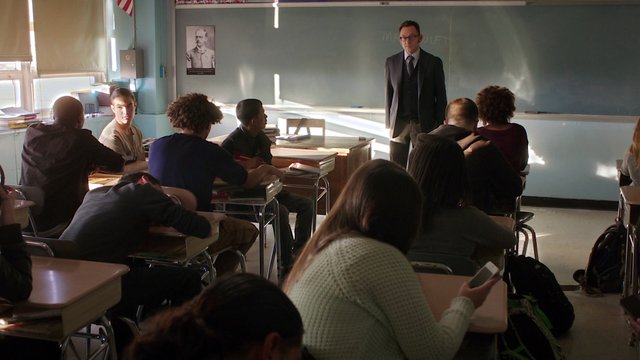
In the meantime, the main storyline deals with a somewhat unusual person whose number was churned out by the Machine: Caleb Phipps (Luke Kleintak). He is a teenager and a high school student who, despite his age, possesses an introverted but incredibly talented mind as a computer programmer. Finch, who must now conduct investigations alone without Reese, finds an ingenious way to get close to the boy, taking on the false identity of "Mr. Swift," his math substitute teacher. Through surveillance, Finch observes Caleb and discovers that he is involved in dealing drugs, which ultimately puts him in conflict with the powerful drug lord Lorenzo (Hassan Iniko Johnson(, over a specific territory. Finch is much surprised to see Caleb not being particularly scared or concerned with the threats and blackmail that come from Lorenzo.
Finch discovers that Caleb’s code—written by hand and later entered into the school’s computer—allows for a revolutionary new mode of data compression. The code has been obtained by Chris Beckner (Luke Kirby), Caleb’s computer science teacher, who later shows it to his friends in IT business circles. Finch at first believes that Beckner wants to cheat his student out of the billions he would make if his idea is put into practice. However, Beckner, when confronted, actually reveals that he was approached by Caleb in order to help with the sale, and that he does not want to take Caleb’s credit. Finch slowly realises that Caleb for some reason wants to obtain a large amount of money. After talking with Andrew Murphy (James Colby), an NYPD transit officer who witnessed a tragic incident in the subway two years earlier, he learns what Caleb’s motive is. Andrew feels enormous guilt over a drunken contest which led to the death of his older brother, and wants to punish himself by jumping in front of a train. The money Caleb is making is intended to be used for a trust fund for his alcoholic mother, Lori (Mary McCann). Finch prevents Caleb from suicide and talks him into continuing his life and creating his code.
The decision of scriptwriter Richard J. Lewis to pay less attention to Reese’s stay behind the bars and more to the procedural storyline involving Caleb is both a strength and a weakness of this episode. The strength lies in making the whole proceeding somewhat more realistic—Reese getting out so quickly and so easily would have strained suspension of disbelief too much. Furthermore, the story of Caleb shows potential which is at least partially exploited. Although the idea of a guilt-ridden tech supergenius seems somewhat too convenient and too Hollywood-like, Luke Kleintak plays the character well, maintaining a believable level of awkwardness and brilliance. However, the episode is undoubtedly anchored by Michael Emerson, who truly shines in this episode. Emerson has the opportunity to establish a good rapport with a youth, channeling his own performance as alternate Ben Linus as high school teacher in the final season of Lost. His ability to manipulate Caleb while genuinely caring for him adds a layer of complexity to Finch that is often missed.
Emerson was also given some great dialogue, most notably the speech describing Pi—a number that goes forever and can contain the code and numbers of everything there is. This dialogue serves as a thematic parallel to the Machine itself, suggesting that within the infinite chaos of data, there is order and meaning. The episode also hints at some major character exposition, showing Finch’s enthusiasm for the history of the early Internet and subtly suggesting that he might have been the great hacker in the early 1980s. This connection adds depth to his character, explaining his expertise and giving weight to his subsequent actions. It paints him not just as a guardian of the Machine, but as a relic of the digital age who is trying to ensure its future.
Even supporting players, like James Colby, are given an opportunity to shine, in his case in a single scene that describes the moral decision of Officer Murphy not to report young Caleb for the accidental death of his brother. Colby delivers a poignant performance that highlights the grey areas of police work and the heavy burden of responsibility that the officers carry. It is a subtle but important moment that adds texture to the world of Person of Interest, showing that the consequences of actions ripple outwards long after the initial event.
Ultimately, 2 Pi R is a good episode, although it doesn’t live to its full potential. Caleb’s storyline is at times too melodramatic, and some of the plot strands are left unfinished, leaving the audience feeling a bit unsatisfied with the resolution of the immediate conflict. Yet, the good acting and occasionally good writing would make most of the audience disregard those flaws. The chemistry between Emerson and Kleintak is undeniable, and the episode succeeds in delivering a compelling character study that complements the procedural format of the show. While it may not have the edge of some other episodes in the series, it stands as a testament to the strength of the cast and the writers' ability to balance high-concept ideas with human emotion.
RATING: 6/10 (++)
==
Blog in Croatian https://draxblog.com Blog in English https://draxreview.wordpress.com/ InLeo blog https://inleo.io/@drax.leo Substack https://draxster.substack.com
LeoDex: https://leodex.io/?ref=drax InLeo: https://inleo.io/signup?referral=drax.leo Hiveonboard: https://hiveonboard.com?ref=drax Rising Star game: https://www.risingstargame.com?referrer=drax 1Inch: https://1inch.exchange/#/r/0x83823d8CCB74F828148258BB4457642124b1328e
BTC donations: 1EWxiMiP6iiG9rger3NuUSd6HByaxQWafG ETH donations: 0xB305F144323b99e6f8b1d66f5D7DE78B498C32A7 BCH donations: qpvxw0jax79lhmvlgcldkzpqanf03r9cjv8y6gtmk9


