Grey Matters (S02E10)
Airdate: 10 December 2009
Written by: Ashley Edward Miller & Zack Stentz Directed by: Jeannot Szwarc
Running Time: 44 minutes
After what felt like an eternity of mystery-of-the-week instalments, Fringe finally remembered it had a mythology to attend to. By the tenth episode of its second season, the series had spent considerable time spinning its wheels with standalone mysteries that, whilst entertaining enough, did little to advance the overarching narrative. The mystery-box approach to storytelling meant that every answer inevitably spawned three more questions, leaving viewers in a perpetual state of narrative limbo. Yet Grey Matters—and yes, the pun is unavoidable—proved to be the instalment that genuinely lived up to its title. This was the moment the show stopped treading water and started swimming toward something genuinely compelling.
The episode opens with a sequence designed to unsettle. At the Harrington Mental Health Institute in Boston, we're introduced to a man (Sebastian Roché) who is quietly performing brain surgery on a patient named Joseph Slater (Jeff Perry). Slater, rambling incoherently about "Heather," a flower in her hair, and a girl in a red dress, appears to be the victim of some grotesque medical experimentation. When security inevitably intervenes, Newton and his accomplices flee before they can properly seal the man's skull. It's a visceral, almost horror-film opening that immediately establishes something is profoundly wrong.
Enter the Fringe Division. Brought in to investigate the bizarre circumstances, they discover something extraordinary: Slater, who had been institutionalised for paranoid schizophrenia and rendered virtually unable to communicate, has been miraculously restored to full cognitive function. The unauthorised brain operation hasn't harmed him—it's cured him. This reversal of fortune raises immediate questions about who would possess both the capability and the motivation to perform such a procedure, and what connection it might have to the Pattern.
Olivia Dunham quickly identifies the surgeon through security footage, recognising him as the same individual whose cryogenically frozen head had been stolen in an earlier case. Meanwhile, Astrid and Walter uncover a crucial link: Slater had been treated fourteen years prior by a physician named Dr. Simon Paris—a name that proves to be an alias. Further investigation reveals that Dr. Paris had prescribed medication to Slater and two other patients, both of whom have similarly experienced miraculous recoveries from severe psychological disorders. One is a woman consumed by an obsession with the number 28; the other, a man convinced he was Sydney Greenstreet, the rotund actor immortalised in Casablanca. All three, they discover, had been prescribed organ transplant medication, suggesting their bodies had been harbouring foreign tissue.
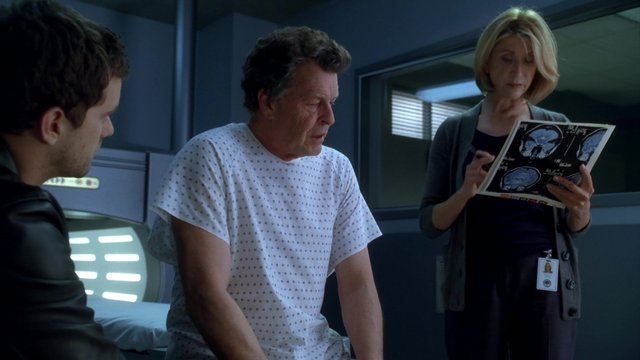
The revelation that follows is nothing short of staggering. The Fringe Division determines that all three patients had undergone brain surgeries to remove objects that were apparently causing their mental conditions. When Walter submits to an MRI scan, the truth becomes undeniable: portions of his own brain are missing—the very sections that had been residing in the three patients' heads. Someone, operating under the guise of Dr. Paris, had surgically extracted parts of Walter's brain and concealed them within other people's skulls for safekeeping. It's a grotesque and brilliant conceit that recontextualises everything we thought we knew about Walter's mental deterioration.
As the episode progresses, we learn the devastating purpose behind this cerebral hide-and-seek. Those excised portions of Walter's brain contained his memories regarding the location of the gateway between our world and the Alternate Universe—the very portal that serves as the series' central MacGuffin. The shapeshifters seize their opportunity when Walter is left unguarded, abducting him and connecting those three preserved brain fragments to his consciousness in a desperate attempt to extract the information.
Olivia and Peter's race against time to locate Walter provides the episode's propulsive final act. They track him to a house that Newton and his operatives have commandeered for their procedure, finding Walter unconscious and vulnerable. Olivia confronts Newton's van, engaging in a firefight that leaves two shapeshifters dead and Newton himself her prisoner. Yet Newton has played his final card: before his capture, he injected Walter with a neurotoxin that will prove fatal without the precise antidote combination. Faced with an impossible choice, Olivia reluctantly releases Newton in exchange for the life-saving information—a decision that speaks volumes about her character and priorities.
Philip Broyles later offers Olivia validation for her choice, reassuring her that letting Newton escape was the right and logical decision given that Walter's life held greater strategic value. It's a cold comfort, but comfort nonetheless, acknowledging the brutal calculus that field operations sometimes demand.
The episode's closing moments deliver one final revelation that rewrites our understanding of the series' history. During another MRI scan, Walter experiences a flashback that exposes the true identity of Dr. Paris: he was William Bell all along. The procedure had been undertaken decades earlier specifically to prevent anyone—Walter included—from accessing dangerous knowledge about the portal's location. It's a masterstroke of retroactive continuity that enriches the relationship between these two scientific giants.
Grey Matters holds particular significance for franchise devotees as the first episode to feature John Noble sharing screen time with Leonard Nimoy. Nimoy's appearances as William Bell were always treated as special events, and critics widely praised the special effects that convincingly de-aged him for sequences depicting his character treating Bishop decades in the past. The technical achievement served the narrative beautifully, bridging the gap between past and present.
Under the direction of Jeannot Szwarc, best known for the science-fiction classic Somewhere in Time, the episode emerged as one of the most critically acclaimed instalments of the entire series. Ashley Edward Miller and Zack Stentz's screenplay garnered particular praise for crafting a mystery that not only resolved satisfactorily but, more importantly, provided crucial context for Walter Bishop's eccentricities. Suddenly, his fragmented mental state wasn't merely tragic—it was deliberate, protective, and deeply tragic in an entirely different way.
The episode also deserves recognition for introducing a genuinely formidable antagonist to challenge the Fringe team. Following the demise of David Robert Jones, Newton arrived as more than a decent replacement—he was an upgrade. Sebastian Roché imbues the character with a calculating menace that makes him genuinely threatening, whilst the character's name pays homage to the alien protagonist of Walter Tevis's 1963 science-fiction novel The Man Who Fell to Earth, immortalised by David Bowie in Nicolas Roeg's 1976 film adaptation.
The episode's genre references extend into horror territory, with nods to H.P. Lovecraft's "The Dunwich Horror" and the films of Stuart Gordon. Yet despite the deceivingly gruesome opening sequence, the episode largely eschews straightforward horror in favour of psychological and science-fiction tension.
If one were to identify a flaw, it might be found in the relative ease with which Olivia dispatches Newton's henchmen, thereby establishing the circumstances for her dramatic final choice. The confrontation feels slightly too convenient, slightly too easily resolved, to carry the full weight the narrative demands.
Even so, this minor quibble does little to diminish the episode's considerable achievements. Grey Matters is a very good instalment of Fringe—arguably the finest the series had produced up to that point. It demonstrated that the show could balance procedural elements with mythology, that it could deepen character relationships whilst advancing plot, and that it could surprise even viewers who thought they had guessed its secrets. For an episode about missing pieces of a brain, it proved remarkably intelligent.
RATING: 8/10 (+++)
Blog in Croatian https://draxblog.com Blog in English https://draxreview.wordpress.com/ InLeo blog https://inleo.io/@drax.leo Substack https://draxster.substack.com
LeoDex: https://leodex.io/?ref=drax InLeo: https://inleo.io/signup?referral=drax.leo Hiveonboard: https://hiveonboard.com?ref=drax 1Inch: https://1inch.exchange/#/r/0x83823d8CCB74F828148258BB4457642124b1328e
BTC donations: 1EWxiMiP6iiG9rger3NuUSd6HByaxQWafG ETH donations: 0xB305F144323b99e6f8b1d66f5D7DE78B498C32A7 BCH donations: qpvxw0jax79lhmvlgcldkzpqanf03r9cjv8y6gtmk9


