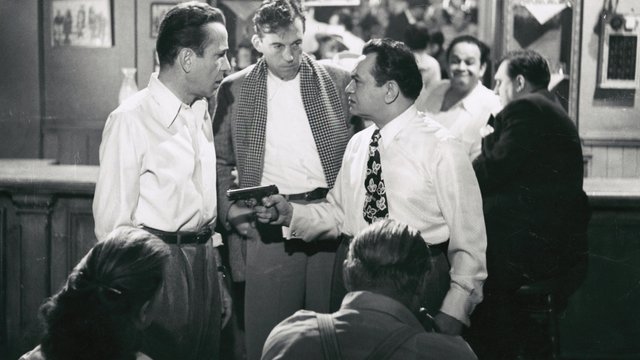
It is almost impossible to say why some films become classics. Old Hollywood gives some sort of answer to this question. The classics made during that golden era are films that are unique products of their time, yet they possess enough universal meaning to be watched and appreciated in all ages. One such great Hollywood classic is Key Largo, the 1948 drama directed by John Huston.
The protagonist of the film is Frank McCloud (played by Humphrey Bogart). He travels through the Florida Keys and stops to visit James (played by Lionel Barrymore) and Nora Temple (played by Lauren Bacall), the father and widow of his friend George, who was killed in Italy during the Second World War. The Temples run a hotel which is supposed to be vacant during the summer, but Frank encounters a few mysterious, menacing guests there. The mystery is revealed when it turns out that their leader is Johnny Rocco (played by Edward G. Robinson), a notorious gangster who has recently been deported from the USA. Rocco has apparently defied the deportation order and the backwater hotel serves as the temporary headquarters for his counterfeit operation. Rocco's thugs take everyone at the hotel hostage in order to secure his safe return to Cuba. But the hurricane, the presence of local Indians and other unexpected events not only foil Rocco's plans, but also force Frank to make some difficult decisions.
Key Largo is often viewed as Humphrey Bogart's film. The Hollywood icon indeed appears on the film's posters and his character is the film's protagonist, but Frank McCloud is not one of Bogart's most impressive roles. His character of a world-weary, disillusioned Second World War veteran is in many ways a variation of his role in Casablanca. Furthermore, Bogart's charisma is easily overshadowed by another impressive Hollywood icon – Edward G. Robinson. The actor, who made a career out of playing gangsters, leaves a formidable impression by playing one of the most despicable characters of Old Hollywood. His Johnny Rocco in this film is not only sadistic, brutal, arrogant and perverse, but also a very alive character – the transformation from a seemingly professional criminal into a monster is marvellous. The scene during which he whispers profanities into the ear of a young, beautiful and virtuous woman (played by Bogart's wife Lauren Bacall) is as revolting today as it was more than half a century ago – Robinson's performance and the audience's imagination work much better than the explicit verbal and physical abuse we could expect in today's films. Robinson delivers another, more delightful, transformation when his all-powerful gangster turns into a pathetic coward whenever things don't go his way.
Another great performance comes from Claire Trevor in the incredibly realistic and moving role of Rocco's alcoholic and emotionally abused girlfriend. That performance, awarded an "Oscar", managed to overshadow even another Hollywood icon – the wheelchair-bound Lionel Barrymore, this time in another role as a patriarchal figure.
The very good acting in Key Largo managed to overcome some of the film's limitations. The script by Richard Brooks and John Huston is based on the stage play by Maxwell Anderson – the storm, just like in many films based on plays, provides a convenient excuse for the entire plot to take place in a limited setting. It also provided Huston with a convenient excuse to shoot the film almost entirely at the studio, thus sparing him from the budget troubles that had plagued his production of The Treasure of the Sierra Madre. At times, the film looks a little bit outdated and too artificial, but viewers, even those conditioned by the magic of early 21st-century film-making, probably wouldn't care that much about those shortcomings – the plot and characters are sufficient to carry Key Largo on their own.
Many details in the plot show that the film, although fictional, was grounded in real life and made by people who, unlike Hollywood film-makers of today, paid attention and cared for what went on in the world around them. Huston made this film under the deep impression of the events he had witnessed before, during and after the Second World War. The Battle of San Pietro, referenced in the film, is the very event Huston captured in his famous 1945 documentary. The Second World War, which is in this film's background, is far from being the "Good War" – a simple and easily understood titanic struggle between forces of Good and Evil after which the world was supposed to be a better place. Frank McCloud doesn't see it that way – once he left the uniform he returned to the very same bleak civilian life that he had left; the country is still plagued by unemployment, corruption and organised crime. That mirrors Huston's frustration – just like McCloud, he served a noble cause only to later see Hollywood being stripped of its best talents because of the new anti-Communist hysteria. Key Largo suggests that this is not the only (and, as current events show, not the last) time that the ideals and hopes of men returning from war have been betrayed – the film mentions the sad tale of the 1935 hurricane that killed hundreds of impoverished First World War veterans while they were building a railroad through the Florida Keys. The only glimmer of hope appears at the very end when a veteran, who is obviously incapable of handling civilian life, gets the opportunity to put some of his wartime skills to good use.
Key Largo also suggests that the problems of 1940s America didn't come out of the blue. Through the cynical McCloud, the film counters the simplistic notion that America, a country built on noble ideals, somehow got corrupted by "foreign" Old World elements embodied in Italian gangsters like Johnny Rocco (modelled on the real-life crime figure Lucky Luciano, just as the character of Rocco's girlfriend was modelled on Luciano's real-life girlfriend). The roots of corruption are much older and could be found in the way the land was forcibly taken away from the Indians.
The best thing about Key Largo is the way that it addresses the future, just as it addresses the past. One of the gangster characters says that Prohibition should be brought back, with crime being more organised, less violent and far from public focus – which is, in some sort of way, what really happened with the illegal narcotics trade in post-1940s America. The most memorable line in Key Largo belongs to Rocco when he describes Florida politics. It is difficult to imagine a movie quote more used in the months following the 2000 US presidential election.
Key Largo gives a glimpse of the past, addresses issues that are relevant and does all that in an entertaining and effective manner. Because of that, it more than deserves its status as an Old Hollywood classic.
RATING: 8/10 (+++)
(Note: The text in its original form was posted in Usenet newsgroup rec.arts.films.reviews on May 17th 2004)
Blog in Croatian https://draxblog.com Blog in English https://draxreview.wordpress.com/ Cent profile https://beta.cent.co/@drax Minds profile https://www.minds.com/drax_rp_nc Uptrennd profile https://www.uptrennd.com/user/MTYzNA
Rising Star game: https://www.risingstargame.com?referrer=drax
BTC donations: 1EWxiMiP6iiG9rger3NuUSd6HByaxQWafG ETH donations: 0xB305F144323b99e6f8b1d66f5D7DE78B498C32A7



