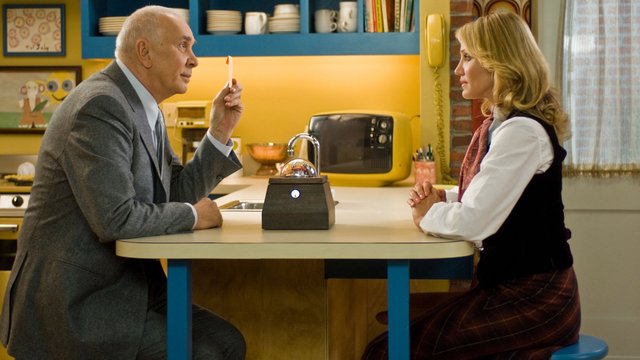
Having a debut feature film reach cult status is indeed a double-edged sword. It brings the glory and the attention, but it inevitably guides viewers of your future work to make direct comparisons and set the high standards that they aren’t likely to be met. This particular fate befell Richard Kelly, the American director whose celebrated 2001 debut, Donnie Darko, remains a touchstone of genre cinema and a cult favourite that continues to spawn analysis and discussion. After achieving such heights, Kelly managed to direct only two further films before his career trajectory began a rather precipitous decline, the last of which was the 2009 period science fiction thriller The Box.
The film is based on Richard Matheson’s 1970 short story “Button, Button,” one of the most celebrated authors of American speculative fiction in the second half of the 20th century. Matheson’s influence is palpable, and the story had already proven itself on screen in 1986 as a pivotal episode of the renewed The Twilight Zone anthology. However, adapting such a concise narrative into a feature-length thriller required significant expansion, and this is where the film begins to struggle. While the pedigree of the source material is undeniable, the jump from a twenty-minute television segment to a two-hour cinematic experience proved to be a challenge that the narrative could not overcome.
The plot is set in Virginia in late December 1976. The protagonists are Norma Lewis (Cameron Diaz), a literature teacher at a local private school, and her husband Arthur (James Marsden), an NASA employee who was indirectly involved in the Mars Viking probe program. They live together with their young son Walter (Sam Oz Stone). The narrative tension begins when a mysterious box with a button is delivered to the Lewis’ home, shortly after a man named Arlington Steward is mentioned in an internal CIA memo. Steward (Frank Langella), whose face is disfigured because of severe burns, visits Norma and gives her a simple proposal: if she agrees to push the button, a random person will die, but the Lewises will be given $1 million. Norma, who has her own disfigured foot from childhood and faces the financial burden of rising school tuition for Walter, ultimately decides to push the button. Yet, Arthur is very unhappy about it and tries to discover who Steward is and for whom he works. What unfolds is a complex web of intrigue that reveals Steward is part of a larger conspiracy involving the CIA, the NSA, and NASA. The stakes escalate further when it is revealed that aliens are using human “vessels” to conduct experiments, seeking to determine whether the human race is worth saving or if it is to be exterminated.
Richard Kelly also wrote the screenplay, drawing personal inspiration from his own father’s life; like Arthur, his father worked for NASA and took part in the Mars Viking program. Because of this, the period is set in late 1976, and, much like he did with Donnie Darko and the late 1980s, great effort was made to provide a proper period “feel” through music, costumes, and props. The decision to use snow as a visual motif was intended to make this film look visually distinct from Donnie Darko, shifting the atmospheric focus from the nostalgic 80s to a colder, more sterile 70s landscape.
Technically, the film is made in an old-school technique, relying on a conventional but atmospheric soundtrack and long, well-composed shots that relatively well establish an atmosphere of dread and conspiratorial paranoia. The performances are generally strong, with Cameron Diaz and James Marsden delivering competent work as the couple, and Frank Langella always providing a reliable gravitational pull as the enigmatic Arlington Steward.
However, at the end of the day, the great effort, which also included good performances, didn’t produce anything more than merely solid film. The problem lies in the relatively short and simple literary source, which wasn’t exactly suitable for a feature film. Consequently, much of the added subplots—such as the extended investigation by Arthur and the introduction of various neighbours—often looked like padding rather than substantive storytelling. The actual explanation of the conspiracy becomes increasingly complicated, and the ending, despite a powerful twist, looks a little bit rushed. It attempts to resolve a mythology that was never fully established within the runtime, leaving the audience with more questions than answers.
The Box is a solid film, but the vast majority of critics disagreed with this assessment. They panned it, and in many ways, this critical backlash torpedoed much of Kelly’s career. The film serves shows the burden of expectation, proving that while a cult classic can launch a career, it can just as easily sink it if the follow-up fails to reach the same creative peak.
RATING: 6/10 (+++)
==
Blog in Croatian https://draxblog.com Blog in English https://draxreview.wordpress.com/ InLeo blog https://inleo.io/@drax.leo Substack https://draxster.substack.com/
InLeo: https://inleo.io/signup?referral=drax.leo Leodex: https://leodex.io/?ref=drax Hiveonboard: https://hiveonboard.com?ref=drax Rising Star game: https://www.risingstargame.com?referrer=drax 1Inch: https://1inch.exchange/#/r/0x83823d8CCB74F828148258BB4457642124b1328e
BTC donations: 1EWxiMiP6iiG9rger3NuUSd6HByaxQWafG ETH donations: 0xB305F144323b99e6f8b1d66f5D7DE78B498C32A7 BCH donations: qpvxw0jax79lhmvlgcldkzpqanf03r9cjv8y6gtmk9


