Masks (S70E17)
Airdate: 21 February 1994
Written by: Joe Menosky Directed by: Robert Wiemer
Running Time: 46 minutes
Star Trek: The Next Generation produced some of the greatest pieces of science fiction television in the history of the medium, delivering iconic explorations of humanity, ethics, and the unknown. However, even the most illustrious franchises are not immune to producing stinkers, and TNG was certainly no exception to this rule. The presence of such duds in the series' penultimate season can be largely explained by the sheer exhaustion that comes with a seven-year run. By the time Season 7 rolled around, the cast and crew were often depleted of their creative energies, perhaps conserving their remaining strength for the grand finale and the subsequent cinematic adventures that would follow. At least, this is a charitable explanation used to analyse Masks, an episode that is frequently cited by hardcore Star Trek fandom as one of the worst instalments in the franchise's history.
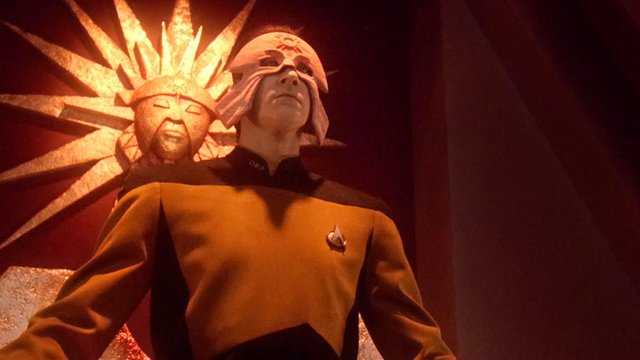
The narrative premise of the episode begins with a relatively charming scene featuring Data attending an art class, where he is supervised by Deanna Troi as he attempts to sculpt and hone his artistic abilities. This humanising moment is abruptly interrupted when the crew's attention is drawn to the arrival of a massive, rogue comet hurtling through space. This celestial body has been travelling the cosmos for an astonishing 87 million years. As the Enterprise probes the comet, they discover that it is of artificial origin and contains what appears to be a colossal library of data and artefacts from a long-lost civilisation. However, the retrieval of this knowledge comes with a dire price. The attempts of the crew to decode the data result in computer viruses from the comet infecting the Enterprise’s systems, taking control of the replicators and attempting to physically remake the ship into a strange alien image.
These bizarre alterations affect Data in the most profound way, as his mind becomes a battleground for different alien personalities, most notably a malevolent entity that warns of a cosmic predator calling itself "Masaka." When attempts by the crew to destroy the alien Archive fail, Captain Picard makes the bold decision to communicate directly with it. The story culminates in a bizarre, ritualistic drama where a significant portion of the Enterprise is transformed into a temple, and Data assumes the identity of Masaka. Picard, realising that Masaka is waiting for someone named "Korgano" to challenge it, steps up to perform the ritual and take on that identity himself. As ritual ends, "Masaka" goes into a slumber, which gives an opportunity for Gordie LaForge to sever the connection with the Archive and return the Enterprise to normalcy.
Although it is not as bad as many of its detractors among Star Trek fandom ascertain – and notably, detractors included almost the entire cast – Masks still represents a huge disappointment and is undoubtedly one of the more forgettable pieces of TNG. It attempts to be epic but falls flat, leaving the viewer with a sense of "what could have been" rather than satisfaction. While the episode has a truly intriguing premise and features high standards of production that TNG had in its final season, especially in terms of special effects, its technical quality simply cannot compensate for failures in execution. The grandeur of the visuals is undermined by a script that lacks cohesion and purpose.
The main problem is a palpable lack of inspiration, a flaw that can be observed immediately in the production design. The alien civilisation, supposedly tens of millions of years old, has artefacts and symbols that look strikingly human and are very much inspired by Ancient Egypt. There is no sense of genuine otherworldliness or ancient mystery; it looks as though Egyptians simply went to space 87 million years ago and forgot to evolve. This lazy visual shorthand robs the story of any genuine wonder. However, the more noticable and the most notorious aspect of this episode is, without a doubt, the acting. Almost any cast members delivers their lines with a lack of enthusiasm, as if they are simply going through the motions to get to the end of the week.
Even Brent Spiner, the most dependable actor in the ensemble, fails to make an impact in a role that requires him to inhabit multiple conflicting personalities. Spiner later explained that this struggle was due to the script being delivered in the last minute, and that he had only one day to prepare for the role before shooting started. This rushed preparation forced him to improvise and channel his earlier incarnations of Data, specifically the emotionless, manipulative android known as Lore, rather than the dignified Commander Data we know. The result is a disjointed performance that highlights the chaotic production environment of the episode, cementing its status as a nostalgic curiosity rather than a high point of the series.
RATING: 4/10 (+)
Blog in Croatian https://draxblog.com Blog in English https://draxreview.wordpress.com/ InLeo blog https://inleo.io/@drax.leo Substack https://draxster.substack.com
LeoDex: https://leodex.io/?ref=drax InLeo: https://inleo.io/signup?referral=drax.leo Hiveonboard: https://hiveonboard.com?ref=drax 1Inch: https://1inch.exchange/#/r/0x83823d8CCB74F828148258BB4457642124b1328e
BTC donations: 1EWxiMiP6iiG9rger3NuUSd6HByaxQWafG ETH donations: 0xB305F144323b99e6f8b1d66f5D7DE78B498C32A7 BCH donations: qpvxw0jax79lhmvlgcldkzpqanf03r9cjv8y6gtmk9


