Johari Window (S02E12)
Airdate: 14 January 2010
Written by: Josh Singer Directed by: Joe Chappelle
Running Time: 44 minutes
When Fringe relocated its production from New York to Vancouver for its second season, the comparisons to The X-Files became rather harder to dodge. There's something about those mist-shrouded Pacific Northwest forests that inevitably calls to mind Mulder and Scully's early adventures, and Johari Window, the twelfth episode of Season Two, practically invites the parallel. In fact, you'd be forgiven for thinking this instalment had been plucked straight from Chris Carter's 1990s playbook, so thoroughly does it embrace that familiar formula of small-town secrets, government experiments gone awry, and grotesque creatures lurking just off the woodland path.
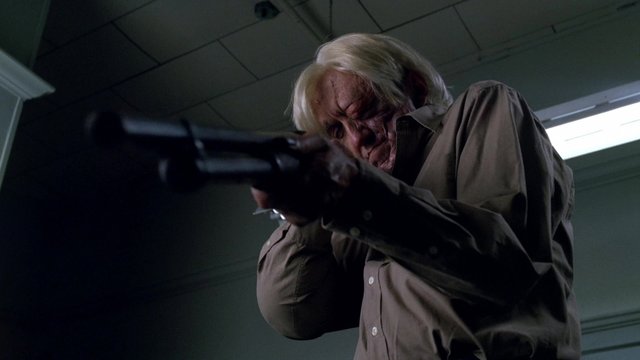
The episode opens with a cold sequence that wastes no time establishing its unsettling atmosphere. We're in what passes for upstate New York—actually the damp, mossy outskirts of Vancouver standing in for the fictional town of Edina. Rain sheets down as a state trooper pulls over a young boy named Teddy (Liam James). The officer means well, offering the boy a lift, but the goodwill curdles into horror mid-journey when Teddy suddenly transforms into something grotesque—a deformed creature that would look at home in a carnival sideshow from decades past. The trooper, understandably shaken, hauls his captive back to the station, where the debate over what to do with this monstrous child is cut brutally short. Two more deformed figures with shotguns burst through the door, and within moments, every officer in the building lies dead.
It's this massacre that brings the Fringe Division to Edina. Before the troopers met their end, they'd dispatched Teddy's photograph to criminal databases, and combined with scattered reports of "deformed people" spotted in the vicinity, that's more than enough to warrant federal attention. Olivia, Peter and Walter arrive to find Sheriff Paul Velchik (Michael O'Neill) waiting to greet them. When Olivia notices a peculiar humming sound permeating the air, Velchik offers a convenient explanation: it's merely noise from the nearby military installation, nothing to worry about. The trio accepts this at face value, at least initially, but their departure from Edina takes a violent turn. Another vehicle forces their SUV off the road, leaving Olivia and Walter knocked unconscious. Only Peter remains awake to confront the assailant, who advances with a shotgun. Grabbing Olivia's weapon, Peter fires back, mortally wounding the attacker—though when the body is later recovered, it appears perfectly ordinary.
Back in Boston, Broyles fills them in on the area's classified history. During the late 1970s, the US Army ran experiments at that nearby base under the ominous codename "Project Elephant." Meanwhile, Walter—ever the magpie for natural curiosities—produces a butterfly he collected during their Edina visit, convinced Astrid will appreciate its beauty. Yet when he presents his prize in the laboratory, the illusion shatters: the magnificent butterfly reveals itself as nothing more than a common moth. The mystery deepens when the shooter's corpse, previously unremarkable in appearance, suddenly manifests the same deformities witnessed in Edina.
These clues trigger Walter's memory of an old acquaintance, Dr. Edward Cobb, a researcher connected to Project Elephant. The initiative's original purpose, it transpires, was developing an electromagnetic pulse capable of camouflaging soldiers in the field—essentially rendering them invisible to the naked eye. Tragically, the local civilian population became unwitting test subjects for this technology. Though the army abandoned the project decades ago, the consequences lingered: residents developed a genetic condition causing severe physical deformities. Working with Astrid, Walter deduces that the electromagnetic pulse remains active to this day. It explains the persistent humming Olivia detected, but more remarkably, it functions as a collective hallucination—making Edina's disfigured citizens appear normal to outside observers.
Peter and Olivia return to investigate further, only to walk into a trap. Sheriff Velchik and his deputy ambush them, determined to eliminate these federal agents and preserve their town's terrible secret at any cost. A firefight ensues, with both lawmen falling before the agents' guns. They're aided by Rose Falls (Laura Mennell)—the widow of the man Peter shot earlier and mother to young Teddy. With the violence concluded, Rose explains the truth: Dr. Cobb, her father, tormented by the deformities Project Elephant had inflicted upon the community, chose to remain in Edina and devise a solution. He created an electromagnetic illusion that allows the townspeople to perceive themselves and each other as ordinary human beings. The catch, of course, is that they must remain within the pulse's boundaries; venture beyond, and their true appearance becomes visible to the outside world.
The episode concludes with Walter making an uncharacteristically emotional appeal to Broyles. He argues that the people of Edina deserve to maintain their fragile semblance of normalcy, particularly since those responsible for murdering the state troopers have already faced justice. Broyles, in a rare display of compassion that overrides his usual bureaucratic rigidity, reluctantly agrees to bury the affair.
Josh Singer's script, for all its emotional resonance, rests upon a premise that hasn't aged particularly gracefully. His vision of future warfare relying on frontline soldiers using their own eyes rather than satellite feeds or drone cameras feels almost charmingly antiquated in an era of ubiquitous remote surveillance. Equally problematic is the notion of an entire town maintaining total self-isolation for decades without the script bothering to address the practicalities. How exactly did thousands of Edina residents manage to sever contact with former friends, relatives, classmates and colleagues who lived just beyond the machine's reach? The episode simply shrugs at this question, hoping we won't notice the gaping plot hole.
Yet if one can accept these foundational contrivances, Singer's script treats its premise with admirable internal logic. The townspeople's desperation to preserve their normalcy—even at the cost of permanent isolation—rings true, and their moral compromises feel tragically understandable rather than merely monstrous. What could have been mere monster-of-the-week fodder becomes something genuinely poignant, particularly bolstered by Broyles' unexpectedly humane decision in the final moments. It's altruism we rarely see from him, and it lends the conclusion genuine emotional weight.
The episode also wears its influences proudly, peppering the narrative with pop culture nods that attentive viewers will savour. There are mentions and refetences of Deliverance, The Wizard of Oz in the journey to uncover hidden truths, and most obviously, The Elephant Man in the visual design of Edina's afflicted citizens.
Contemporary critics weren't particularly kind to Johari Window, dismissing it as standard procedural fare. Yet John Noble—who surely knows Walter Bishop better than anyone—has frequently cited it among his favourite episodes, and it's not difficult to understand why. The instalment gives him moments of genuine pathos, scientific curiosity, and quiet moral authority, often within the same scene.
Ultimately, Johari Window represents solid mystery-of-the-week filler—competently constructed, emotionally affecting, and perfectly serviceable without ever threatening to become truly exceptional. It won't reshape your understanding of the series' mythology, nor does it aim to. Instead, it offers a self-contained tragedy that reminds us why Fringe could be so effective when operating in this particular mode: taking an outlandish concept and grounding it in recognisably human desperation.
RATING: 6/10 (++)
Blog in Croatian https://draxblog.com Blog in English https://draxreview.wordpress.com/ InLeo blog https://inleo.io/@drax.leo Substack https://draxster.substack.com
LeoDex: https://leodex.io/?ref=drax InLeo: https://inleo.io/signup?referral=drax.leo Hiveonboard: https://hiveonboard.com?ref=drax 1Inch: https://1inch.exchange/#/r/0x83823d8CCB74F828148258BB4457642124b1328e
BTC donations: 1EWxiMiP6iiG9rger3NuUSd6HByaxQWafG ETH donations: 0xB305F144323b99e6f8b1d66f5D7DE78B498C32A7 BCH donations: qpvxw0jax79lhmvlgcldkzpqanf03r9cjv8y6gtmk9


