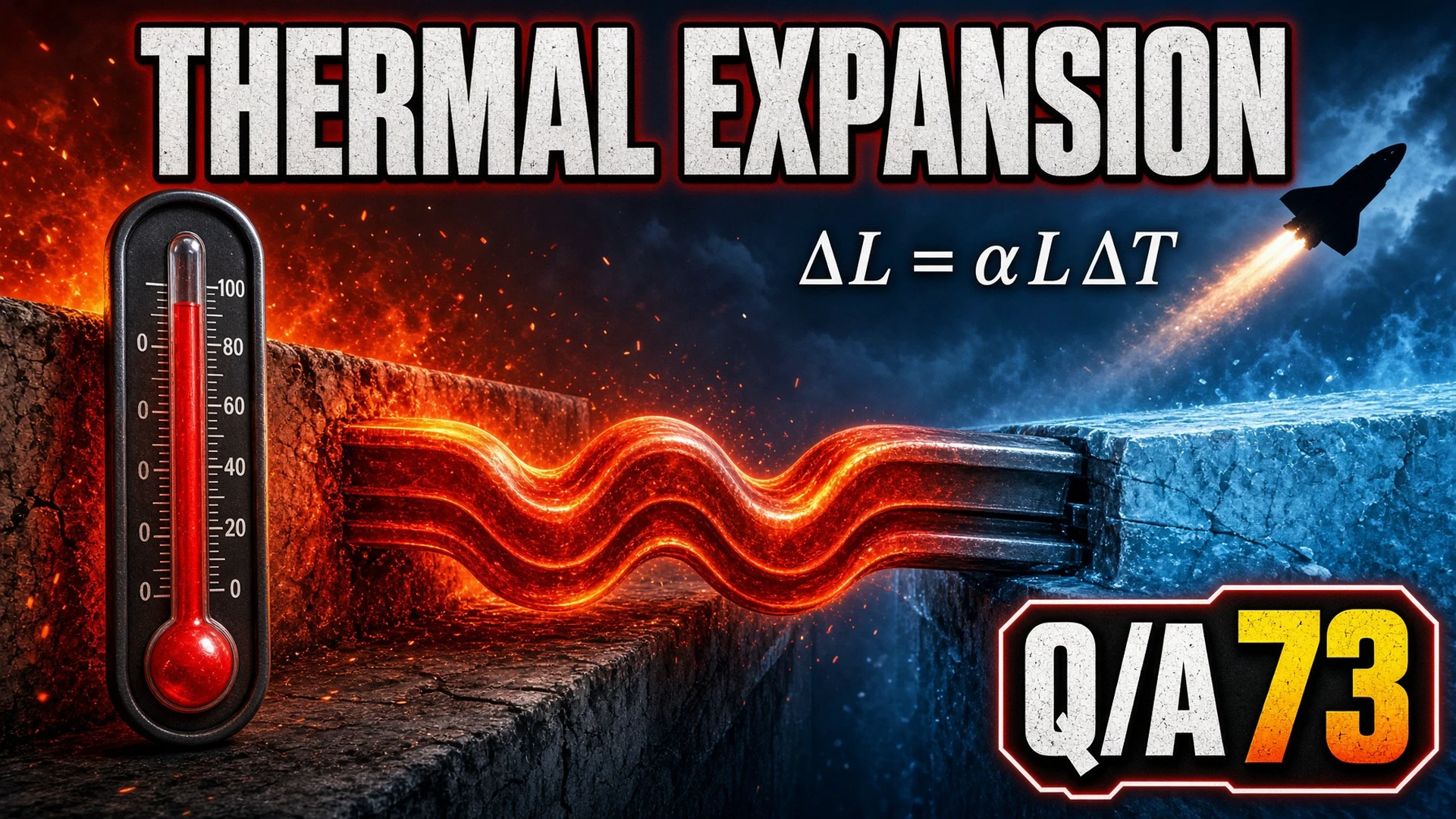
In this video, I review the Mechanics of Materials needed to solve Problem 1 of the EM 304 test that Dr. Judy Wood gave her students on February 6, 2003, five days after the Space Shuttle Columbia disaster. I cover strain and thermal expansion, the 2014-T6 aluminum alloy used in the aerospace industry, and the elastic constants: Young's modulus (stress and the stress-strain curve), the shear modulus (shear stress and shear strain), and Poisson's ratio. At the end, I show the free MES Mechanics of Materials calculator at mes.fm/materials, try it out yourself!
Watch on: Notes · YouTube · Rumble · Odysee · BitChute · Telegram
Timestamps:
- 0:00 Review of Mechanics of Materials
- 0:19 Strain and thermal expansion
- 0:52 Strain is relative deformation compared to a referenced position
- 1:58 Thermal expansion is the tendency of matter to increase in size with increasing temperature
- 4:15 2014-T6 aluminum alloy is often used in the aerospace industry
- 5:28 T6 temper involves solution heat-treating and artificially aging until the metal meets standard mech
- 7:44 Elastic constants
- 8:57 Young's modulus is the axial stress divided by the axial strain
- 9:23 Stress describes the forces present during deformation of materials
- 10:44 Typical stress-strain curve for a material under axial stress
- 12:31 Shear modulus is the shear stress divided by the shear strain
- 13:59 Shear stress is the shear force coplanar with a material cross section divided by that cross section area
- 15:55 Poisson's ratio is the lateral or transverse strain divided by the axial strain (a negative sign is included so the ratio is positive)
- 20:11 MES Mechanics of Materials calculator – https://mes.fm/materials

Notes and playlists:
- Full video: https://mes.fm/space-shuttle-columbia
- Playlist: https://www.youtube.com/playlist?list=PLEJOImrX4SIc
- https://mes.fm/math