Longform reviews of films, TV, anime, books, and audiobooks, written by the scrobble.life community and published to the Hive blockchain, so each one is owned by its author and can earn rewards from readers. 60,077 reviews and counting.
Written by: Christopher Kyle
Directed by: Leslie Liebman & Larry Williams
Running Time: 46 minutes
The Homicide: Life on the Street episode Closet Cases, first broadcast in 1998, has not aged well, revealing the limitations of its ambitious but ultimately shallow approach to representation of homosexuality. While late 1990s television produced groundbreaking content that pushed boundaries, many such works now feel dated, relying on the novelty of their subjects rather than genuine depth. Closet Cases epitomises this: its central plot hinges on homosexuality, a topic barely acknowledged on mainstream American TV until short time ago, but its execution leans heavily on clichés and moralising, using the “heart in the right place” as a crutch to overlook structural flaws.
The main storyline follows detectives Pembleton and Bayliss investigating the brutal murder of a man discovered dumped in lingerie near a Baltimore restaurant popular among gay community, his face so badly damaged that identification proves challenging. The restaurant’s owner, Chris Rawls (Peter Gallagher), immediately suspects a hate crime, given the victim’s location and the violent nature of the attack. The detectives eventually identify the victim as Alan Costello, whose long-term partner, Sam Farrell (Kirk Penberthy), reveals Alan occasional use of male street hustlers, including Peter Fields (Brian Van Holt), who confesses to the killing after forcing Bayliss to compliment his physique in a cringe-inducing exchange. The subplot involving Bayliss’s sudden romantic interest in Rawls—a decision framed as an exploration of his sexuality—further complicates the narrative. Pembleton’s bafflement at his partner’s abrupt shift, coupled with Bayliss’s own eagerness to “come out” in public, undermines the scene’s sincerity, feeling instead like a gimmick to shock audiences. The episode’s climax, in which Bayliss dates Rawls, is handled with awkward haste, underscoring the show’s struggle to balance progressive themes with realistic character development.
The supporting storylines, typical of Homicide’s multi-plot structure, falter here. Falsone’s ongoing custody battle with his ex-wife, Janine (Monica Trombetta), plays out in a tired, melodramatic manner, recycling clichés about single fathers and marital strife. This subplot, part of an extended arc, lacks the nuance or emotional weight that defined the series’ earlier seasons, instead opting for predictable theatrics. Meanwhile, the continuation of the Luther Mahoney saga—already overextended—descends into soap opera tropes. Kellerman’s reluctant confession to Steevers about a non-existent incriminating tape, followed by Georgina Rae’s manipulative “twist” wherein she admitting fabricating the tape’s existence to test Kellerman’s guilt over her brother’s death, feels contrived. The resolution, in which Georgina declares her intent to seek revenge, adds little beyond gratuitous drama, distancing the episode from the grounded realism that once made Homicide stand out. These subplots, once strengths of the series, here feel forced and disconnected, bogged down by unnecessary complexity.
The episode’s treatment of gay themes, while progressive by 1990s standards, now reads as superficial and clichéd. Bayliss’s sudden interest in exploring his sexuality—a bold move for a network TV protagonist at the time—feels more like a ratings stunt than a meaningful character arc. His eagerness to announce his newfound openness to Pembleton, combined with the episode’s reliance on stereotypes—drag queens, gym-obsessed men, and the killer’s contradictory homophobia despite selling sex to men—reinforces outdated tropes. The Baltimore gay community is reduced to a series of shorthand signifiers, lacking the depth or humanity that the show applied to other marginalised groups. The killer’s motivation, rooted in internalised prejudice, is underdeveloped, serving only to sensationalise rather than illuminate. What was once groundbreaking now feels like a missed opportunity, prioritising shock value over substance.
A curious anachronism emerges in the cameo of Joe Grifasi as Lt. Neal, a character from the short-live Homicide: Second Shift web series. Launched in 1997 as a photonovel—a text-and-image format limited by its time’s technology—the web spinoff is a relic of internet infancy, and Neal’s appearance here serves no narrative purpose beyond a vague nod to continuity. Similarly, the mention of conservative US Senator Jesse Helms—a figure controversial for his staunch opposition to homosexuality—feels like a dated cultural reference, inserted to score cheap points rather than engage meaningfully with the episode’s themes.
The subplots, while typical of Homicide’s layered storytelling, here drag the episode into melodrama. Falsone’s custody drama, though acted competently, is bogged down by repetitive conflict and underdeveloped emotional stakes, while the Mahoney saga’s “twist” feels like a cheap ploy to extend a storyline that should have been resolved. The nighttime conference between detectives about Luther Mahoney’s death lacks the tension or moral ambiguity that defined earlier episodes, instead leaning into histrionics. The series’ earlier strengths—its unflinching realism, moral complexity, and nuanced characterisation—feel diluted here, replaced by tired clichés and rushed resolutions.
Ultimately, Closet Cases is a product of its time, both constrained and defined by the narrow boundaries of late-1990s TV. While its attempt to tackle gay issues with sensitivity was once notable, its execution is hampered by a reliance on stereotypes and a narrative that prioritises shock over substance. For all its ambition, the episode underscores how even well-meaning attempts at progress can falter when hampered by structural laziness and a failure to engage deeply with its subject matter.
Hello, dear friends, lovers of good cinema, it's been a long time since I last wrote a review. I've been away from the world of cinema for various reasons, and I'm back with a post following the recent death of the great actor Michael Madsen, whose true motives are barely known. Because of this, I rewatched Reservoir Dogs, the debut film by the great Quentin Tarantino, released in 1992. This film would dazzle for many reasons, one of them being the violence it handles and the charismatic character Mister Blonde (Michael Madsen). I'll briefly comment on my thoughts, references to the main characters, and finally, I'll focus on Mr Blonde.
Hola queridos amigos amantes del buen cine, hace mucho tiempo que no hago una reseña, y es que estuve muy alejado del séptimo arte por varias razones, y vuelvo con una publicación motivo del reciente fallecimiento del gran actor Michael Madsen, quien apenas se conocen los verdaderos motivos. Debido a esto volví a ver Reservoir Dogs, ópera prima del Gran Quentin Tarantino, estrenada en el año 1992, película que deslumbraría por muchas razones, una de ellas, la violencia manejada y un personaje carismático como Mister Blonde (Michael Madsen). Comentaré brevemente mis apreciaciones, referencias a los personajes principales y al final me centraré en Mr Blonde.
"Reservoir Dogs" (1992) isn't just a film; it's a statement of intent. From its opening minutes, with the iconic line about "Like a Virgin" and tips, Tarantino immerses us in a universe of incisive dialogue, graphic violence, and a nonlinear narrative structure that would become his trademark (everyday dialogue). More than a heist film, "Reservoir Dogs" is a study of character, loyalty, and the inevitable spiral of paranoia when things literally go to shit.
"Reservoir Dogs" (1992) no es solo una película; es una declaración de intenciones. Desde sus primeros minutos, con el icónico diálogo sobre "Like a Virgin" y las propinas, Tarantino nos sumerge en un universo de diálogos incisivos, violencia gráfica y una estructura narrativa no lineal que se convertiría en su sello distintivo (diálogos cotidianos). Más que una película de atracos, "Reservoir Dogs" es un estudio de personajes, la lealtad y la inevitable espiral de paranoia cuando las cosas Literalmente se van a la mierda.
The plot is deceptively simple: a group of professional criminals, who don't know each other and use colorful aliases (Mr. White, Mr. Orange, Mr. Blonde, Mr. Pink, Mr. Brown, and Mr. Blue), reunite after a jewelry store robbery gone horribly wrong. The police were expecting them, and it's clear there's a snitch among them. Most of the film takes place in an abandoned warehouse, where tension builds as they try to uncover who betrayed them, while trust crumbles and violence erupts at the hands of one of them, for whom there are moments that are worth the cruel fun even though the rest have lost their sanity.
La trama es engañosamente sencilla: un grupo de criminales profesionales, que no se conocen entre sí y usan alias de colores (Mr. White, Mr. Orange, Mr. Blonde, Mr. Pink, Mr. Brown y Mr. Blue), se reúne después de un atraco a una joyería que ha salido horriblemente mal. La policía los esperaba, y es evidente que hay un soplón entre ellos. La mayor parte de la película transcurre en un almacén abandonado, donde la tensión se acumula a medida que intentan descubrir quién los traicionó, mientras la confianza se desmorona y la violencia estalla de la mano de uno de ellos, para quien hay momentos que merecen la pena divertirse cruelmente aunque el resto haya perdido la cordura.
Joe Cabot, played by Lawrence Tierney, serves as the brains of the operation and the patriarch of the group. Joe is the ultimate representation of the old-school mob boss: authoritarian, blunt, and very ruthless. His presence commands respect and fear; his orders are always obeyed to the letter. Although his screen time is arguably limited, his influence is felt in every decision and in the power structure within the group. He represents the strict father figure who organizes everything, and his death is the point of no return for the final dissolution of the team.
Joe Cabot protagonizado por Lawrence Tierney, es quien funge como el cerebro de la operación y el patriarca del grupo. Joe es el mejor representante del jefe de la mafia de la vieja escuela: autoritario, sin rodeos y muy despiadado. Su presencia impone respeto y temor, siempre es seguro que sus órdenes sean obedecidas al pie de la letra, aunque su tiempo en pantalla podría decirse que es limitado, su influencia se siente en cada decisión y en la estructura de poder dentro del grupo. Representa la figura del padre estricto que lo organiza todo, y su muerte es el punto de no retorno para la disolución final del equipo.
Mr. White is played by Harvey Keitel, also known as Larry Dimmick. Mr. White is the emotional "father" of the group, a highly experienced criminal with a particular code of honor. You could say he's the only one, or at least the one with the least moral compass. He's the most level-headed and the one who tries to mediate, but he's also prone to violence when he feels betrayed. His relationship with Mr. Orange is the emotional heart of the film; White's loyalty is a central theme; although he's a criminal, he has a sense of personal justice and takes betrayal as a matter of honor. His performance anchors the film, conveying a mix of toughness and vulnerability.
Mr. White es interpretado por Harvey Keitel, También conocido como Larry Dimmick. Mr. White es el "padre" del grupo en un sentido emocional, un criminal muy experimentado y con un código de honor particular, podría decirse que es el único, o al menos quien tiene un poco menos la moral extraviada. Es el más sensato y el que intenta mediar, pero también es propenso a la violencia cuando se siente traicionado. Su relación con Mr. Orange es el corazón emocional de la película, la lealtad de White es un tema central; aunque es un criminal, tiene un sentido de la justicia personal y se toma la traición como un asunto de honor. Su actuación es un ancla para la película, transmitiendo una mezcla de dureza y vulnerabilidad.
Mr. Pink, played by the irreverent Steve Buscemi, is the criminal of the entire team with the most pragmatic instincts, the one most concerned with the logic of the heist and the escape, and the only one who seems to truly understand what went wrong. Mr. Pink is a first-class complainer, cynical and often cowardly, but his survival instinct is the strongest. He's famous for his monologue about why he doesn't tip and for being the only one who, theoretically, manages to escape in the end. His personality reminds me a lot of that of the rats!
Mr. Pink es personificado por el irreverente Steve Buscemi, es el criminal de todo el equipo que posee un instinto pragmático, el que más se preocupa por la lógica del atraco y el escape, y el único que parece entender realmente lo que salió mal. Mr. Pink es un quejón de primer nivel, cínico y, a menudo, cobarde, pero su instinto de supervivencia es el más fuerte. Es famoso por su monólogo sobre por qué no da propinas y por ser el único que, teóricamente, logra escapar al final. Su personalidad me recuerda mucho al de las ratas!
Mr. Orange Tim Roth (Lie to Me) Also known as Freddy Newendyke, Mr. Orange is the undercover cop, the snitch everyone is looking for. He is the most tragic character in the film, caught between his duty and the loyalty he surprisingly develops towards Mr. White. His agony throughout the film, both physical and emotional, is palpable. The scene of his training for the mission is a brilliant example of how Tarantino builds character and suspense. He is the center of betrayal and, therefore, the catalyst for all the tension and violence. His internal struggle and eventual revelation are the emotional climax of the entire film.
Mr. Orange Tim Roth (Lie to Me) También conocido como Freddy Newendyke es el policía encubierto, el soplón que todos buscan, Mr. Orange es el personaje más trágico de la película, atrapado entre su deber y la lealtad que de forma sorprendente desarrolla hacia Mr. White. Su agonía a lo largo de la película, tanto física como emocional, es palpable. La escena de su entrenamiento para la misión es un brillante ejemplo de cómo Tarantino construye el personaje y el suspense. Es el centro de la traición y, por lo tanto, el catalizador de toda la tensión y la violencia. Su lucha interna y su eventual revelación son el punto culminante emocional de toda la película.
If there's one character who embodies the essence of the disturbing randomness and passionless brutality in "Reservoir Dogs," it's undoubtedly Mr. Blonde, whose real name is Vic Vega (an important detail, since he's the brother of Vincent Vega from "Pulp Fiction"). The recently deceased Michael Madsen gives a performance that has become iconic, and for very good reason. From the moment we meet him, Mr. Blonde exudes a disturbing calm. While the other characters are frantic, wounded, or panicking, Blonde is a cold and enigmatic figure. His presence on screen is magnetic, not because of his abundant dialogue, but because of his aura of a character full of unpredictable shifts. He speaks little, but when he does, his words carry weight, often with either threatening intent or total disinterest in the situation. This attitude reminds me a lot of that of the Nazi war criminal Adolf Eichmann.
Si hay un personaje que encarna la esencia de la inquietante lo aleatorio y la brutalidad sin pasión en "Reservoir Dogs", ese es sin duda Mr. Blonde, cuyo nombre real es Vic Vega (un detalle importante, ya que es el hermano de Vincent Vega de "Pulp Fiction"). Michael Madsen, recientemente fallecido, ofrece una interpretación que se ha convertido en icónica, y por muy buenas razones. Desde el momento en que lo conocemos, Mr. Blonde exuda una calma perturbadora, mientras los otros personajes están frenéticos, heridos o en pánico, Blonde es una figura fría y enigmática. Su presencia en la pantalla es magnética, no por su diálogo abundante, sino por su aura de personaje lleno de cambios que son imprevisibles, habla poco, pero cuando lo hace, sus palabras tienen peso, a menudo con una intención amenazante o de desinterés total por la situación. Esta actitud me recuerda mucho a la del criminal de guerra nazi Adolf Eichmann.
Mr. Blonde's calmness is not that of a man in control of his emotions, but rather that of one who lacks them entirely. He is a pure psychopath in every sense, without remorse, empathy, or a discernible moral code beyond his own sadistic satisfaction. His personality contrasts sharply with Mr. White, who, by contrast, has a marked sense of loyalty, or Mr. Pink, who is driven by greed. Mr. Blonde seems to act out of pure pleasure in the destruction and pain of others.
La calma de Mr. Blonde no es la de un hombre que controla sus emociones, sino la de uno que carece de ellas por completo. Es un psicópata puro en toda la expresión, sin remordimientos, empatía o un código moral discernible más allá de su propia satisfacción sádica. Su personalidad contrasta mucho con Mr. White, que con marcada diferencia tiene un sentido de la lealtad, o Mr. Pink, que es impulsado por la avaricia, Mr. Blonde parece actuar por puro placer en la destrucción y el dolor ajeno.
The defining moment that elevates him to legendary status in cinematic history is, of course, the policeman's torture scene. While Mr. White, with his scruples, has gone to seek medical help, Mr. Blonde is left alone with the tied-up policeman, with a chilling smile and to the strains of Stealers Wheel's "Stuck in the Middle with You," calmly dancing as he cuts off the officer's ear. The brutality lies not only in the act itself, but in the casualness with which he executes it, as if he were performing a very everyday task. There is no anger, no passion; only a cold, calculated torture that entertains him. This scene is a landmark in Tarantino's cinema, not only for its graphic violence, but for the way it reveals the psyche of a character who enjoys inflicting pain.
El momento que lo define y que lo eleva a un estatus legendario en la historia del cine es, por supuesto, la escena de la tortura del policía. Mientras Mr. White, con sus escrúpulos, se ha ido a buscar ayuda médica, Mr. Blonde se queda solo con el policía atado, con una sonrisa escalofriante y al ritmo de "Stuck in the Middle with You" de Stealers Wheel, baila tranquilamente mientras corta la oreja del oficial. La brutalidad no reside solo en el acto en sí, sino en la casualidad con la que lo ejecuta, como si estuviera realizando una tarea muy cotidiana. No hay ira, no hay pasión; solo una fría y calculada tortura que lo entretiene, esta escena es un hito en el cine de Tarantino, no solo por su violencia gráfica, sino por la forma en que revela la psique de un personaje que disfruta infligiendo dolor.
With the recent passing of actor Michael Madsen, I also remember the passing of Val Kilmer and Ray Liotta, top-tier actors the likes of which are rarely seen today. So, revisiting these carefully crafted, low-budget productions relives the cinematic genius that has been so lost today. "Reservoir Dogs" is undoubtedly a film that demands repeated viewing and analysis. Its well-structured narrative, polished dialogue, and character development make it a fundamental piece of independent cinema and a pillar in Quentin Tarantino's filmography. It's a work that, despite its simple premise, beautifully explores moral and psychological complexities, leaving us as viewers pondering. The tension, violence, and characters—especially the unsettling presence of Mr. Blonde—remain etched in the memory, cementing it as an undisputed classic.
Con el reciente fallecimiento del actor Michael Madsen, también recuerdo que partieron de este mundo Val Kilmer y Ray Liotta, actores de primer nivel como ya no se ven ahora, por lo que volver a disfrutar estas producciones realizadas con tanto esmero, bajo presupuesto, nos hace revivir esa genialidad dle cine que se ha perdido tanto en la actualidad. "Reservoir Dogs" es sin duda una película que exige ser vista y analizada repetidamente, su narrativa muye bien fragmentada, sus diálogos pulidos y la construcción de sus personajes la convierten en una pieza fundamental del cine independiente y en un pilar en la filmografía de Quentin Tarantino. Es una obra que, a pesar de su premisa sencilla, explora muy bien complejidades morales y psicológicas, dejandonos a nosotros como espectadores reflexionando mucho. La tensión, la violencia y los personajes, especialmente la inquietante presencia de Mr. Blonde, se quedan grabados en la memoria, consolidándola como un clásico indiscutible.
This anime wasn’t something I planned to watch—I stumbled on it one evening while bored, scrolling through Crunchyroll’s top picks. I knew MAPPA, I knew dark fantasy, but the title Jigokuraku (roughly "Hell's Paradise") sounded intense. A quick trailer showed a man wielding a katana in a nightmare island of flesh and flowers. It felt gutsy and fresh. So I clicked.
And within minutes? I was gripping my seat, heart pounding. That’s when I knew it would be different.
The anime is set in the Edo-period of Japan and chronicles the story of Gabimaru, a ninja who is more or less immortal and is condemned to death. Given a pardon in case he discovers the mythical Elixir of Life on the distant and lethal island, Shinsenkyo, he links up with a group of death-row criminals and their executioners. Together with Sagiri, a master swordsman assigned to watch over him, Gabimaru plunges into an island inhabited by vengeful souls, monstrous beings known as Tensen and savage survival challenges.
A quest of freedom evolves into a journey of self-discovery and survival when they encounter the perils that challenge their flesh--and their souls.
The raw, emotional core is what drew me in. Gabimaru is no anonymous hero. He is close to immortal and hides behind a mask of emptiness. He did not run away to die in order to be glorified, but he runs away so that he can see his wife. It was that yearning that made the story have its emotional tone.
Sagiri is more than a sidekick, she is highly motivated, conflicted, and very powerful. The relationship between them is covered with unspoken guilt, admiration, and something more.
One minute I was sitting with trembling legs when Gabimaru was fighting demons. The following time I choked over their silent, ghostly glances.
The animation by MAPPA is simultaneously beautiful, with floral explosions in lush forests, gore and monstrosity reminding people of Berserk.
Yes, there are some fans of Reddit who mentioned that at times the quality of animation will dip, but a great majority said that the fight scenes are strong and beautiful.
The color schemes and the atmosphere were a punch in the face even through the imperfect frames. Nature looked alive but hostile, paradise became sinister.
As I was watching I experienced Tension, I was holding my breath through every nightfall, every monster attack, every tense group scene.
I was also touched, even though they committed crimes, I was concerned about Gabimaru and Sagiri. Their suffering, remorse, their will struck me on the chest.
I just could not live out the fact that I Wonder- it surprised me when I saw a ninja use Tao (alchemical/spiritual power). Fights were poetry in motion.
Drained by observing how mutilated souls struggle to recover their human nature. Filled because they had struggled and that struggle was not in vain- they wished to believe in hell.
The line that Gabimaru says at the end, which is, I will live to see her once more, is not mere plot. It’s human.
The transformation that Sagiri went through as a law-enforcement executioner to the person who comprehended the value of life was a reflection of a personal reality: empathy is the sharpest knife to handle.
After watching this show, I could ask myself: What would happen to me, the one who was killed, and then given a second opportunity? Was I going to do battle with my demons; literal or within?
Hell's Paradise Jigokuraku is one of those dark fantasy gems; the kind of raw, beautiful survival and redemption tale where it takes everything to remain human in a world that is basically shouting hell!
Watch it to see a struggle within Gabimaru and the heart of steel of Sagiri.
If you're looking for an anime with emotional depth, moral complexity, bloody beauty, and moments that slash through your heart and leave it pumping—Jigokuraku is your paradise. Or your hell.
Thumbnail is designed by me on pixelLab and other images are screenshot from the movie
Buscaba una película qué mirar, al azar, y me encontré con la imagen de Tom Hanks, pero la de hace 37 años, o sea, cuando protagonizó una película en 1988.
I was looking for a movie to watch, at random, and I came across the image of Tom Hanks, but the one from 37 years ago, that is, when he starred in a movie in 1988.
Para entonces, yo tenía 6 años, y Tom Hanks, pues ya era Tom Hanks. Me he dado cuenta de que sufre en muchos de sus papeles, y sonará raro, pero le queda bien, lo interpreta bien, al final es feliz, pero a qué costo.
En Quisiera ser grande o Deseo cumplido según la traducción para Big, interpreta a un adolescente que pide un deseo: ser adulto, y así se despierta una mañana. He resumido algunos minutos de película porque quiero llegar a un detalle que me pareció peculiar.
By then, I was 6 years old, and Tom Hanks, well, he was already Tom Hanks. I've noticed that he suffers in many of his roles, and it may sound strange, but it fits him well, he plays it well, he's happy in the end, but at what cost.
In I Wish I Was Big or Wish Fulfilled as translated for Big, he plays a teenager who makes a wish: to be an adult, and so he wakes up one morning. I have summarized a few minutes of the film because I want to get to a detail that I found peculiar.
Cuando se ve como adulto, aunque sólo físicamente ya que seguía teniendo 13 años; Josh se pregunta qué hará mientras espera respuesta de la ubicación de la máquina que le concedió el deseo para retornar a su cuerpo real, y es allí cuando su mejor amigo (otro adolescente) le dice que busque un empleo, qué puede ser peor que asistir a la escuela.
En esa búsqueda, usan el periódico para leer las vacantes. ¡Ajá! ¿Recuerdan cuando las empresas publicaban la búsqueda de personal en diarios impresos? ¡Qué tiempos! Mi papá asistió a una entrevista así, y consiguió el trabajo, por un llamado que encontró en un clasificado de El Universal.
Josh lee varias vacantes y se decide por el que más le atrae, uno relacionado con computadoras en una empresa de juguetes. Esto me parece un dato interesante. Es un joven en un cuerpo de adulto que desde su inocencia e inexperiencia hace lo que quiere hacer porque no tiene prejuicios y le va bien.
Antes de entrar a la entrevista, llena un formulario con lo que sería su experiencia, algo así como un CV y todo lo inventa, Jajaja el amigo le recuerda que debe mirar a los ojos al entrevistador, y Josh, ya en ésta, así lo hace y sólo confirma lo que le preguntan. Facilito.
Consigue el empleo y en poco tiempo es ascendido porque siempre hizo lo que quería hacer, en este caso, jugar, divertirse, pasarla bien, sin temor al qué dirán, mucho menos a hablar, pues, era una fábrica de juguetes. Vista como niño era el lugar soñado; un lugar al que no miraban igual ninguno de los adultos, adultos que en ella laboraban, entrando en juego la relación entre compañeros de trabajo.
When he sees himself as an adult, although only physically since he was still 13 years old; Josh wonders what he will do while waiting for an answer from the location of the machine that granted him the wish to return to his real body, and that's when his best friend (another teenager) tells him to look for a job, what could be worse than going to school.
In that search, they use the newspaper to read the vacancies. Aha! Remember when companies used to publish their personnel search in printed newspapers? Those were the days! My dad went to an interview like that, and got the job, because of a call he found in a classified in El Universal.
Josh reads several openings and decides on the one that appeals to him the most, one related to computers at a toy company. This strikes me as an interesting tidbit. He is a young man in an adult body who from his innocence and inexperience does what he wants to do because he has no prejudices and does well.
Before entering the interview, he fills out a form with what would be his experience, something like a CV and he makes it all up, hahaha the friend reminds him to look the interviewer in the eye, and Josh, already in this one, does so and only confirms what he is asked. Easy.
He gets the job and in a short time is promoted because he always did what he wanted to do, in this case, play, have fun, have a good time, without fear of what people will say, much less to speak, because it was a toy factory. Seen as a child, it was a dream place; a place that was not looked at as a child.
A pesar de todo, Josh quiere volver.
Ya sé por qué uno añora el pasado; porque es una forma de regresar a ese lugar seguro, por lo general feliz.
Quisiera ser grande puede dejar muchos aprendizajes. Yo la elegí porque quería ver algo relajado, que me diera paz y me desconectara, (además sé que Tom no me defraudará) no es una graaaan producción, no hay plomo ni persecución; así que si eso es lo que buscas, no es esta la opción. Me encanta cuando las películas de esa época inician con la voz en Off que te dicen el nombre del actor jajaja
Aunque viajé al pasado, sin saberlo me mantuvo en el presente. Actualmente planifico un taller sobre Oratoria como Marketing Personal en el que pretendo ayudar a otros a encontrar un mejor trabajo desde el manejo de sus habilidades comunicacionales. Debe ser por eso que no pasé por alto lo que les compartí de esta película y puedo decir que hay una constante. En una entrevista, así como en tu currículum, siempre debes ser tú mismo.
In spite of everything, Josh wants to go back.
Iknow why you long for the past; because it's a way to get back to that safe, usually happy place.
I'd like to be great can leave a lot of learnings. I chose it because I wanted to watch something relaxing, peaceful and unwinding, (plus I know Tom won't let me down) it's not a big production, there's no lead and no chase, so if that's what you're looking for, this isn't it. I love it when movies from that era start with the voice over telling you the name of the actor hahaha.
Although I traveled back in time, it unknowingly kept me in the present. I am currently planning a workshop on Public Speaking as Personal Marketing in which I intend to help others find a better job from managing their communication skills. That must be why I did not overlook what I shared with you from this movie and I can say that there is a constant. In an interview, as well as in your resume, you should always be yourself.
Every game must come to an end! The squid game finally ended and I must say, it has to be one of the longest and heartbreaking game to watch. Has it really ended? The finale had the loudest silence and it had me pondering deeply.
Let's go back to 2021 when I first heard of the first season release. I was one of those who never see a series until it is completed because I'm not good with prolonged suspense but with this series, I didn't mind at all and I gladly waited.
From the first season to the final season, I waited to see each of them and I'll say the wait was totally worth for every season released. It's not common to have a series released up to three seasons and still keep their viewers all excited.
It's been over four years and we've seen the end from where we started, I never would have thought it'd turn out like this. I guess that's the point of series like this, they give you the unexpected and you'd find yourself enjoying it all.
Is it just me? Cause I can't remember all the characters in the game but for each season, every character sure did their best in playing their roles. Having popular and random faces join in the game sure gave viewers more excitement.
I want to go on and beat around the bush with this series as it's totally worth the hype but let's stop here and focus on each season from my own point of view. I've had my first experience following up a series like this so pardon the hype.
Look at that smile! Even I was laughing without realizing that the next scene wasn't something we were informed to prepare for. A lacking baby daddy finds himself in a death game to pay off his debt becomes the winner, surviving strong.
Maybe it's because it's the first game that woke viewers to the series reality, "Green Light, Red Light" is the game that has stayed in the hearts of many. I got to listen to "Fly Me To The Moon" song after a long while thanks to this season.
I can't point where the first season was lacking, from the recruit man (Gong Yoo) to the old man we never imagined would be as evil as he turned out to be, every suspense was well played out especially with the brainstorming for the games.
I knew there would be a second season when I saw that the recruit man was at it again, but what I didn't see coming was having our last winner compete again. Then again, I thought it would be quite predictable since he knew all the games.
Well, then comes the all new games, new characters who are ready to do whatever to win the games and take the prize home for all their pathetic reasons. Not knowing which of the main cast will die next was the thrill we enjoyed more.
I must say, the second season had me on more suspense than the first for many reasons. To see if our last winner will win again, to see what happens after the game comes to an end, I didn't wait long to see it and the unexpected happened.
There's like so much I want to say about this season, the end to all the suspense and thrills but I'm sure I won't be able to say all. For it's worth, I love the characters chosen to give us the finale and having to see Lee Byung-hun more was cool.
Oh my! The final episode, the last game, the unspoken screams against all the masterminds of the game, the lessons learnt, the sacrifices and most importantly, the games unexpected winner who isn't even aware of her big bagging.
I read a spoiler before I saw the final game but it didn't remove the excitement and I still had my eyes all curious to see what's next. But really, "How come they didn't clean up the places where the past games happened?" it was somewhat.
In general, the lessons are quite clear... Every beginning has an end whether good or bad, greed can lead to one's death, humans are not to be sacrificed, there is still love where evil abides and money isn't everything even if we still think so.
It's finally over, now I could go check out my next kdrama series to see. Until then, this was all worth the watch and I'll highly recommend for your thrills and suspense. It's also my entry to the Korean Hive Village Contest and you're invited.
Hello and good morning, my friends of Movie and TV Shows. A while back, I started looking for information on Johnny Depp's most exciting and, perhaps, heartwarming films, with the goal of gathering content for a new film release. I found a film that, although I am not a big fan of the genre, I found it interesting for constructive criticism and an in-depth exploration of the theme it develops.The film is titled Nightmare on Elm Street and was considered Johnny Depp's debut in 1984.
The film was directed by Wes Graven and starred Robert Englud (Freddy Cruger) and Johnny Depp (Glen Lanz). The plot revolves around a group of friends who begin to have horrible nightmares in which a deformed creature with claws stalks and chases them throughout the city. But the most terrifying thing is that each night these dreams reach a level of realism that, for those of us who saw the film for the first time, will find it hard to forget every single moment of the shoot.
Personally, and because I'm not a big fan of this genre, I found the film to be unsettling and full of expectations. It's worth noting that, although the year of its production and release wasn't exactly great in terms of special effects, there was always something striking about it that makes it stick in our memories to this day.
On the other hand, Depp and Glun's performances were quite convincing and memorable, even making the villain of the installment and Depp stay on the screen for another season in spaces that hold a special memory in our memories. For Depp it was his biggest debut and for Glun a prelude to spaces aimed at a brave audience.
Although I'm a bit scared, I admit that the mere fact that Depp appears in the film made me enjoy it on more than one occasion and lose my fear of Freddy Gruger, who dominated us for a long time in the seventh art.
So friends, after having learned about this movie, do you still dare to enjoy it?
Hola y buenos días, amigos de Cine y Series. Hace un tiempo, empecé a buscar información sobre las películas más emocionantes y, quizás, conmovedoras de Johnny Depp, con el objetivo de recopilar contenido para un nuevo estreno. Encontré una película que, aunque no soy un gran fan del género, me pareció interesante por su crítica constructiva y por explorar a fondo la temática que desarrolla. La película se titula Pesadilla en Elm Street y fue considerada el debut de Johnny Depp en 1984.
La película fue dirigida por Wes Graven y protagonizada por Robert Englud (Freddy Cruger) y Johnny Depp (Glen Lanz). La trama gira en torno a un grupo de amigos que comienzan a tener horribles pesadillas en las que una criatura deforme con garras los acecha y persigue por toda la ciudad. Pero lo más aterrador es que cada noche estos sueños alcanzan un nivel de realismo que, para quienes vimos la película por primera vez, será difícil olvidar cada momento del rodaje.
Personalmente, y como no soy una gran aficionada a este género, la película me resultó inquietante y llena de expectativas. Cabe destacar que, aunque el año de su producción y estreno no fue precisamente excelente en cuanto a efectos especiales, siempre tuvo algo impactante que la ha marcado hasta el día de hoy.
Por otro lado, las actuaciones de Depp y Glun fueron bastante convincentes y memorables, logrando incluso que el villano de la entrega y Depp permanecieran en pantalla una temporada más en espacios que guardan un recuerdo especial en nuestra memoria. Para Depp fue su gran debut y para Glun, un preludio a espacios dirigidos a un público valiente.
Aunque me da un poco de miedo, admito que el solo hecho de que Depp aparezca en la película me hizo disfrutarla en más de una ocasión y perderle el miedo a Freddy Gruger, quien nos dominó durante mucho tiempo en el séptimo arte.
Así que, amigos, después de haber conocido esta película, ¿aún se animan a disfrutarla?
Hello everyone, welcome to my blog. Today, I will be reviewing "Sword Art Online". It's now one of my favourite because of the unique storyline. I love to see animes related to video games. So, if you are a gamer then you are going to love this anime series.
If you watch the trailer you're gonna have a good idea about the anime, as the protagonist you see he is wearing a gear helmet which connects with his nerves and helps him to enter the virtual world. One of the most powerful anime I have ever seen.
Creator: Reki Kawahara
Release date: July 8, 2012
Season: 1
Episodes: 25
Genre: Action, Adventure, Romance, Sci-fi
The story follows the life of "Kirito" he is a skilled gamer, one day he was playing a virtual reality MMORPG called Sword Art Online and he got trapped in the game along with other real players. After that players could not log out of the game and there's an announcement about if the players die in the game, they die in real life too. Kirito always has been a solo player but he ends up teaming up with Asuna.
They both start to navigate the game's challenges and fought the monsters to survive as they had to clear the levels in order to escape the game. The story explores different type of themes such as friendship, love, and the dark side of technology, as Kirito and Asuna make great efforts to clear the game. They progressed a lot in the game as they encountered many type of characters and ultimately grew deeper connections. The relationship deepens between Asuna and Kirito.
Sword Art Online has an unique concept that is engaging because it sparks curiosity, keeping viewers on the edge of their seats. There are so many intense scenes that they seem almost tangible. The tension during emotional moments cannot be described. Kirito was a lone wolf, but later he became a protective partner. The female lead, Asuna, is seen from the beginning as a skillful and powerful player. She is someone who is a perfect partner for Kirito.
If I talk about the animation, then I must say that it is visually stunning. The end of Season 1 left us wanting more from their stories. Overall, Season 1 is a captivating adventure because, back in the day, stories like this were rare to see. To me, Kirito and Asuna's journey is going to remain iconic. This anime is one of the best because of its exploration of love and friendship in a virtual world.
The opening song is so inspiring, I feel so energetic whenever I hear this music it felt like I was in my own battlefield. I wanted to share this iconic song with you all, hope you enjoy.
Lastly I want to say that for at least once you must try watching this anime because it is a masterpiece.
I like to read and I like to go to the movies. Books and movies are my main sources, not only for fun and entertainment, but also for reflection and questioning. And just as I believe that rereading is the real reading, I think that watching a movie a second time is even better. You no longer have the surprise of the first time, but I think of that quote from David Gilmour (the film critic, not the Pink Floyd member) who said: "… the second time you see something is really the time. You need to know how it ends before you can appreciate how beautifully it's put together from the beginning".
Me gusta leer y me gusta ir al cine. Libros y películas son mis fuentes principales, no sólo de diversión y esparcimiento, sino también de reflexión y cuestionamiento. Y al igual que creo que la relectura es la verdadera lectura, pienso que ver una película por segunda vez es aún mejor. No se cuenta ya con la sorpresa de la primera vez, pero pienso en aquella frase de David Gilmour (el crítico de cine, no el integrante de Pink Floyd) que dijo: "La segunda vez que ves algo es realmente la primera vez. Solo sabiendo cómo acaba algo se puede apreciar lo bien montado que está desde el principio".
For that reason there are books that I like to reread (sometimes several times) and movies that I revisit after some time has passed. In this case it was not due to an exercise in film criticism but for another reason. I am participating in a feminist book club in which over the course of four months we will discuss four books written by women and featuring gender perspectives. The third work on the list was Persepolis, the graphic novel by Marjane Satrapi, through which we explore racism, xenophobia and the condition of women in the midst of authoritarian governments, theocratic or not. So after having read this great work and a couple of days before discussing it with my club mates I decided to revisit the 2007 film, which I had seen - if I remember correctly - at least ten years ago. Revisiting it after knowing the graphic novel, but especially after having lived, read, seen, thought, analyzed and known so many other things, made me appreciate it even more and made me notice certain details and analyze some things that certainly must have passed unnoticed before my eyes that first time. It would seem that the selection of this text had been thought according to the current crisis in the Middle East, but the club's schedule had already been fixed since the beginning of the year, so the fact that Iran is again being discussed at the time we have read the comic is one of those coincidences with which life often tempts us to think that they don't exist.
Por esa razón hay libros que me gusta releer (a veces varias veces) y películas que vuelvo a visitar después de pasado algún tiempo. En este caso no se debió a un ejercicio de crítica cinematográfica sino a otro motivo. Estoy participando en un club de lectura feminista en el que a lo largo de cuatro meses conversaremos sobre cuatro libros escritos por mujeres y que presentan perspectivas de género. La tercera obra en la lista era Persépolis, la novela gráfica de Marjane Satrapi, a través de la cual exploramos el racismo, la xenofobia y la condición de la mujer en medio de gobiernos autoritarios, teocráticos o no. Así que luego de haber leído esta gran obra y un par de días antes de discutirla con mis compañeras del club decidí volver a ver la película de 2007, la cual había visto - si recuerdo bien - hace al menos diez años. Volver a visitarla después de conocer la novela gráfica, pero sobre todo después de haber vivido, leído, visto, pensado, analizado y conocido tantas otras cosas, me hizo apreciarla aún más y me hizo reparar en ciertos detalles y analizar algunas cosas que sin duda debieron pasar inadvertidas ante mis ojos aquella primera vez. Pareciera que la selección de este texto hubiera sido pensada de acuerdo a la crisis actual que hay en el medio oriente, pero la programación del club ya estaba fijada desde principios de año, con lo que el hecho de que nuevamente se esté hablando de Irán en el momento en que hemos leído el cómic es una de esas casualidades con la que la vida suele tentarnos a pensar que no existen.
I've seen several adaptations of graphic novels and although there are some that are presented in live action with quite good results, such as Le bleu est une couleur chaude or Poulet aux prunes (by the same writer of Persepolis), I always prefer those that are adapted in animated format taking as a reference the same illustration style of the original work because it gives me the feeling that the book literally came to life, a bit like those pictures of the magical world of Harry Potter.
He visto varias adaptaciones de novelas gráficas y aunque hay algunas que son presentadas en live action con bastante buen resultado, como Le bleu est une couleur chaude o Poulet aux prunes (de la misma escritora de Persépolis), siempre prefiero aquellos que son adaptados en formato animado tomando como referencia el mismo estilo de ilustración de la obra original porque me genera la sensación de que el libro literalmente cobró vida, un poco como esas fotografías del mágico mundo de Harry Potter.
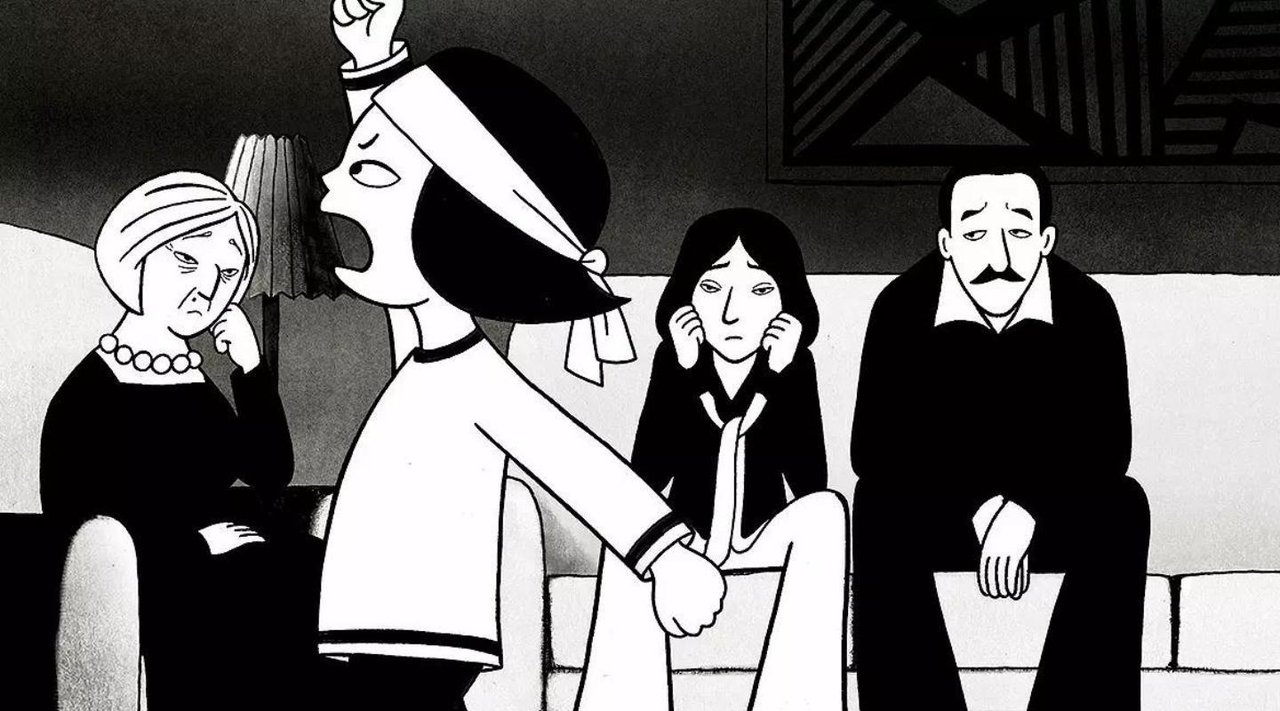
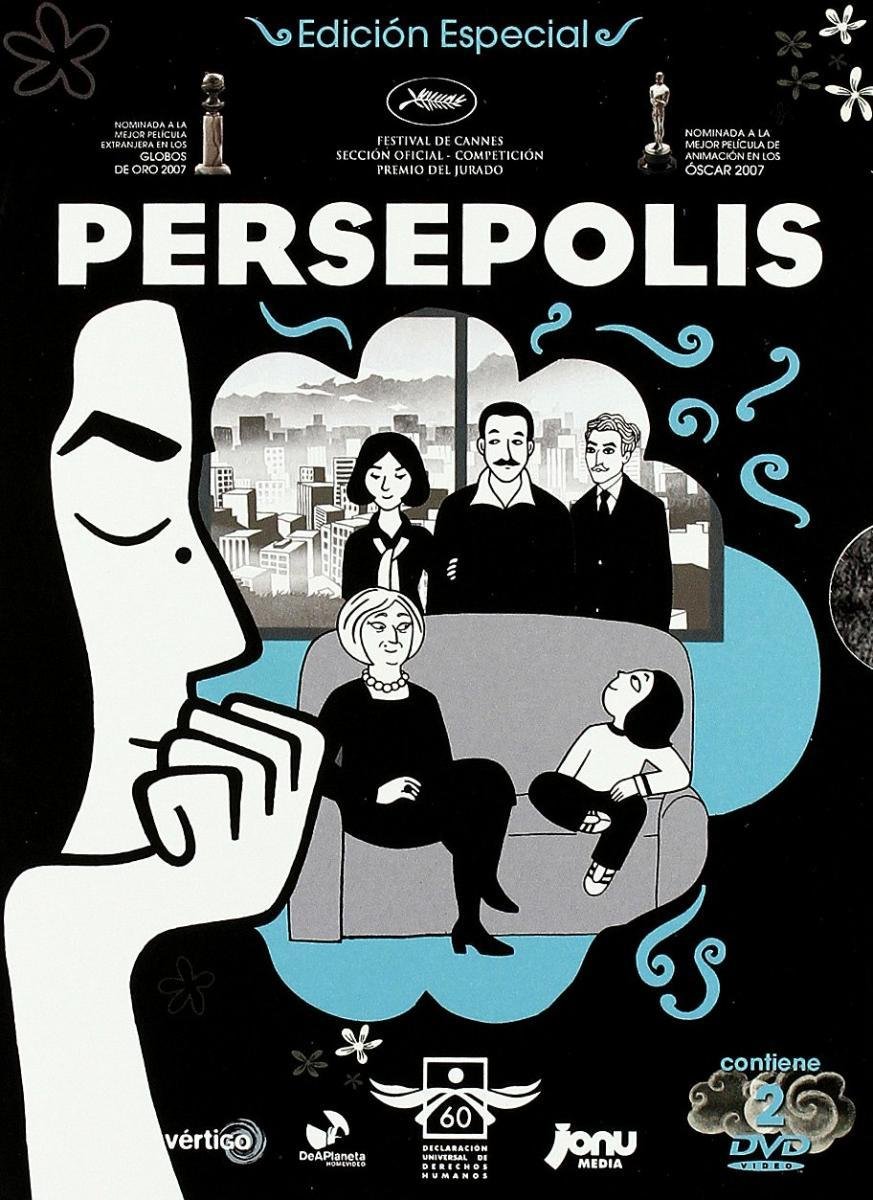
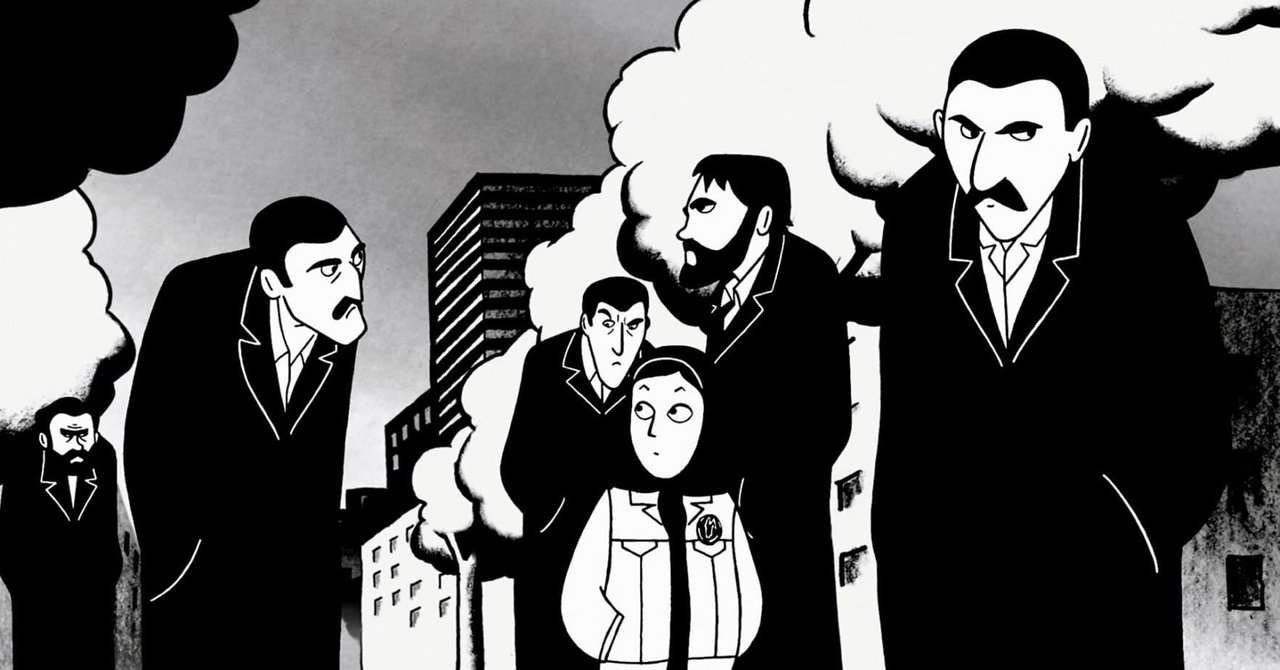
And that happens with Persepolis because Marjane Satrapi herself, creator of the comic book, wrote the screenplay and directed the film together with Vincent Paronnaud; moreover, an important addition is that the story is autobiographical. Marjane tells us here her own story from the time she was a ten-year-old Iranian girl when the Islamic revolution and the fundamentalists took power, forcing society to return to certain retrograde values such as forcing women to wear veils and political persecutions in the name of order and good manners. Thousands of people imprisoned, disappeared, murdered, the war between Iraq and Iran, migration, exile and the loss of freedoms, is the backdrop against which little Marjane discovers the world: punk music, ABBA, Iron Maiden, literature and later, love. Once a culturally advanced society and respected in the rest of the continent and the world, the arrival of theocracy plunges Iran into a climate of conflict and oppression, and turns its citizens into victims, pariahs, accomplices or outcasts, depending on the eye of the beholder. Thanks to the purchasing power of her parents, Marjane manages to go to live in Europe for a few years and there she gets to know another culture, very different from that of her country, and although she has more favorable conditions for her development, she also discovers the nostalgia and identity crises of all migrants who no longer inhabit the land to which they belong and who still don't belong to the one they now inhabit; and perhaps never will.
Y eso sucede con Persepolis porque la propia Marjane Satrapi, creadora del cómic, escribió el guion y dirigió la película junto a Vincent Paronnaud; además, un agregado importante es que la historia es autobiográfica. Marjane nos cuenta aquí su propia historia desde que era una niña iraní de diez años cuando la revolución islámica y los fundamentalistas tomaron el poder, forzando a la sociedad a volver a ciertos valores retrógrados como el obligar a las mujeres a llevar velo y además con persecuciones políticas en nombre del orden y de las buenas costumbres. Miles de personas encarceladas, desaparecidas, asesinadas, la guerra entre Irak e Irán, la migración, el exilio y la pérdida de las libertades, es el telón de fondo sobre el cual la pequeña Marjane descubre el mundo: la música punk, ABBA, Iron Maiden, la literatura y posteriormente, el amor. Alguna vez una sociedad avanzada culturalmente y respetada en el resto del continente y del mundo, la llegada de la teocracia sume a Irán en un clima de conflicto y opresión, y convierte a sus ciudadanos en víctimas, parias, cómplices o marginados, según el ojo de quien los mire. Gracias al poder adquisitivo de sus padres, Marjane logra irse a vivir a Europa durante unos años y allí conoce otra cultura, muy diferente a la de su país, y aunque tiene condiciones más favorables para su desarrollo, también descubre la nostalgia y las crisis de identidad que tienen todos los migrantes que no habitan ya la tierra a la que pertenecen y que aun no pertenecen a la que ahora habitan; y quizás nunca lo hagan.
Marjane's story is full of very moving episodes, some of them cruel, painful and sad, but others very tender, hopeful and clearly funny. Disruptive from her earliest childhood, “Marji” had and has a way of questioning the world from her innocent look that makes us reflect on different things. The animated format of the story softens how disturbing certain scenes could be, but doesn't spare us the analysis of situations that should no longer be repeated in the history of our humanity and that, nevertheless, continue to happen.
La historia de Marjane está repleta de episodios muy emotivos, algunos crueles, dolorosos y tristes, pero otros muy tiernos, esperanzadores y claramente divertidos. Disruptiva desde su más tierna infancia, "Marji" tenía y tiene una forma de cuestionar el mundo desde su mirada inocente que nos hace reflexionar sobre diferentes cosas. El formato animado de la historia nos suaviza lo perturbadoras que podrían resultar ciertas escenas, pero no nos ahorra el análisis de situaciones que no deberían ya repetirse en la historia de nuestra humanidad y que, sin embargo, siguen pasando.
25 years after its first publication, Persepolis is still relevant, not so much because these things keep happening, but because it reflects on enduring and very human themes: family, parenthood, migration, xenophobia, authoritarianism, freedom, love, life, integration... each chapter of the novel and each scene of the film serve to talk for hours and hours about different aspects of our humanity. As an addition to the experience of the film, originally recorded with French voices, I found that Marjane is voiced by Chiara Mastroianni, actress daughter of an iconic couple, Marcello Mastroianni (La dolce vita and 8½) and Catherine Deneuve (Les parapluies de Cherbourg and Belle de jour), who voices her mother in the film. In addition to pursuing a successful career as a creator of graphic novels, human and women's rights activist, Marjane Satrapi has also directed other feature films, the latest being a biopic about Marie Curie, Radioactive, starring Rosamund Pike. Her latest editorial work, Femme, Vie, Liberté is a project coordinated by her in which through individual stories, portraits and vignette reports, different artists and experts speak out after the death of Mahsa Amadi at the hands of the moral police in Iran during the fall of 2022. I recommend reviewing all of Satrapi's work, but you can start with Persepolis, on paper and on screen, because I think hers it's a voice that deserves to be heard, read and spread, how many of you have seen this movie? have you read the comic? I read you in the comments.
A 25 años de su primera publicación, Persépolis sigue vigente, no tanto porque sigan pasando estas cosas, sino porque reflexiona sobre temas imperecederos y muy humanos: familia, paternidad, migración, xenofobia, autoritarismo, libertad, amor, vida, integración... cada capítulo de la novela y cada escena de la película sirven para conversar horas y horas sobre diferentes aspectos de nuestra humanidad. Como agregado a la experiencia de la película, grabada originalmente con voces en francés, encontré que la voz de Marjane la hace Chiara Mastroianni, actriz hija de una pareja icónica, Marcello Mastroianni (La dolce vita y 8½) y Catherine Deneuve (Les parapluies de Cherbourg y Belle de jour), quien hace la voz de su madre en la película. Además de seguir una exitosa carrera como creadora de novelas gráficas, activista por los derechos humanos y de las mujeres, Marjane Satrapi ha dirigido también otros largometrajes, siendo el último una biopic sobre Marie Curie, Radioactive, protagonizada por Rosamund Pike. Su último trabajo editorial, Femme, Vie, Liberté es un proyecto coordinado por ella en la que a través de historias individuales, retratos y reportajes en viñetas, diferentes artistas y expertos se pronuncian tras la muerte de Mahsa Amadi a manos de la policía de la moral en Irán durante el otoño de 2022. Recomiendo revisar toda la obra de Satrapi, pero pueden comenzar con Persepolis, en el papel y en la pantalla, porque creo que es una voz que merece ser oída, leída y difundida, ¿cuántos de ustedes han visto esta película? ¿han leído el cómic? Los leo en los comentarios.
Hello, cinema fans. Today we're going to talk about one of the best science fiction and action movies I've seen in my youth. This is one of those many movies with dystopian worlds and elaborate stories for young adults that became quite popular a decade ago. Based on the novel of the same name written by James Dashner, this film adaptation was directed by Wes Ball. The film stars Dylan O'Brien, Kaya Scodelario, Thomas Brodie-Sangster, Will Poulter, Patricia Clarkson, among others. Discover one of the best films I recommend watching if you are a fan of suspense and dystopian worlds with teenagers.
SPANISH VERSION
Hola, fanáticos del cine. Hoy vamos a hablar de una de las mejores películas de ciencia ficción y acción que he visto en mi juventud. Esta es una de esas muchas películas con mundos distópicos e historias elaboradamente hechas para jóvenes adultos que llegaron a popularizarse bastante hace una década atrás. Basada en la novela homónima escrita por James Dashner, esta adaptación cinematográfica fue dirigida por Wes Ball. La película cuenta con el protagonismo de Dylan O’Brien, Kaya Scodelario, Thomas Brodie-Sangster, Will Poulter, Patricia Clarkson, entre otros. Conoce una de las mejores películas que recomiendo ver si eres fan del suspenso y los mundos distópicos con adolescentes.
The film begins with what appears to be an underground elevator with a young man who is just waking up, completely confused. The elevator rises at full speed until it reaches the top. When the iron doors that held him open, he is greeted by a group of young people who treat him as if he were their new pet. One of them helps him up, but suddenly runs off into what appears to be a wide meadow until he stumbles. Looking up, he realizes that the place is completely surrounded by fairly high walls. This space they find themselves in is called the Glade, and our young protagonist remembers nothing about his life, his past, or even his identity. The leader of the group of young people who welcomed him helps show him around the place, which seems to be a small society where everyone works together and follows the rules. However, our protagonist is curious about what lies beyond the walls.
SPANISH VERSION
Trama
La película inicia con lo que parece ser un ascensor subterráneo con un joven que recién se va despertando completamente confundido. El ascensor sube a toda velocidad hasta llegar a la cima. Al abrirse las puertas de hierro que lo detuvieron, lo reciben un grupo de jóvenes que lo ven como si fuera su nueva mascota. Uno de ellos lo ayuda a levantarse, pero de repente sale corriendo en lo que parece ser un prado amplio hasta tropezarse. Al levantar la vista, se da cuenta de que el lugar está completamente rodeado de unos muros bastante altos. Este espacio en el que se encuentran se llama el Claro y nuestro joven protagonista no recuerda nada de su vida, su pasado o su identidad siquiera. El líder del grupo de jóvenes que lo recibieron le ayuda a mostrarle el lugar, lo que parece ser una pequeña sociedad donde todos colaboran entre sí y siguen las reglas. Sin embargo, nuestro protagonista tiene curiosidad por lo que hay más allá de los muros.
I barely remember when this type of film, adapted from various science fiction and action novels that became bestsellers and ended up on the big screen, became very popular at that time. The first film I saw of this style was Divergent, but I'll review that one later. The Maze Runner, however, was a film I saw some time later and liked quite a bit, much more than any other dystopian film aimed at young adults from that decade. The mix of suspense with the action of the chases, the visual aesthetics, and the way in which they developed this post-apocalyptic world, starting with a complex maze full of traps and monsters, is one of the most fascinating and impressive things I have seen to date. That is why it is the first and the one I most recommend watching if you are a fan of this type of work.
Before delving deeper into my opinion about this film, I want to clarify first that I have not read the novel on which it is based. All I know is that it is the closest and most faithful adaptation of a literary work of this style that has been made. That is why I will only talk about what I know, what I have seen, and what I have come to understand and enjoy about it. This film, which is just under two hours long, has an excellent introduction as well as an excellent ending. From start to finish, we see how they perfectly construct a story full of mystery, suspense, tension, and emotion. And best of all is how the story unfolds, beginning with the protagonist suffering from amnesia, just like the others in this Glade. A closed space where the young people who inhabit it live as a society, fulfilling specific roles and obeying certain rules.
SPANISH VERSION
Apenas recuerdo cuando en aquella época se volvió muy popular este tipo de películas adaptadas de diferentes novelas de ciencia ficción y acción que se volvieron un éxito en ventas y terminaron llegando a la pantalla grande. La primera película que vi de este estilo fue Divergente, pero esa ya le haré una reseña más adelante. The Maze Runner, sin embargo, fue una cinta que vi tiempo después y que me gustó bastante, mucho más que cualquier otra película distópica dirigida para jóvenes adultos de aquella década. La mezcla de suspenso con la acción de las persecuciones, la estética visual y la forma en la que desarrollaban este mundo post-apocalíptico empezando por un complejo laberinto repleto de trampas y monstruos es de lo más fascinante e impactante que he visto hasta la fecha. Es por eso que es la primera y la que más recomiendo ver si eres fan de este tipo de obras.
Antes de profundizar más con mi opinión acerca de esta película, quiero aclararles primero que no he leído la novela en la cual está basada. Lo único que sé es que es la adaptación más cercana y fiel a una obra literaria que se ha hecho de este estilo. Es por eso que solo hablaré de lo que sé, lo que he visto y lo que he llegado a entender y disfrutar de la misma. Este metraje de poco menos de dos horas de duración posee una excelente introducción, así como también un excelente final. De inicio a fin vemos cómo construyen de manera perfecta una historia repleta de misterio, suspenso, tensión y emoción. Y lo mejor de todo es cómo se desarrolla dicha historia, empezando con el protagonista con amnesia al igual que los demás de este Claro. Un espacio cerrado donde los jóvenes que la habitan viven como una sociedad cumpliendo roles específicos y obedeciendo ciertas reglas.
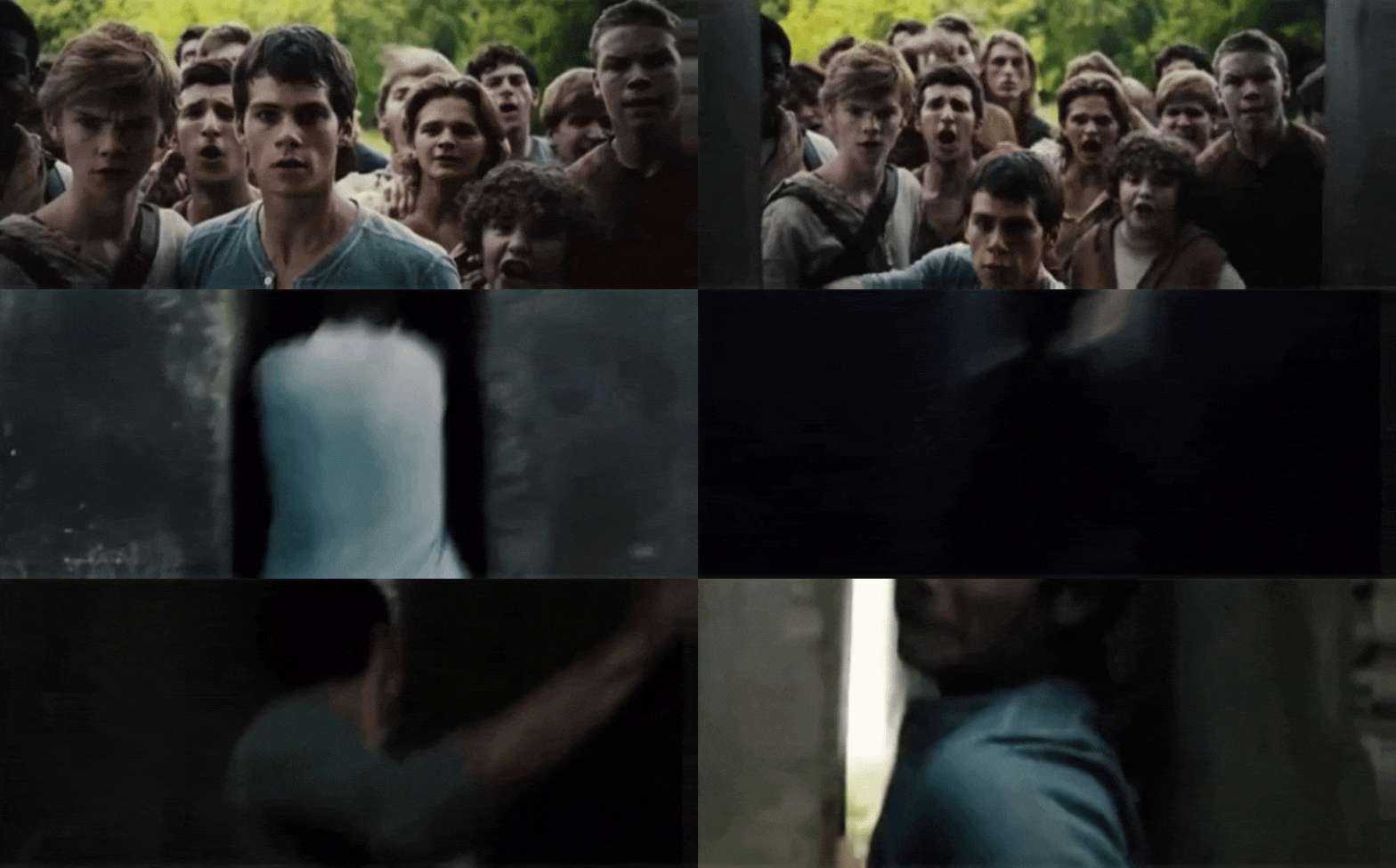
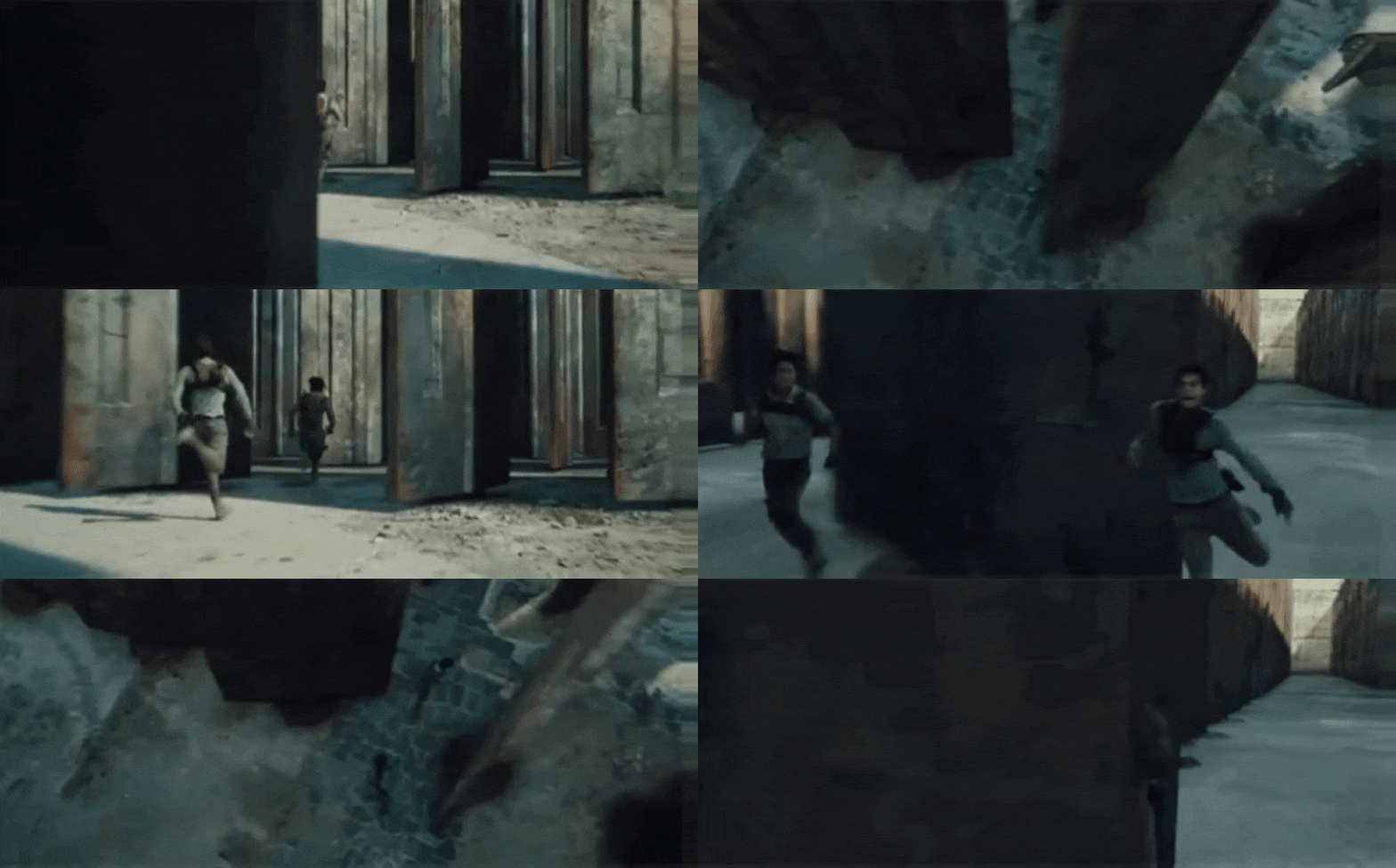
What happens next is somewhat predictable, but still entertaining to watch. Upon remembering his name, Thomas (the protagonist) begins to experience disturbing situations in the Glade. It starts with one of the Maze Runners attacking him in broad daylight after being infected by a Griever (yes, similar to a zombie, but different). After that, we see how the people banish him from the Glade and send him to the maze to spend the night there. The next day, we see how the leader of the runners, Minho, goes with the veteran of the place back to the maze and then returns just as the doors are closing, thus becoming trapped inside. However, Thomas is the only one who steps forward and also enters the maze, even though he knows it's against the rules. Everything changes from here on out, revealing both a possible way out and the origin and identity of those behind it all.
I repeat, I am fascinated by how well the story is crafted, with an enemy behind everything that is happening in this enormous maze infested with monstrous creatures and young runners who do not know who they are or where they come from. Elements such as the society they have in the Glade, the rules, the way they navigate the maze, the way the Grievers are made, and the dreams or visions our protagonist has offer us a huge variety of doubts and questions that become more and more important as the film unfolds. All this while the truth is slowly revealed until we reach the end... an ending that is both revealing and fascinating and heartbreaking at the same time. What we see in this feature film is a perfect blend of dystopian and post-apocalyptic future with suspense, action, and drama at a level never seen before.
SPANISH VERSION
Lo que sucede después es algo que era de esperarse, pero igual es entretenido de ver. Al recordar su nombre, Thomas (el protagonista) empieza a experimentar situaciones inquietantes en el Claro. Empezando por uno de los Corredores del Laberinto que le ataca a pleno día luego de haberse infectado por un Penitente (si, parecido a un zombie, pero diferente). Luego de eso vemos cómo la gente lo destierra del Claro y lo envía al laberinto para que pase la noche allí. Al día siguiente vemos cómo el líder de los corredores, Minho, va con el veterano del lugar de vuelta al laberinto para luego regresar justo al momento en el que se cierran las puertas y así quedarse atrapados en el mismo. Sin embargo, Thomas es el único que da un paso adelante y entra también al laberinto, aún sabiendo que está contra las reglas. Todo cambia a partir de aquí, lo cual revela también tanto una posible salida como también el origen y la identidad de quienes están detrás de todo esto.
Repito, me fascina cómo la historia está bien hecha con un enemigo que se encuentra detrás de todo lo que está sucediendo en este enorme laberinto infestado de criaturas monstruosas y jóvenes corredores que no saben quiénes son y de dónde vienen. Elementos como la sociedad que tienen en el Claro, las reglas, la forma en la que recorren el laberinto, la forma que están hechos los Penitentes y los sueños o las visiones que tiene nuestro protagonista nos ofrecen una enorme variedad de dudas y preguntas que se vuelven más y más importantes a lo que va desarrollándose la película. Todo esto mientras la verdad se va desvelando poco a poco hasta llegar al final… un final que es tanto revelador como fascinante y desgarrador a la vez. Lo que vemos en este largometraje es una mezcla perfecta de futuro distópico y post-apocalíptico con suspenso, acción y drama a un nivel nunca antes visto.
Now, regarding the cast of this film, I think there is nothing to complain about. The performances and interpretations we see are top-notch. Especially Dylan O'Brien, who plays Thomas, the protagonist. From the beginning, we see that he is different from the others, showing a certain curiosity and interest in things that not everyone likes to talk about, and he is driven by a desire to do something to escape. When we remember his past and everything he has done before arriving at the Glade, we understand why he ended up there and what he is now, due to his desire to be free and escape from the clutches of those who oppress them there. But we also have the case of other characters we meet in the Glade, such as Minho, Alby, and Newt. Each has a personality and a way of acting and making decisions that go hand in hand with the principles they share with the protagonist.
On the other hand, we have Gally, played by young Will Poulter. He is the protector and leader of the Glade, the one who follows the rules and maintains order in this place. His decision-making and firm stance regarding the changes that have been taking place show that he is the type of character who prefers to keep things as they are and gets rid of anyone who disagrees with him. This representation of order and law that has been established in this small society ends up becoming a clear enemy of the protagonist, who seeks only freedom and escape from this hellish maze. But what really blew my mind, to be honest, is the theme of WICKED (W.C.K.D.), an organization that gives me the vibe of being an imitation of The Hive from Resident Evil (the zombie movie series, not the video game series).
SPANISH VERSION
Ahora, con respecto al elenco que tiene esta película, considero que no hay nada de qué quejarse. Las actuaciones e interpretaciones que vemos son de lo mejor. Sobre todo con Dylan O’Brien que hace de Thomas, el protagonista. Un personaje que desde el principio vemos que se diferencia de los demás, demuestra cierta curiosidad e interés por cosas que no a todo el mundo le gusta hablar y es impulsado por un deseo de querer hacer algo por escapar. Al recordar su pasado y todo lo que ha hecho antes de llegar al Claro notamos el por qué llegó hasta ahí y lo que es ahora debido a su deseo de querer ser libre y escapar de las garras de quienes los oprimen ahí. Pero también tenemos el caso de otros personajes que conocemos en este Claro, como es el caso de Minho, Alby y Newt. Cada uno tiene una personalidad y una forma de actuar y tomar decisiones que van de la mano con los principios que comparten con el protagonista.
Por otro lado, tenemos a Gally quien es interpretado por el joven Will Poulter. Este es el protector y líder del Claro, aquel que sigue las reglas y mantiene el orden en este lugar. Su toma de decisiones y su conducta firme con respeto a los cambios que han estado sucediendo demuestran que es ese tipo de personaje que prefiere mantener las cosas como están y se deshace de cualquiera que no esté de acuerdo con él. Esta representación del orden y la ley que se ha establecido en esta pequeña sociedad termina convirtiéndose en un claro enemigo del protagonista quien busca solamente la libertad y escapar de este laberinto infernal. Pero lo que más me voló la cabeza, la verdad, es el tema de CRUEL (W.C.K.D.) una organización que me da una vibra de ser una imitación de La Colmena, de Resident Evil (la saga de películas de zombies, no la de videojuegos).
Last but not least, let's talk about the technical and audiovisual aspects of the film. Without a doubt, this is one of its strongest points, especially considering that it is a feature film lasting almost two hours with a budget of only $34 million. This is a great achievement in itself, as achieving this level of quality and detail in a film of this style with so little is something that does not always happen. The photography styles, the moving cameras, the panoramic views, the cold and dark color palette, and the chase and racing sequences in this film are among the best. There is also good use of practical effects and computer-generated imagery (CGI). The sound effects are also very well done, but nothing compares to the soundtrack, which manages to convey all the emotion and tension of this work. Recommended for all fans who like dystopian and post-apocalyptic worlds.
Personally, I give it a 9/10 rating in terms of the science fiction, action, and suspense genres.
SPANISH VERSION
Por último, pero no menos importante, hablemos del apartado técnico y audiovisual que tiene la película. Sin duda alguna, esto es de lo mejor que puede ofrecer, sobre todo al considerar el hecho de que es un largometraje de casi dos horas con un presupuesto de tan solo 34 millones de dólares. Esta es una hazaña grandiosa de por sí, ya que lograr el nivel de calidad y detalles en una cinta de este estilo con tan poco es algo que no siempre ocurre. Y es que tanto los estilos de fotografía, las cámaras en movimiento, las vistas panorámicas, la paleta de colores fríos y oscuros, las secuencias de persecuciones y carreras que tiene esta película es de lo mejor. También está el buen uso de los efectos prácticos y los efectos hechos a computadora (CGI). Los efectos de sonido están muy bien hechos también, pero nada como la banda sonora, la cual consigue impactar y transmitir toda la emoción y la tensión que posee esta obra. Recomendada para todos los fans que les gustan los mundos distópicos y post-apocalípticos.
Personalmente, le doy una calificación de 9/10 en lo que respecta al género de ciencia ficción, acción y suspenso.
Tell me, have you seen the movie yet? What did you think of it? You can leave me your answer in a comment.
Dime, ¿ya has visto la película? ¿Qué te ha parecido? Puedes dejarme tu respuesta en un comentario.
Hello anime lovers, here am I with another review! Today's anime is Ponyo, it's quite famous I hope many of you have heard of this anime movie. If not then read my post you will have an idea about this. If you're looking for something fun and adventurous then it's the perfect choice. It was released in 2008 and that's really long ago but still it's worth the time. It has a happy ending so no crying.
The trailer is so calming like the music and all blends pretty well. Made me feel like being a kid again. The nostalgic I feel for Ponyo can not be described and I watched this movie when I was a kid. It's kids animation but even when I much older but I still like this anime very much. From start to end everything about this anime is amazing. This movie truly deserves far more appreciation.
The story begins with Ponyo she is a goldfish and a princess. One day she escaped from her underwater home and somehow she got rescued by a five-year-old boy who's name Sosuke. He began to take care of the gold fish as he doesn't know anything about the fish. Meanwhile the wizard came looking for her and took her back but Ponyo expressed her desire to become human in order to meet Sosuke as a person because she likes him.
Sosuke and Ponyo became friends, and her helps her navigate her new life on land. As Ponyo began to live with Sosuke some magical events took place that causes imbalance between the ocean and the human world. Everything happened because of Ponyo as she transforms into a human girl and her decision's caused many troubles and that includes the the town where Sosuke lives it was flooding.
The important part of the movie is the the colour pallet, it is different than other Studio Ghibli movies. This movie will show you the importance of love, courage, and respecting the nature. This is an amazing movie and is a must watch for anyone who likes meaningful and magical storytelling. I feel that the visuals are stunning and the soundtrack is incredible.
I have seen people complaining about the character Ponyo that she's annoying but what do you expect from a kid? Both Sosuke and Ponyo are kid and that's how kids behave. Ponyo is just a curious and adventurous gold fish. The character that I liked the most is Sosuke's mother Lisa she was very supportive throughout the journey. Also, Sosuke was very kind hearted it melted my heart right away. Well, I adored the movie so it was good for me. If you are having a bad day then you can watch this movie and I can guarantee you are gonna feel much much better.
Ratings: 8.5
Leave a comment if you have watched this anime or not, feel free to share your opinion. Also, let me know if there's something I can improve.
Hello everyone, although I like Japanese music and my favorite band is one of these, I have not been very into odols or kpop, but something that I do like a lot are animated movies and, as I have been resuming watching movies more often, recently I had been seeing videos on my TikTok referring to a specific one that, after much thought, a few days ago I decided to watch and for that reason today I come to give you my opinion on this occasion about the movie: K-Pop Demon Hunters.
Hola a todos, aunque me gustan las músicas japonesas y mi banda favorita es una de estas, no he estado muy metida en el tema de idols o kpop, pero algo que sí me gusta mucho son las películas animadas y, como he estado retomando el ver películas más seguido, recientemente me había estado saliendo en mi TikTok videos referentes a una en específico que, luego de mucho pensar, hace unos días me decido a ver y por lo mismo hoy vengo a darles mi opinión en esta oportunidad sobre la película: K-Pop Demon Hunters.
To begin with, this film was released on June 20th by Netflix and it mixes mystery, fantasy and above all music, this being one of the things that usually catch my attention on many occasions, and the thing is that with this film I didn't have many expectations since I felt that it might be a vile copy of the film Red, which in my opinion is one of my favorites, and although it doesn't have any themes other than the one that resonates the most in its time, I loved it, so I was waiting for this one to surprise me.
Para empezar, esta película salió el pasado 20 de junio de la mano de Netflix y mezcla misterio, fantasía y sobre todo música, siendo esta una de las cosas que suelen llamarme la atención en muchas ocasiones, y es que con esta película no tenía tantas expectativas ya que sentía que capaz sería una vil copia de la película Red, que en mi opinión es de mis favoritas, y aunque no tiene temas más que el que más resuena en sus tiempos, me encantó, por lo que estaba esperando que esta me sorprendiera.
This film centers on Huntrix, a group of three idols: Rumi, Mira, and Zoey, who use their voices as priestesses to protect the city from demons by creating a barrier. At first, it seemed a bit far-fetched, but as we get deeper into the nearly two-hour film, we realize the plot isn't really going in that direction. If we're good viewers, we'll see it's more about self-acceptance and liberation from the norm, something that captivated me.
Esta película se centra en Huntrix, formado por tres idols: Rumi, Mira y Zoey, las cuales usan sus voces a modo de sacerdotisas para proteger la ciudad de los demonios a través de una barrera. En un comienzo se me hizo algo volado, pero a medida que nos adentramos en las casi dos horas de película, nos fijamos que la trama no va en realidad hacia ese rumbo, pues si somos buenos espectadores podremos ver que va más bien de la autoaceptación y la liberación del estándar, algo que me logró atrapar.
Regarding the animation, I must say I was curious to see how the idols' expressions were often very cartoonish, manga-style, I might say. Likewise, this style was clearly defined in each character, and of course, the idol aesthetic was faithfully adopted in each group, creating for many that appreciation for the cuteness of each idol, whether male or female. Since we can see the Saja Boys, a group of male idols who give a nod to other well-known bands, the details in their hair, eyes, and even nails, although barely noticeable, are well done.
Con respecto a la animación, debo decir que me fue curioso ver cómo las expresiones de las idols en muchos momentos eran muy caricaturescas, estilo manga podría decir. Así mismo, este estilo en cada personaje estaba bien marcado y, claro, la estética idol fielmente adoptada en cada grupo, haciendo para muchos ese gusto hacia lo lindo de cada idol, ya sea chico o chica. Puesto que podemos ver a los Saja Boys, siendo estos un grupo de idols masculinos que dan un guiño a otras bandas conocidas, así mismo los detalles en cabello, ojos e incluso uñas, aunque poco perceptibles, están bien hechos.
The plot itself, though it has several clichés, isn't boring at all; the time flew by while I watched it. I would have even liked to see a few more common clichés in this one, but no. Likewise, when it comes to which character I liked, I could say a bit of each one, because they offer depth, even if it's not obvious in them. But the main one is Rumi and her internal struggle, which could be a representation of when we hide who we are and how that affects everyone around us, including ourselves.
En sí, la trama, aunque llega a tener varios clichés, no aburre en absoluto; a mí se me pasó el tiempo volando mientras la veía. Incluso me hubiera gustado ver uno que otro cliché más común en esta, pero no. Así mismo, al decir qué personaje me gustó, podría decir que un poco de todos, porque profundizan, aunque no sea evidente en ellos, pero la principal es Rumi con su lucha interna, que puede ser una representación de cuando ocultamos quiénes somos y cómo eso afecta a todo nuestro entorno, incluidos nosotros mismos.
Now, regarding the songs, I simply liked them. There are very simple songs, yet catchy because of the melody, like some that are just a listen; we know what they mean. And although there's a lot of music, this is precisely what the film is based on, not so much how they sing or whether it's K-pop music, but how through the voice, change or expression can be achieved, something they even imply and mention in the film that something well said or that connects makes a difference. And well, personally, I have more than one song stuck; in fact, as I mentioned in my previous review, I'm listening to one of the songs, in this case "Golden," as I write this review.
Ahora bien, con respecto a las canciones, simplemente me gustaron. Hay desde temas muy simples, pero pegadizos por la melodía, como unos que son solo de escuchar; sabemos qué quieren decir. Y aunque hay mucha música, justamente de esto se basa la película, no tanto de cómo cantan o si es música K-pop, sino de cómo a través de la voz se puede ejercer un cambio o una expresión, cosa que incluso dan a entender y mencionan en la película que algo bien dicho o que conecte hace la diferencia. Y bueno, en lo personal tengo más de una canción pegada; incluso, como mencioné en mi reseña anterior, estoy escuchando uno de los temas, en este caso "Golden", mientras escribo esta reseña.
It's a highly recommended film, whether you're a fan of the musical genre or the aesthetic, comedy, or, on the contrary, want to watch and analyze the characters or the lyrics. Personally, I like the lyrics of Asian songs, as they convey beautiful messages, even if the melody is different, but they make it fit, which I simply enjoy. In this case, understanding the film in depth means paying attention to the songs and the plot so that everything fits together correctly and the real context of the film reaches us.
Es una película que es muy recomendada, tanto si eres fan del género musical o la estética, la comedia o si, por el contrario, quieres ver y analizar a los personajes o a las letras. En lo personal, me gustan las letras de las canciones asiáticas, ya que transmiten bonitos mensajes, incluso si la melodía es distinta al mismo, pero hacen que encaje, cosa que simplemente disfruto, y en esta ocasión entender a profundidad la película es prestarle atención a las canciones y a la trama para que todo embone correctamente y el real contexto de esta nos llegue.
In itself it has everything: music, romance, comedy, fantasy and an inner message, so yes I would watch it again without a problem and with respect to whether it exceeded my expectations, well yes, it is a slightly more adult version of Red and this one touches on more themes, so yes, not so much to say that it is better by far, but it has my complete approval.
En sí tiene todo: música, romance, comedia, fantasía y un mensaje interno, por lo que sí la volvería a ver sin problema y con respecto a si superó mis expectativas, pues sí, es una versión un poco más adulta de Red y esta toca más temas, así que sí, no tanto para decir que por mucho sea mejor, pero tiene mi completo aprobado.
So, well, this is my little opinion regarding this KPop Demon Hunters movie, hoping to have been as specific as possible with everything I wanted to address and that it has been to your liking, so thank you very much for reading this post.
Así que, bueno, esta es mi pequeña opinión con respecto a esta película KPop Demon Hunters, esperando haber sido lo más específica con todo lo que quería abordar y que haya sido de su agrado, así que muchas gracias por leer este post.
It is nice to have a new TV show to talk about today. Recently, I have adopted the act of watching new TV shows as a means of putting my mind to rest after a long day or to start my weekend.
One genre of TV shows I have enjoyed over and over in the past is murder mystery. Mindfully, not the deep dark murder mystery or documentaries like the Jeffrey Dahmer, or American Murder Mystery documentaries and the rest of that kind, rather I'm talking about the kind of murder mystery that comes with a feel of comedy or comic relief.
I think that murder mysteries can be all serious, but at the same time, there should be a form of comedy relief, as that is what will keep a person like me glued to the show or movie. Life is quite serious already, so let's cope with some comedy.
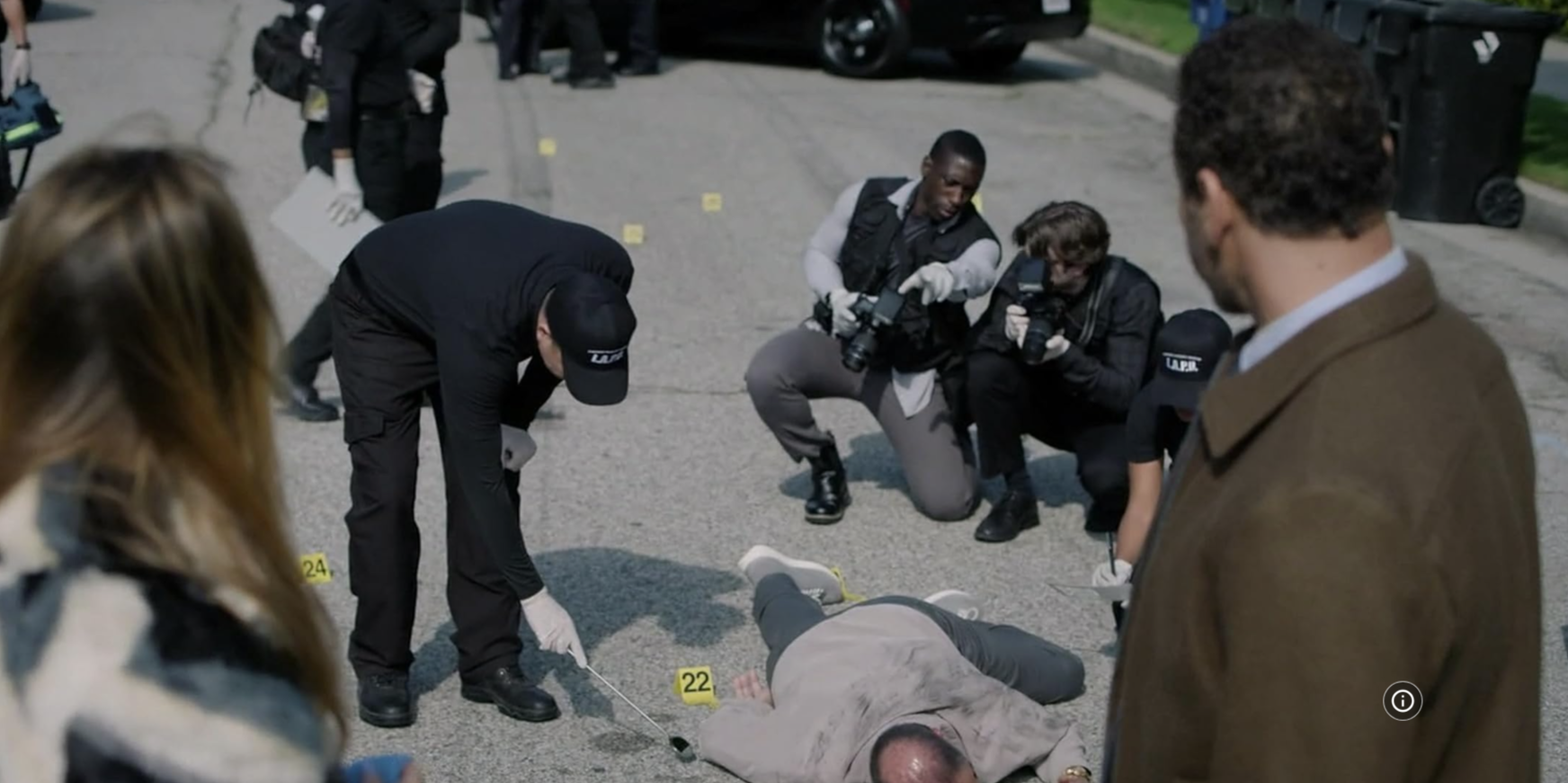
[Murder on High Potential](https://www.imdb.com/title/tt22091076/mediaviewer/rm3466891266/?ref_=ext_shr_lnk)
In this mindset, I have watched the Mentalist, which happens to be my favourite on the list of murder mysteries. The back-and-forth tussle between Patrick Jane and Red John. Although some may argue that the Mentalist is not a murder mystery that comes with comic relief. But in that defense, it does.
Have you ever taken your time to watch how Patrick Jane plays with every given case, undermining the seriousness that comes with murder while making it obvious that nothing can be hidden from him. Or is it how he likes to act like a psychic that can read your mind and even speak to the dead, which are all lies since they are all clever psychological tricks he has mastered and implemented over and over again.
[Mr Patrick Jane - The Mentalist](https://www.imdb.com/title/tt1196946/mediaviewer/rm2492985856/?ref_=ext_shr_lnk)
With this, it was a no-brainer when I decided to watch High Potential. Although I have to confess I was not so enthusiastic about the movie at first because I felt the glamorous use of an attractive Kaitlin Olson and Daniel Sunjata as the lead characters kind of undersold the murder mystery to me.
I thought these good-looking actors should just make this show another too-hot-to-handle or desperate housewives saga. Well, what did they say about judging a book by its cover? You end up losing the knowledge or missing out on something good.
[Kaitlin Olson and Daniel Sunjata](https://www.imdb.com/title/tt22091076/mediaviewer/rm1416533762/?ref_=ext_shr_lnk)
So this was my case until I said to myself yesterday, what do I have to lose? Frankly nothing. Since all I am looking for is something to keep my mind busy and possibly sleep off as well on it, if it helps.
Lo and behold, it keeps getting good. Kaitlin Olson, who plays Morgan, a cleaner at the LAPD with a high IQ, keeps finding new information in an ongoing investigation that proves the police have it all wrong most times.
Her detailed attention to every single piece of information and spotting the missing piece is what I find quite intriguing. She is that kind of person who can spot a grammatical error in an expression where a period was used instead of a question mark, while at the same time reading the content at top speed.
The micro bits of information are how she gets to solve the murder case for each episode, even something as minor as the weather condition of last night, or what direction the wind was blowing from last night.
This is what got me thinking. Are there people like Morgan from the ABC TV show High Potential, who have an insanely high IQ and the ability to consume a large amount of information at top speed while understanding every bit of it? I think these kinds of things can only be found in movies, although I stand to be proven wrong or, better still, corrected.
I am currently on episode 5, where she is finally working full time for the LAPD consultant for murder investigation, and at the same time, trying to uncover what happened or led to the disappearance of her ex-husband. So far, it gets better as Morgan has become the female version of Patrick Jane from The Mentalist. If you enjoyed The Mentalist, I recommend you check High Potential.
I am @samostically, I love to talk and write about chess because I benefited a lot from playing chess, and I love writing about chess.