Longform reviews of films, TV, anime, books, and audiobooks, written by the scrobble.life community and published to the Hive blockchain, so each one is owned by its author and can earn rewards from readers. 60,679 reviews and counting.
This film, along with The Amazing Spider-Man 2, was shown on TV not long ago.
As we weren’t sure whether we’d seen them, we recorded them to watch later.
We’d seen the versions starring Tom Holland and those starring Tobey Maguire, which tell, more or less, the same story, at least as far as Spider-Man’s early days are concerned.
This first instalment runs for 2 hours and 16 minutes.
Ce film, ainsi que The Amazing Spiderman 2, est passé à la télévision il y a peu de temps.
N'étant pas certains de les avoir vus, nous les avons enregistrés pour les regarder ultérieurement.
Nous avions vu les versions avec Tom Holland et celles avec Tobey MacGuire, qui racontent, à peu de choses près, la même histoire, en tout cas, pour les débuts de Spiderman.
Peter Parker is raised by his uncle and aunt ever since his parents had to flee. His father was a renowned biologist and his colleague, Dr Curt Connors, works for Oscorp.
When Peter comes across some old documents containing his father’s notes, he tracks down Dr Curt Connors, whom he had seen in a photograph, and decides to take part in the guided tour for Oscorp interns. He does not reveal his true identity straight away, but still makes an impression with his knowledge of the subject.
He falls in love with his classmate Gwen Stacy, which does not go down well with her father.
Peter Parker est élevé par son oncle et sa tante, depuis que ses parents ont dû s'enfuir. Son père était un biologiste reconnu et son associé, le Dr Curt Connors, travaille pour la société Oscorp.
Quand Peter retrouve des anciens documents avec les notes de son père, il recherche le Dr Curt Connors qu'il a vu sur une photo et décide de participer à la visite guidée pour les stagiaires de la société Oscorp. Il ne dévoilera pas directement sa réelle identité, mais se fera tout de même remarqué par ses connaissances sur le sujet.
Il tombera amoureux de sa copine de classe Gwen Stacy, ce qui ne plaira pas vraiment au père de celle-ci.
My opinion and a few facts /Mon avis et petites infos :
We already knew the story, so there were no surprises on that front.
The cast is pretty good; take a look:
Andrew Garfield: Peter Parker / Spider-Man
Emma Stone: Gwen Stacy
Rhys Ifans: Dr Curt Connors / The Lizard
Denis Leary: George Stacy[15], Gwen’s father
Martin Sheen: Benjamin Parker, Peter’s uncle
Sally Field: May Reilly Parker, Peter’s aunt
Irfan Khan: Dr Rajit Ratha
Campbell Scott: Richard Parker, Peter’s father
Embeth Davidtz: Mary Parker, Peter’s mother[17]
Chris Zylka: Flash Thompson, Peter’s nemesis at school
Nous connaissions l'histoire, donc, nous n'avons pas eu de surprise de ce côté-là.
Le casting est pas mal, voyez plutôt :
Andrew Garfield : Peter Parker / Spider-Man
Emma Stone : Gwen Stacy
Rhys Ifans : Dr Curt Connors / le Lézard
Denis Leary : George Stacy[15], le père de Gwen
Martin Sheen : Benjamin Parker, l'oncle de Peter
Sally Field : May Reilly Parker, la tante de Peter
Irfan Khan : Dr Rajit Ratha
Campbell Scott : Richard Parker, le père de Peter
Embeth Davidtz : Mary Parker, la mère de Peter[17]
Chris Zylka : Flash Thompson, la némésis de Peter au lycée
We wanted to watch the second instalment, but unfortunately we didn’t have enough space left on our recorder, so we could only watch the first half, which we didn’t really enjoy. What’s more, there wouldn’t have been a third instalment, as Spider-Man is joining the rest of the Marvel Cinematic Universe.
Ultimately, it’s hard to keep track of all these different versions. They’re hugely successful, big-budget films and series, but they often tend to go one too far.
Anyway, it was fun.
Enjoy your evenings in front of the telly and see you soon,
Nous voulions regarder le 2e volet, mais, malheureusement, nous n'avions plus assez d'espace disponible sur notre recorder, nous n'avons pu voir que la première moitié, qui ne nous a pas vraiment plu. De plus, il n'y aurait pas eu de 3e volet, puisque Spiderman rejoint le reste de l'univers Marvel.
Finalement, il est difficile de s'en sortir avec toutes ces versions différentes. Ce sont des films et séries à gros succès et gros budget, mais ils ont souvent tendance à vouloir ajouter celui de trop.
Bref, c'était sympa.
Bonnes soirées-tv et à bientôt,
Florence
Source photo : image Qwant autorisée
I used Deepl Translator to translate French into English
Since this is the fourth season (according to Kirkman, half the story/almost half, depending on whether there will be 8 or 9 seasons – he gave both versions), I'll skip the detailed introduction for new viewers. In short, if you like battle-shounen series for a slightly older audience, like HxH, then Invincible is for you. Both stories are similar – they tackle more mature themes, sometimes show more brutality, and the fights aren't as simplistic or formulaic. If you decided based on the fight descriptions that this isn't the story for you, don't worry; there are "slice of life" plotlines, relationship themes, parenting, and Invincible even has its own Nick Fury, who is just as much of a dickhead as he has to be. Because someone has to. My partner usually doesn't like these kinds of cartoons and series, but she liked Invincible. The Viltrumite plots are especially well-done.
[Conquest vs. Mark & Animation]
Now that we've got that out of the way, let's get to the meat. The new chef, Conquest, serves up Mark Grayson spaghetti. Before I do, however, I need to address a few points that have been criticized by some fans. Many point out that the fight scenes are poorly animated, have low frame rates, etc. They say it's because the voice actors consume most of the budget. I don't know for sure how accurate this is, as I don't know much about animation, but I do know one thing: the quality of animation isn't just about money—yes, money is important and certainly motivates the animators, but the main factor is time. Like with gingerbread. A larger budget might help a bit, but time is the most important factor.
I couldn't find a better clip, so I'll say this. Notice the smoothness of the animation (the drawn parts and the CGI models), the quality of the drawings, and how it all "overall" looks (I can't quite put it into words; it's all about the details, how it all comes together). Do you want Invincible to look like this? Well, you have to decide – do you want a season every year, or every 3 or 4 years? You can't skip that, because, as I said, even if you're wasting money, time doesn't matter. It's a very demanding process, and a single episode of FMP: IV took at least 3-6 months to create, and according to some sources, it took a YEAR to create an episode of this quality. Therefore, the criticism of the animation in Season 4 is, in my opinion, exaggerated.
As for me, I prefer a season every year. The animation quality is already well enough for me – it's better than in the first seasons, and that's enough for me. Yes, the unevenness is noticeable, and I might start complaining about it when I rewatch it someday, but so far I haven't particularly complained about any episode. Some fans took the opportunity to complain about the gender swap for this Iron Man-esque character. In the comics, he was a teenager, but here he's a teenage girl. Does that matter? In my opinion, not at all. On the contrary, Al has a more interesting relationship with the girl than with the guy; at least it's nice.
Returning to Conquest, many people have said that Viltrumita could have murdered Marek in several ways. For example, he would have impaled him first with his hand, which had been modified into a spear. While this is true, it is equally untrue. As was said in Kengan Ashura, Rocky, Creed, and, to a much lesser extent, Dragon Ball Super, during a fight, a person has no time to think. They think in a tunnel vision—their reasoning is limited. Instinctive. A month of brutal training that wrings our bodies like a wet rag (like Conquest breaking Olivier in Season 3) is roughly equivalent to one round on a boxing mat. Conquest wasted most of his energy beating Marek like a drum, and then he ran out of energy to destroy him faster. Mystery solved.
Scenes like "I predicted your next move," as Aizen from Bleach likes to say, or the overblown ending of the Gon vs. Pitou fight, are pure nonsense, and it doesn't work that way. Conquest was fighting for his life, and Mark caused him genuine pain by crushing his larynx. The same thing happened to Mark, and when you're fighting for your life, your brain uses its body to its fullest potential. More than one drug addict or someone who's attempted suicide (in other words, murder made to look like suicide) can blow the heads off several bullies holding him up. I say that crudely because it's literally how it is – every muscle tenses, primal instincts are activated, hormones are pumping, and the brain is constantly sending a message: It's either you or him. There's another reason – it couldn't have turned out any other way given the script. I think Kirkman and Ottley convincingly justified Mark's victory.
As I said in my review of last season, ever since I watched DB for the first time, and then the first Broly movie (saiyan-berserk, kind of like Conquest), I've been dreaming of seeing a beast like this in action. A mature, experienced, yet still powerful and brutal opponent. The Season 3 finale was epic, but here we had a fight for survival until the very end. People complained about the minimalist animation during their gym session, and well, I agree, I noticed it on my first viewing, but I didn't pay much attention to it. The emotions, pace, and suspense kept me on edge until the very end. I genuinely felt they both wanted to screw each other and were afraid of each other. That's what I expected, and that's what I got. And that image of Conquest standing behind the unaware Olivier... It's a marvel. I wish there were more of them, but oh well... Either the pacing or the quality.
As I said in my review of the previous season, ever since I watched Broly for the first time, and then the first Broly movie (a saiyan-berserk, sort of like Conquest), I've been dreaming of seeing such a beast in action. A mature, experienced, yet still powerful and brutal opponent. The Season 3 finale was epic, but here we had a fight for survival until the very end. People complained about the minimalist animation during their gym session, and well, I agree, I noticed it on my first viewing, but I didn't pay much attention. The emotions, pacing, and suspense kept me on the edge of my seat until the very end. I genuinely felt they both wanted to fuck each other and were afraid of each other. That's what I expected, and that's what I got. And that image of Conquest standing behind an unaware Oliver... Marvelous. I wish we had more of them, but oh well... It's either the pacing or the quality.
[Other Pros - Characters and Voice Actors]
I'm sure I wasn't the only viewer shocked watching the battle from the penultimate episode. I didn't know Thaedus was a Viltrumite; I thought he was just an ordinary old man. And then Kregg shouts, "Where's the traitor?!" The old man replies, "Here!" and starts punching him in the head like an angry Vitali Klitschko who's met someone he really, REALLY dislikes in a dark alley. After beating the shit out of the general, he goes on to punch the rest of them in the head. He literally flies around the arena, scoring assists on every Viltrumite or personally murdering them. It's as if all his anger from his political days had been expelled in that one moment. And that line at the end: "You were always a weak poser, Kregg." The hidden MVP of this season, like C-17 to the Tournament of Power in DBS. The thing is, Cyborg from DB tried just as hard.
Many people complain that we sacrificed animation quality for expensive voice actors. You know what? I'm still worried. I'll start with the Old Man. I knew I recognized that voice from somewhere, but I couldn't place it. This season, I looked up who was lending his vocal chords and was disappointed I didn't recognize it myself. Peter Cullen aka. Optimus Prime, or Donkey from Winnie the Pooh, is one of those rare Western voice actors who can match the brilliance of his Japanese counterparts. We can laugh at his irritating, squeaky voice, but we have to give them credit for this: they've perfected their voice acting to a masterful level! Peter Cullen is on par with them in expressiveness, emotionality, adaptability, and charisma. When he's a politician, we hear a wise old man with vast experience. When he's fighting, we hear a civilized brute. He exudes charisma and self-confidence, in the healthy sense of the word, because that's what a leader must have.
One more quick note about Walton Goggins. While writing my review of Fallout, I learned that he voices Cecile. I'm not surprised that his cynicism, nihilism, and profanity are so well-received. I'll definitely have to watch more of his films.
My favorite voice actor, however, is Jeffrey Dean Morgan. I love watching the clips from the recording sessions that Amazon uploads. You can see his commitment, the precise positioning of his jaw, and hear his voice modulation... This man is an extension of what I wrote at the end of the previous paragraph. I don't know if it's his skill, perfect casting (fulfilling all the factors 100%, like Ghoul from Fallout), or all of the above, a good period in the actor's life, a rise in his form, etc. The result is that my new ideal Superman-monster is no longer Broly, the furious Omni-Man, but Conquest. His voice and his ability to manipulate it capture everything I wanted to hear. A being with vast experience, who has seen so much that he's become indifferent to violence. A being capable of inflicting and enduring excruciating pain. And those philosophical monologues, Conquest's hilarious dialogue... The Creme de la Creme!
Omni-Man and his time with Oliver was a much-needed segment. Not only as the calm before the storm, but above all, as a need to discuss certain matters with his father. The emotion and difficulty of this relationship were palpable in their voices. It wasn't some outstanding performance from the young Viltrumite—after all, he was probably being voiced by a young, inexperienced teenager—but it certainly wasn't just "doing the job."
The conversations between Debbie and Nolan were even better. Not only do we have a very good and unusual scene, but they also feature experienced voice actors. I've already mentioned J.K. Simmons; he's consistently excellent, playing VA Conquest, Thadeus, and Thragg. Sandra Oh isn't their equal, but I attribute that to her limited experience. She was excellent in Turning Red, good in Raya and the Last Dragon, very good in Invincible. We felt her mix of emotions—anger, despair, sadness, self-rage, and even a certain feistiness. She was very convincing as the wife of one of the most powerful beings in the universe. Like Bulma or Lois Lane, both are strong women not because the scriptwriters made them so, but because they were invented. They're not stupid, either, because they realize their husband's power, but they know what they can afford. Debbie takes advantage of this, trampling on Nolan's ego like the most disgusting worm. The intensity and variety of emotions reflect the deep and intimate relationship between these two people, which spans many years.
However, the destruction of the planet itself... Yes, I like to say that all the characters in Invincible would have been completely obliterated by Krillin from the Buu Saga if he'd given it his all. Yes, I like to say that Vegeta could have completely obliterated such a planet in the Saiyan Saga. Nevertheless, the scene where the Viltrumites' home was destroyed was EPIC. The Viltrumites don't shoot Ki beams, so they did it with their bare hands, accumulating the power of the main character, arguably the most important one (Omni-Man still sticks in many people's minds after Season 1, especially thanks to J.K. Simmons' distinct and charismatic voice) and the second-best grandfather in Invincible. We feel them smashing through the planet, which then shatters into pieces. Unfortunately, the scene wasn't 100% polished (some scenes looked like they were drawn in a better Paint program), but the key shots were characterized by great attention to detail. It was enough to feel the power.
Regarding the depiction of Viltrum's past and its inhabitants, I liked Kirkman's idea. It's clearly inspired by the fate of Krypton or Planet Vegeta, but instead of merely replicating it, he created something of his own. A fascist society driven solely by intense selfishness, incapable of cooperation (I'm ignoring pretense for obvious reasons). Something like the Turanian civilization, or Moscow's Deep State. The Viltrumite motto, "Everything is ours," isn't particularly different from an approach that understands relationships based solely on subordination. Nolan's childhood was sad, but not particularly original. I mean, not that it's a common pattern, but I've seen it a few times in different forms. Not exactly the same one, but Kirkman had plenty to draw inspiration from. Nevertheless, I won't lie, the scene with the 18th birthday "celebration" was brilliant. Venom practically pours out of his mother, while his father exudes maturity and warmth. It looks a bit surreal, but remember, we're watching scenes from Viltrum.
The scene with Conquest's burial beautifully ties Nolan's story together. Thanks to her, I understood his reluctance to kill the Viltrumites in a cowardly manner. Even though he now knows their principles are... at least very evil, he retains at least a modicum of pride from his ancient race. I often deny the importance of honor, because so much is said about it, and when push comes to shove, most people say, "It's not my hand." However, there is such a thing as personal dignity, and you don't reject your own history, because it is an inherent part of each of us. Conquest, though a beast, was also an excellent warrior. I know it's like whitewashing Frieza from DB, but whichever way you look at it, Conquest survived all the purges and became a legend even among the Viltrumites.
[Thragg & Eve's Abortion]
Thragg played the role of Conquest this season. I won't lie, after the attack on the Coalition, I had a low opinion of him, like most viewers unfamiliar with the comics. They laughed at him, called him a weakling, and well, they were kind of right. Luckily, I knew what would happen next and I wasn't disappointed. I don't know Lee Pace; of course, I recognize him from his role as Ronan in the MCU, but so far, that's been my only contact with the actor. He sounds like a true alpha male standing atop a tower. He's more dangerous and terrifying than Conquest. Aside from the unfortunate episode 7 and the planet's destruction, he never loses control of a situation. He's a ruthless warrior, convinced of his superiority. I don't know if he could have gotten a better voice. Probably, because he didn't blow me away like Conquest, but I don't know if he would have been as fitting.
Thragg is exactly what Vegeta from DBZ should be – an elite warrior subjected to rigorous, specialized training. A warrior with an unwavering character and the power and technique to overwhelm most powerful cosmic beings. The way he threw and then flung Nolan off the planet with two very precise punches made a huge impression on me. Especially the second punch; after all, you have to expend more energy to get off the planet's surface than to fly into its atmosphere. When Thragg accumulated aura on Viltrum, I felt a similar sensation to falling from a great height in the game – my body tensed, bracing for discomfort, even though I only felt it in the form of vibrations from the PS5 controller (Return, Doom Eternal).
Eve's abortion is a difficult topic that has sparked controversy. I don't want to discuss it because I believe it's a personal matter for each person. I understand the arguments on both sides; I agree with some, and disagree with others. The memes related to this make me laugh, but I enjoy dark humor, even if it's cruel. The conversation between Eve and Marek could have been improved, but I don't know how. These are very delicate topics; it's easy to overdo it, say too little, or come off as unnatural/unbelievable. Even if you're strongly for or against it, no sane person would say it's a painless topic. It's not on the level of the debate between Geralt and Regis from the Witcher book series; the message could have been strengthened, but it was... I don't know what word to use. I'll say it was rather believable. My partner agreed with me, but the plot didn't make a strong impression on her. She watched with clear engagement, but less than in the series she enjoys.
[Summary]
I think this season is the best yet. We got some comedy, drama, relationship development, world-building (I hope they expand on the threats from each era of Earth, a theme similar to Devilman: Crybaby, which I don't think anyone has yet developed beyond the outline of a potential plot), a few epic scenes, and a fair amount of brutality. Unlike The Boys, it shows how well a superhero concept can be developed; the potential is enormous, and Kirkmark and the others utilize it very well.
Z racji, że to czwarty sezon (wg Kirkamana - połowa historii / prawie połowa, w zależności od tego, czy sezonów będzie 8 lub 9 - podał obie wersje), daruję sobie szczegółowe wprowadzenie dla nowych widzów. W skrócie - jeśli lubisz battle-shouneny dla nieco starszego odbiorcy, jak np. HxH, to Invincible jest dla Ciebie. Obie historie są do siebie podobne - poruszają dojrzalsze tematy, czasem pokazują większą brutalność, walki nie są tak uproszczone lub schematyczne. Jeśli uznałeś po opisie walk, że to nie jest historia dla Ciebie - spokojnie, są wątki typu "okruchy życia", tematy związkowe, rodzicielskie, Invincible ma nawet swojego Nicka Fury'ego, który jest takim samym chujem, którym musi być. Bo ktoś musi. Moja partnerka zwykle nie przepada za takimi kreskówkami i serialami, ale Invincible spodobało się jej. Zwłaszcza wątki dotyczące Viltrumitów, są zrobione naprawdę dobrze.
[Conquest vs Mark & Animacja]
Skoro mamy to za sobą, trzeba przejść do mięsa. Nowy szef kuchni, Conquest, serwuje spaghetti z Marka Graysona. Nim jednak to zrobię, muszę się odnieść do kilku tematów, które były obiektem krytyki niektórych fanów. Wielu wytyka fakt, że sceny walki są brzydko zaanimowane, mają mało klatek animacji etc. Mówią, że to wynika z tego, że aktorzy głosowi pochłaniają większość budżetu. Nie wiem jak to jest na 100%, bo nie znam się na animacji, ale wiem jedno. Jakość animacji nie wynika tylko z pieniędzy - owszem, te są ważne i na pewno motywują animatorów, ale głównym czynnikiem jest czas. Jak w przypadku ciasta piernikowego. Większy budżet mógłby trochę pomóc, ale czas jest najważniejszym czynnikiem.
Nie mogłem znaleźć lepszego fragmentu, więc powiem tak. Zwróćcie uwagę na płynność animacji (tej rysowanej części i modeli CGI), jakość rysunków oraz jak to "ogólnie" wygląda (nie umiem tego ująć, chodzi o wszystkie detale, jak to się łączy w jedną całość). Chcecie by tak wyglądał Niezwyciężony? No to musicie się zdecydować - chcecie dostawać sezon co rok, czy co 3, 4 lata? Nie przeskoczycie tego, bo jak już mówiłem, choćbyście srali pieniędzmi, czasu to nie obchodzi. To bardzo wymagający proces, a jeden odcinek FMP: IV powstawał przynajmniej 3-6 miesięcy, a wg niektórych źródeł, stworzenie odcinka o takiej jakości zajęło ROK. Dlatego krytyka animacji w sezonie 4 jest moim zdaniem przesadzona.
Jeśli o mnie chodzi, wolę sezon co rok. Jakość animacji jest już dla mnie well enough - jest lepiej niż w pierwszych sezonach i mi to wystarczy. Tak, nierówność rzuca się w oczy, być może zacznę narzekać, jak kiedyś będę robił rewatch, ale na ten moment nie narzekałem specjalnie na jakikolwiek odcinek. Korzystając z okazji, niektórzy fani narzekali na zmianę płci u tego typa a'la Iron Man. W komiksie był nastolatkiem, a tu nastoletnią dziewczyną. Czy ma to jakieś znaczenie? Wg mnie, zupełnie nie. Wręcz przeciwnie, Al ma ciekawszą relację z dziewczyną niż z chłopem, przynajmniej jest miło.
Wracając do Conquesta - wielu ludzi mówiło, że Viltrumita mógł zamordować Marka na kilka sposobów. Choćby tak, że przebiłby go wcześniej na wylot dłonią przerobioną na włócznię. To wszystko prawda, ale w takim samym stopniu, jest to nieprawdziwe. Tak jak mówiono w Kengan Ashura, Rockym, Creedzie lub w znacznie mniejszym stopniu, Dragon Ball Super, w trakcie walki człowiek nie ma czasu na myślenie. Myśli w sposób tunelowy - jego tok rozumowania jest ograniczony. Instynktowny. Miesiąc okrutnego treningu, który wyciska nasze ciało jak mokrą szmatę (czyli jak Conquest łamał Oliviera w 3 sezonie), to mniej więcej jedna runda na bokserskiej macie. Conquest zmarnował większość mocy na bicie w Marka, jak w bęben, a potem zabrakło mu siły na szybsze zniszczenie go. Ot tajemnica rozwiązana.
Sceny typu "przewidziałem twój kolejny ruch", jak to lubi mówić Aizen z Bleacha lub przegadany finał walki Gon vs Pitou, to zwykła bujda i to tak nie działa. Conquest walczył o życie, Mark sprawiał mu autentyczny ból miażdżąc mu krtań. Tak samo zresztą jak Mark, a gdy walczy się o życie, mózg wykorzystuje swoje ciało na 100%. Nie jeden narkoman lub człowiek, któremu próbowano zrobić samobójstwo (innymi słowy - morderstwo wyglądające na samobójstwo) potrafi rozjebać łeb kilku byczkom, którzy go podtrzymują. Mówię to wulgarnie, bo dosłownie to tak wygląda - wszystkie mięśnie są napięte, aktywują się pierwotne instynkty, hormony pompują nas od zewnątrz, a mózg nieustannie wysyła sygnał: Albo ty albo on. Jest też inny powód - to nie mogło potoczyć się inaczej z uwagi na scenariusz. Uważam, że Kirkman i Ottley uzasadnili zwycięstwo Marka w przekonywujący sposób.
Tak jak mówiłem w recenzji poprzedniego sezonu, odkąd po raz 1 obejrzałem DB, a potem pierwszy film o Brolym (saiyanin-berserk, coś jak Conquest), marzyłem o zobaczeniu takiej bestii w akcji. Dorosłego, doświadczonego, ale nadal potężnego i brutalnego przeciwnika. Finał S3 był epicki, ale tutaj mieliśmy walkę o przetrwanie do samego końca. Ludzie narzekali na minimalistyczną animację w trakcie ich siłownia i cóż, zgadzam się, dostrzegłem to już podczas pierwszego seansu, ale nie zwracałem na to większej uwagi. Emocje, tempo i niepewność trzymały mnie w napięciu do samego końca. Autentycznie czułem, że obaj chcą się zapierdolić oraz obawiają siebie nawzajem. Tego oczekiwałem i to dostałem. No i ten obrazek, jak Conquest stoi za nieświadomym Olivierem... Cudo. Chciałbym dostać ich więcej, ale cóż... Albo tempo ekranizacji albo jakość.
[Inne zalety - Postacie i aktorzy głosowi]
Pewnie nie byłem jedynym widzem, który był zszokowany oglądając bitwę z przedostatniego odcinka. Nie wiedziałem, że Thaedus jest Viltrumitą, myślałem że jest zwykłym starcem. Aż tu nagle Kregg woła: "Gdzie jest zdrajca?!" Starzec odpowiada: "Tutaj!" I zaczyna napierdalać go po łbie, jak wściekły Witalij Kliczko, który spotkał kogoś kogo bardzo, BARDZO nie lubi w ciemnej alejce. Po tym jak spuścił wpierdol generałowi, idzie łoić po łbach resztę. Dosłownie lata po całej arenie, zaliczając asystę przy każdym Viltrumicie lub osobiście go mordując. Jakby cały jego wkurw z czasów uprawiania polityki, został wyrzucony w tym jednym momencie. I ten tekst na końcu: "Zawsze byłeś słabym pozerem, Kregg." Ukryty MVP tego sezonu, jak C-17 w przypadku Turnieju Mocy w DBS. Chodzi o to, że Cyborg z DB starał się równie mocno.
Wielu ludzi narzeka na to, że poświęciliśmy jakość animacji z uwagi na kosztownych aktorów głosowych. Wiecie co? Mam to w najciemniejszych zakamarkach dupy. Zacznę od Starca, już wcześniej wiedziałem, że skądś kojarzę ten głos, ale nie potrafiłem go skojarzyć. W tym sezonie sprawdziłem, kto użycza mu swoich strun głosowych i byłem zawiedziony, że sam go nie rozpoznałem. Peter Cullen aka. Optimus Prime lub Osiołek z Kubusia Puchatka, jest jednym z tych nielicznych zachodnich aktorów głosowych, którzy dorównują geniuszowi swoich Japońskich odpowiedników. Możemy się śmiać z irytującego, piskliwego głosu, ale jedno musimy im oddać - dopracowali voice acting do poziomu mistrzowskiego! Peter Cullen nie ustępuje im swoją wyrazistością, emocjonalnością, dopasowaniem i charyzmą. Gdy jest politykiem, słyszymy mądrego starca z wielkim doświadczeniem. Gdy walczy, słyszymy cywilizowanego brutala. Czuć od niego charyzmę i pewność siebie, w zdrowym tego słowa znaczeniu, bo lider musi taki być.
Jeszcze krótkie wspomnienie o Waltonie Gogginsie. Pisząc recenzję Fallout, dowiedziałem się że udziela swojego głosu Cecile'owi. Nie dziwię się, że jego cynizm, nihilizm i bluzgi wypadają tak doskonale. Będę musiał koniecznie obejrzeć więcej filmów z jego udziałem.
Moim ulubionym aktorem głosowym jest jednak Jeffrey Dean Morgan. Uwielbiam oglądać fragmenty z sesji nagraniowych, które wrzuca Amazon. Widać jego zaangażowanie, odpowiednie ustawienie szczęki, słyszymy jego modulację głosu... Ten człowiek jest rozwinięciem tego, co napisałem pod koniec poprzedniego akapitu. Nie wiem, czy to kwestia jego umiejętności, perfekcyjnego castingu (wypełniającego wszystkie czynniki w 100%, jak u Ghoula z Fallout), czy wszystkiego powyższego, dobrego okresu w życiu aktora, zwyżki jego formy etc. Efekt jest taki, że moim nowym idealnym Supermanem-potworem nie jest już Broly, wściekły Omni-Man tylko Conquest. Jego głos i zdolność operowania nim, skupia w sobie to, co chciałem usłyszeć. Istotę z wielkim doświadczeniem, która widziała tak wiele, że zobojętniała na przemoc. Istotę zdolną do zadania i przetrwania potwornego bólu. No i te filozoficzne monologi, zabawne dialogi Conquesta... Creme de la Creme!
Omni-Man i wspólny czas z Oliwerem był bardzo potrzebnym segmentem. Nie tylko jako cisza przed burzą, ale przede wszystkim, konieczność przegadania pewnych spraw z ojcem. Czuć było emocje i trudność tej relacji w ich głosach. Nie był to jakiś wybitny pokaz ze strony młodego Viltrumity, w końcu daje mu głos zapewne młody nastolatek bez doświadczenia, ale na pewno nie było to też zwykłe "odwalenie roboty".
Jeszcze lepiej wypadły rozmowy między Debbie, a Nolanem. Tu nie tylko mamy bardzo dobrą i nietypową scenę, ale doświadczonych aktorów głosowych. O J.K Simmonsie już mówiłem, jest niezmiennie doskonały, jak VA Conquesta, Thadeusa i Thragga. Sandra Oh im nie dorównuje, ale zwalam to na jej niewielkie doświadczenie. Świetna rola w Turning Red, dobra w Raya i Ostatni Smok, bardzo dobra w Niezwyciężonym. Czuliśmy mieszankę jej emocji - gniew, rozpacz, smutek, wściekłość na samą siebie, a nawet pewną zadziorność. Wypadła bardzo przekonywująco, jako żona jednego z potężniejszych bytów w kosmosie. Jak Bulma albo Lois Lane, obie są silnymi kobietami nie dlatego, bo tak sobie ubzdurał scenarzysta, tylko tak zostały wymyślone. Nie są jednocześnie głupie, bo zdają sobie sprawę z potęgi swego męża, ale wiedzą na co mogą sobie pozwolić. Z czego Debbie korzysta, depcząc ego Nolana jak najobrzydliwszego robaka. Stężenie emocji i ich różnorodność odpowiadają głębokiej i intymnej wieloletniej relacji dwójki ludzi.
Natomiast samo zniszczenie planety... Tak, lubię mówić, że wszystkie postacie z Invinsible zostałyby rozpierdolone przez Krillana z etapu Buu Saga, gdyby dał z siebie 100%. Tak, lubię mówić, że Vegeta mógłby rozwalić taką planetę na totalnym luzie już na etapie Saiyan Sagi. Niemniej scena zniszczenia domu Viltrumitów wyszła EPICKO. Viltrumici nie strzelają promieniami Ki, więc zrobili to gołymi łapami, kumulując moc głównego bohatera, prawdopodobnie najważniejszego (Omni-man ciągle tkwi w głowach wielu ludzi po 1 sezonie, zwłaszcza przez wyrazisty i charyzmatyczny głos J.K Simmonsa) i drugiego najlepszego dziadka w Invincible. Czujemy jak przebijają się przez planetę, która po tym rozpada się na kawałki. Niestety, scena nie była dopracowana w 100% (niektóre sceny wyglądały, jakby zostały narysowane w lepszym Paincie), ale najważniejsze ujęcia cechowały się dużą dbałością o detale. To wystarczyło, by poczuć tę siłę.
A jeśli chodzi o pokazanie przeszłości Viltrumu i jej mieszkańców, spodobał mi się pomysł Kirkmana. Widać inspirację losami Kryptonu, czy planety Vegety, ale zamiast jedynie powielać, stworzył coś własnego. Faszystowskie społeczeństwo, które kieruje się wyłącznie silnym egoizmem, będąc niezdolnym do współpracy (pomijam z oczywistych względów udawanie). Coś jak cywilizacja Turańska, czyli Deep State Moskwy. Motto Viltrumitów "Wszystko jest nasze" niespecjalnie różni się od podejścia rozumiejącego jedynie relacje na zasadzie podległości. Dzieciństwo Nolana było smutne, ale niezbyt oryginalne. W sensie, nie żeby to był popularny schemat, ale widziałem go parę razy w różnych formach. Nie dosłownie taki sam, ale Kirkman miał z czego czerpać inspirację. Niemniej nie będę ściemniał, scena z "świętowaniem" 18 urodzin wyszła im kapitalnie. Jad wprost wylewa się z jego matki, zaś od ojca bije dojrzałość i ciepło. Wygląda ono trochę surrealistycznie, ale przypominam że oglądamy sceny z Viltrumu.
Scena z pochówkiem Conquesta spina piękną klamrą historię Nolana. Dzięki niej zrozumiałem jego niechęć do zabicia Viltrumitów w tchórzliwy sposób. Mimo że teraz już wie, że ich zasady są... co najmniej bardzo złe, to zachował w sobie przynajmniej minimum dumy dawnej rasy. Sam często neguję ważność honoru, bo tyle się o nim mówi, a jak przychodzi co do czego, to większość osób mówi: "To nie moja ręka". Niemniej jest coś takiego jak godność osobista + nie odrzuca się własnej historii, bo ta jest nieodłączną częścią każdego z nas. Conquest choć był bestią, to był również wyśmienitym wojownikiem. Wiem że to tak, jakbym wybielał Freezera z DB, ale jakby na to nie spojrzeć, Conquest przeżył wszystkie czystki i został legendą nawet wśród Viltrumitów.
[Thragg & Aborcja Eve]
Rolę Conquesta pełnił w tym sezonie Thragg. Nie będę kłamał, po ataku na Koalicję miałem złe zdanie na jego temat, jak większość widzów nie znająca komiksów. Śmiali się z niego, nazywali słabiakiem i cóż, mieli poniekąd rację. Na swoje szczęście wiedziałem, co się stanie potem i nie rozczarowałem się. Nie znam Lee Pace, oczywiście kojarzę go z roli Ronana w MCU, ale dotychczas to była moja jedyna styczność z tym aktorem. Brzmi jak prawdziwy samiec alfa stojący na szczycie wieży. Jest niebezpieczniejszy i bardziej przerażający niż Conquest. Pomijając niefortunny odcinek 7 i zniszczenie planety, nigdy nie traci kontroli nad sytuacją. Jest bezwzględnym, przekonanym o swojej wyższości wojownikiem. Nie wiem, czy mógłby dostać lepszy głos. Pewnie tak, bo nie powalił mnie jak Conquest, ale nie wiem czy byłby równie pasujący.
Thragg jest taką osobą, jaką powinien być Vegeta z DBZ - elitarny wojownik poddany ciężkiemu, specjalistycznemu treningowi. Wojownik o niezłomnym charakterze oraz z mocą i techniką, przytłaczającą większość potężnych kosmicznych bytów. To jak wrzucił, a następnie wyrzucił Nolana z planety za pomocą dwóch, bardzo precyzyjnych ciosów, zrobiło na mnie gigantyczne wrażenie. Zwłaszcza ten drugi cios, w końcu trzeba włożyć więcej energii przy wypierdoleniu z powierzchni planety niż wlatywaniu w jej atmosferę. Gdy Thragg kumulował aurę na Viltrumie, poczułem podobne uczucie, co podczas spadania z bardzo dużej wysokości w grze - moje ciało napięło się, szykując na dyskomfort, mimo że odczułem go jedynie w formie wibracji pada na PS5 (Returnal, Doom Eternal).
Aborcja Eve to trudny temat, który wywołał kontrowersje. Nie chcę go poruszać, bo uważam że to osobisty temat każdego człowieka. Rozumiem argumenty obu stron, z niektórymi się zgadzam, z innymi nie. Śmieszą mnie memy związane z tym, ale lubię czarny humor, nawet jeśli jest okrutny. Można było poprawić rozmowę między Eve, a Markiem, ale nie wiem jak. To są bardzo delikatne tematy, łatwo przeszarżować, powiedzieć za mało, wypaść w nienaturalny / niewiarygodny sposób. Nawet jeśli jest się zdecydowanie za lub przeciw, nikt normalny nie powie, że to bezbolesny temat. Nie jest to poziom debaty między Geraltem, a Regisem z książkowej serii "Wiedźmin", można było wzmocnić przekaz, ale było... Nie wiem jakiego słowa użyć. Powiem tak, wyszło raczej wiarygodnie. Moja partnerka zgodziła się ze mną, ale wątek nie zrobił na niej mocnego wrażenia. Oglądała z wyraźnym zaangażowaniem, ale mniejszym niż w lubianych przez siebie seriali.
[Podsumowanie]
Uważam, że ten sezon jest najlepszym z dotychczasowych. Dostaliśmy w nim trochę komedii, dramatu rozwoju relacji, world-buildingu (mam nadzieję, że rozwiną temat zagrożeń z poszczególnych er Ziemi, temat podobny do Devilman: Crybaby, a nikt go jeszcze chyba nie rozwinął dalej niż w formie zarysowania potencjalnego wątku), parę epickich scen, sporo brutalności. W przeciwieństwie do The Boys pokazuje, jak świetnie można rozwinąć koncept z super-hero, potencjał jest gigantyczny, a Kirkmark i reszta go bardzo dobrze wykorzystują.
Today I'm here with what I consider one of the best romances of the summer 2025 season. I found this anime truly beautiful, both in its story and animation, and for that reason, I'm recommending it, hoping they release a second season.
Released in 2025, directed by Miyuki Kuroki and produced by CloverWorks; the creator of this story full of romantic comedy and drama is Saka Mikami, and it had a total of 13 episodes.
The story revolves around two neighboring schools that represent opposite worlds: Chidori Academy, an all-boys school notorious for housing delinquent and disreputable boys, and Kikyo Academy, an elite and prestigious school for refined and well-to-do young ladies. This rivalry between the schools leads them to avoid and despise each other equally. However, everything changes when Rintaro Tsumugi, a Chidori student who intimidates everyone with his rough appearance and imposing height (when people judge by physical appearance), meets Kaoruko Waguri, an incredibly cheerful, expressive, and kind-hearted girl, at his family's pastry shop.
To Rintaro's surprise, Kaoruko isn't intimidated by him at all. Instead, she's charmed by his kindness and the sweets he bakes, causing them to connect instantly. However, the real twist comes when they discover she attends Kikyo Academy, the school that so vehemently rejects Chidori students. This creates some obstacles in their relationship. Will they be able to break down the strict and different barriers between their schools? Can they have a smooth relationship?
What I liked most about this story was that it didn't adopt a melodramatic style, given the circumstances of their relationship, but rather one of emotional maturity and how they integrate their respective groups of friends, transforming initial distrust into unwavering loyalty. In other words, it subverts the viewer's expectations. The central conflict isn't a lack of communication between the protagonists, but rather the invisible barriers that society builds through appearances, which has always been a significant problem. The story employs an incredibly mature narrative about prejudice and mental health (especially low self-esteem and the trauma of social rejection). What captivates you isn't whether they like each other or not, because the chemistry is evident from the first minute; what captivates you is seeing how these two worlds, so hostile to each other, begin to heal and understand one another.
Regarding the character development, they have incredible chemistry and personalities that you can't help but connect with. Their relationships and how they live their lives clearly illustrate social stigma. For example, Rintaro is judged by his appearance, like a book by its cover. Kaoruko, on the other hand, could have been the typical perfect, idealized girl, but she feels real: she's a glutton, laughs with her whole body, is expressive, and has an unwavering moral compass. The same is true for the entire group of friends; each one's appearance belies their inner selves. The animation is beautiful; I find it captivating, with harmonious color palettes that clearly evoke the characters' emotions.
Characters and story you can connect with: It's not limited to the main couple. The friends on both sides have real backstories, believable fears, and satisfying growth.
Maturity and exemplary communication: It's the end of absurd misunderstandings. If there's a doubt, a fear, or a mistake, the characters sit down and talk like mature adults, apologize sincerely, and move forward.
Beautiful visual aesthetic, faithful to the manga.
Balance between romance and friendship: The story doesn't isolate the couple in a bubble. The growth of their love goes hand in hand with the creation of a close-knit group of friends, which adds dynamism to the plot.
Slow or leisurely pace: Because it focuses so much on feelings, internal monologues, and everyday life, the pace may feel slow for those looking for a romance with dramatic twists, fast-paced comedy, or intense drama.
Repetition of emotional speeches: At times, the play insists too much on the characters thanking each other or repeating how much they value their friendship, which may seem a bit redundant or melodramatic to some viewers.
9/10 Story │ 10/10 Animation │ 8.5/10 Sound │ 10/10 Character Design │ 9/10 Overall
I feel that this isn't just a simple romance anime; it's a reminder of what love should be in all its forms: self-love, romantic love, and the love of friends. It's a healing work, a beautifully animated story with characters you'd want to sit down and have coffee with, and a profound message about breaking down the prejudices that separate us from others.
Images were taken from the IMDb website. Cover designed in Canva. Text translated using Google Translate.
Thank you for reading my post. I hope you enjoyed it. I'll be happy to answer your comments. You can visit my blog, follow my content, and connect with me on social media.
Hoy vengo con el que considero uno de los mejores romances de la temporada del verano del 2025, realmente este anime se me hizo muy bonito, tanto en historia como en animación y por ello, lo traigo como recomendación, esperando que saquen una segunda temporada del mismo.
Estrenada para el año 2025, bajo la dirección de Miyuki Kuroki y del estudio de animación CloverWorks; el creador de esta historia llena de comedia romántica y drama es Saka Mikami y conto con un total de 13 episodios.
La historia se desarrolla en torno a dos institutos vecinos que representan mundos opuestos: la Academia Chidori, un colegio masculino famoso por albergar a chicos problemáticos y de mala reputación, y la Academia Kikyo, una elitista y prestigiosa escuela para señoritas refinadas y de buena posición. Esta rivalidad que existe entre las escuelas, hace que los se eviten y desprecien por igual, sin embargo, todo cambia cuando Rintaro Tsumugi, un estudiante de Chidori que intimida a todos con su aspecto rudo y su gran estatura (cuando la gente juzga por su apariencia física) conoce en la pastelería de su familia a Kaoruko Waguri, una chica increíblemente alegre, expresiva y de buen corazón.
Para sorpresa de Rintaro, Kaoruko no se siente intimidada por él, sino que queda encantada con su amabilidad y con los dulces que prepara, haciendo que ambos conecten desde el primero momento, no obstante, el verdadero giro llega cuando descubren que ella pertenece a la Academia Kikyo, la escuela que tanto rechaza a los estudiantes de Chidori, por lo que crea algunos inconvenientes en el proceso ¿Serán capaces de romper las barreras estrictas y diferentes entre sus escuelas? ¿Podrán conllevar una relación sin problemas?
Esta historia lo que más me gustó fue, en el hecho de que no dieran ese estilo melodramático, por las circunstancias de su relación, sino de madurez emocional y de cómo integra a sus respectivos grupos de amigos, transformando la desconfianza inicial en una lealtad inquebrantable, es decir, subvierte las expectativas del espectador. El conflicto central no es la falta de comunicación entre los protagonistas, sino las barreras invisibles que la sociedad construye a través de las apariencias y que siempre ha sido un problema bastante remarcable en la misma; la historia maneja una narrativa increíblemente madura sobre los prejuicios y la salud mental (especialmente la baja autoestima y el trauma del rechazo social), lo que te atrapa no es el ¿se gustarán o no?, porque la química es evidente desde el primer minuto, lo que te atrapa es ver cómo estos dos mundos tan hostiles entre sí empiezan a sanar y a entenderse.
En cuanto a la construcción de sus personajes, tienen una química increíble y con personalidades que logras conectar sin duda alguna, las relaciones de cada uno y como llevan sus vidas son el claro ejemplo del estigma social, por ejemplo a Rintaro con su apariencia es juzgado, como un libro por su portada, o como con Kaoruko, podría haber sido la típica chica perfecta e idealizada, pero se siente real: es glotona, ríe con todo el cuerpo, es expresiva y tiene una brújula moral inquebrantable y así mismo con todo el grupo en general de amigos, cada uno lleva sus apariencias que por el interior son mucho más. La animación es una belleza, para mi resulta super cautivadora y con paletas de colores armónicas, que evocan claramente las emociones de sus personajes.
Personajes e historia con el que logras conectar: No se limita a la pareja principal. Los amigos de ambos lados tienen trasfondos reales, miedos creíbles y un crecimiento satisfactorio.
Madurez y comunicación ejemplar: Es el fin de los malentendidos absurdos. Si hay una duda, un miedo o un error, los personajes se sientan a hablar como personas maduras, se disculpan de corazón y avanzan.
Estética visual hermosa y fiel al manga.
Equilibrio entre romance y amistad: La historia no aísla a la pareja en una burbuja. El crecimiento de su amor va de la mano con la creación de un grupo de amigos súper unido, lo que le da dinamismo a la trama.
Ritmo pausado o "lento": Al enfocarse tanto en los sentimientos, los monólogos internos y el día a día, el ritmo puede sentirse lento para quienes buscan un romance con giros drásticos, comedia acelerada o drama intenso.
Repetición de discursos emocionales: En ocasiones, la obra insiste demasiado en que los personajes se agradezcan mutuamente o repitan lo mucho que valoran su amistad, lo que puede resultar un poco redundante o melodramático para cierto tipo de público.
9/10 Historia │ 10/10 Animación │ 8.5/10 Sonido │ 10/10 Diseño de personajes │ 9/10 General
Siento que, este no es un solo simple anime de romance, es un recordatorio de cómo debería ser el amor en todas sus formas: el amor propio, el amor romántico y el amor de amigos. Es una obra que sana, una historia bellamente animada, con personajes con los que querrías sentarte a tomar un café, y un mensaje profundo sobre romper los prejuicios que nos separan de los demás.
Las imágenes fueron capturadas de la página IMDb. Portada diseñada en CANVA. Texto traducido en Google Translated.
Gracias por leer mi post. Espero que les haya gustado. Estaré atenta a responder sus comentarios. Pueden visitar mi blog, seguir mis contenidos y redes sociales.
There exists a peculiar category of film that functions not merely as entertainment but as a near-perfect time capsule of its era, offering a potent source of nostalgia for those who lived through it and an idealised image of a ‘simpler time’ for later generations seeking escape from an unbearable present. The early 1960s in America, often viewed in the rose-tinted retrospect of nostalgia as the gentle ‘Camelot’ years preceding the tumult of Vietnam and civil rights upheaval, is perhaps best encapsulated in Hollywood’s 1963 musical Bye Bye Birdie. It stands as a glittering, frenetic monument to a moment on the very precipice of change, a last, blissfully ignorant dance before the fall. The film’s enduring appeal lies less in its artistic merits—which are considerable but flawed—and more in its accidental preservation of a national mood soon to be shattered.
The film is an adaptation of the eponymous, Tony-award-winning 1960 Broadway musical, itself a sharp satire inspired by the real-life phenomenon of teenage hysteria surrounding Elvis Presley, particularly the media circus engulfing his 1958 drafting into the US Army. The cinematic translation begins with the news that fictional rock ‘n’ roll idol Conrad Birdie (Jesse Pearson) has been drafted, sending his legion of adolescent fans into paroxysms of grief. The nominal protagonist, however, is the hapless Albert Peterson (Dick Van Dyke), a biochemist who has squandered six years chasing a songwriting career. Just as he resolves to abandon this folly, his long-suffering secretary and girlfriend, Rosie DeLeon (Janet Leigh), reveals she has secured a spectacular opportunity: Birdie will perform one of Albert’s songs on The Ed Sullivan Show as a farewell before his military service. The segment will also feature a ‘lucky’ teenage fan selected to give Birdie a ‘last kiss’. That fan is sweet sixteen-year-old Kim MacAfee (Ann-Margret), whose delight at this honour severely tests her relationship with her wholesome, jealous boyfriend, Hugo Peabody (Bobby Rydell). The ensuing chaos descends upon Kim’s hometown of Sweet Apple, Ohio, where Birdie is to be hosted by her perpetually exasperated father, Harry (a brilliantly manic Paul Lynde).
The transition from stage to screen involved significant creative shifts. Director George Sidney, a veteran of MGM’s golden age of musicals, took the helm after stage director Gower Champion gracefully declined, professing he was not a film director. Sidney’s talent is most evident in the film’s series of elaborate, spectacular production numbers. He masterfully orchestrates scenes that walk a fine line between celebratory exuberance and surreal absurdity, visually commenting on the vacuity of celebrity worship. A prime example is the infamous ‘Shriner’s Ballet’ sequence, where an intoxicated Rosie, having infiltrated a convention, performs a mischievous dance with the men’s fezzes, assembling them into a towering, unmistakably phallic sculpture. This moment of risqué, playful subversion showcases Sidney’s willingness to inject adult humour into the family-friendly format, a daring touch that the Broadway original might have applauded.
However, the film’s script, written by Hollywood veteran Irving Brecher, makes a consequential and often-criticised pivot. It systematically drains much of the stage show’s satirical bile, shifting focus away from the grotesque parody of the Conrad Birdie phenomenon and towards the domestic and professional anxieties of Albert and Rosie. This softening is a critical flaw. By 1963, the rock ‘n’ roll that once symbolised rebellious youth had been thoroughly commercialised and sanitised for mainstream consumption. The teenage audience—the very Baby Boomers becoming adolescents at the time—was already developing a taste for the more authentically edgy sound of The Beatles, who would shortly inspire a new, even more intense celebrity hysteria. The film’s decision to blunt its own satire feels oddly out of step, a point underscored by the semi-ironic presence of Ed Sullivan playing himself; the same man who would, within months, be midwifing the British Invasion that made Birdie-like figures seem passé.
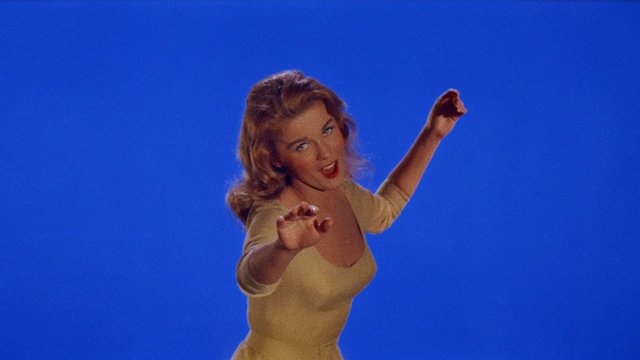
In tandem with this narrative dilution, Sidney’s direction reveals a distinct, perhaps disproportionate, fascination with his young star, Ann-Margret. Then just 22, she delivers a performance of volcanic energy and captivating screen presence. Sidney’s camera adores her, exploiting the character’s duality—the tug-of-war between girlish innocence and burgeoning sexual adulthood—with a focus that often sidelines other plotlines. Her rendition of ‘How Lovely to Be a Woman’ is a great example of this juxtaposition, perfectly capturing Kim’s infatuation with the vain, one-dimensional rock star while simultaneously trying to honour her ‘proper’ relationship with Hugo. Ann-Margret’s star power is undeniable, but the film’s obsession with her occasionally unbalances the ensemble nature of the story, making it feel as much a vehicle for a rising star as an adaptation of a cohesive stage play.
The script further anchors the film in its specific historical moment through curious, almost documentary-like inserts. Alongside Sullivan’s cameo, we find images of President John F. Kennedy and Soviet Premier Nikita Khrushchev, firmly stamping the story in the early ‘60s. Brecher even indulges in a clunky Cold War subplot involving a visiting Moscow ballet troupe on the CBS show, a narrative misfire that feels less like satire and more like a clumsy, therapeutic gesture for an audience still rattled by the recent Cuban Missile Crisis. It is a weak element, but one that reinforces the film’s role as a cultural snapshot.
And it is this role as a snapshot that constitutes the film’s most profound and enduring legacy. Bye Bye Birdie was released in April of 1963. It played in theatres for months, a vibrant, colourful celebration of a very particular American normality. Then, in November, came the shots in Dallas. For the generation that would define the latter half of the century, the assassination of JFK was the watershed, the event that permanently ended the perceived innocence of the ‘Camelot’ era. In this light, Bye Bye Birdie becomes, retroactively, a last hurrah. Viewed from the other side of that trauma, details within it acquire a haunting, unintended poignancy. The teenage protests over Birdie’s draft are playful, devoid of the grim, mortal stakes that Vietnam would soon impart to conscription. Albert Peterson spiking MacAffe’s a tortoise with miracle supplement to make it run now reads less as a slapstick joke more as an amphetamine abuse, a darker undercurrent in the supposedly sunny landscape. The world it depicts is one where such shadows were not yet fully recognised, let alone understood.
Upon release, the film received mixed-to-positive reviews and was a commercial success. Ann-Margret’s career was cemented, leading to her reunion with Sidney a year later for Viva Las Vegas, arguably Elvis Presley’s best film. Yet, its true cultural reassessment came decades later. Television writer Matthew Weiner, crafting his meticulous period drama Mad Men, recognised Bye Bye Birdie’s unparalleled time-capsule quality. He built a significant portion of the show’s third season around its references, having his characters attend a screening and react to its depiction of their world. Weiner understood that the film was less about plot and more about atmosphere—the captured light of a vanishing America.
Bye Bye Birdie is a fascinating, flawed spectacle. As a musical, it is energetically directed and buoyed by a star-making turn, yet weakened by a script that dulls its satirical teeth. As a historical document, however, it is invaluable. It freezes a national psyche in amber: optimistic, commercially vibrant, obsessively conformist yet nervously anticipating change, and blissfully unaware of the darkness gathering at the edge of its sunny, Sweet Apple horizon. It is not a great film, but it is an essential one—the last, loudest party before the silence fell.
Written by: Nic Pizzolatto
Directed by: Cary Jo Fukunaga
Running Time: 59 minutes
The second episode of any television serial traditionally marks the moment of reckoning—that precarious juncture where creators, convinced they have successfully baited their audience with a superlative pilot, often prove reluctant to lavish similar creative energy upon subsequent instalments. True Detective appears to have eluded this fate, though not through any conventional means. Rather, it is the series’ fundamentally unconventional conception that permits such evasion. The journey commenced with The Long Bright Dark promises, if Seeing Things is any indication, to be extraordinarily protracted and deliberately paced. The criminal investigation—which nominally constitutes the central narrative engine—remains stubbornly inert throughout, advancing only in the closing sequence, reserved, in accordance with respectable televisual convention, for the final scene.
This narrative inertia, however, furnishes an opportunity for deeper character excavation and environmental immersion. Those seeking dramatic surprises or plot contrivances within the investigation itself shall find none; yet the detectives, already compelling figures in the pilot, emerge as still more fascinating specimens. With Rustin Cohle, we obtain fragmentary illumination regarding his transformation into what can only be described as a human wreck. What proves particularly noteworthy is the implicit, unobtrusive, yet devastatingly effective manner in which this backstory is delivered. Cohle simply recounts his traumatic history, and even his hallucinations and trauma-induced visions present themselves without ostentation, entirely devoid of the "cool" aesthetic that lesser productions might have imposed upon such material. Whatever one's ultimate verdict on the serial, it would prove difficult for even the most zealous moralist to accuse these opening episodes of promoting narcotic consumption.
Martin Hart, conversely, reveals himself as a considerably more complex construction than his initial presentation suggested. Behind the façade of the conventional family man and composed civil servant lurks a dangerously short fuse, perpetually threatening to detonate with comparable destructiveness to Cohle's more overt dysfunction. Moreover, Hart's private life scarcely resembles that of a credible moral authority. Perhaps the most brilliant stroke lies in Hart's own awareness of these contradictions, and his discovery of the perfect rationalisation for his extramarital "activities"—which he shares with an American president whose name, cited by Hart’s conservative father-in-law as the very embodiment of modern American degeneracy, provides Hart with convenient justification before himself and others as the optimal method for reconciling his domestic and professional existence.
Whether viewers subsequently dismiss him as a repellent hypocrite or embrace these failings as evidence of common humanity, this development arrives as a perfectly calculated opportunity for HBO to deploy its trademark preoccupation—specifically, what the programme's substantial male demographic anticipates. In Seeing Things, this manifests as what might, in more innocent times, have been termed a "risque scene”, in which Alexandra Daddario—hitherto recognised primarily for her participation in juvenile Percy Jackson adaptations—exposes considerably more than her thespian capabilities to the camera's unblinking gaze.
This particular detail may strike certain audience segments as gratuitous, potentially signalling that creative exhaustion or substantive deficiency shall be compensated through cheap sensationalism and melodramatic reversals. The danger of such deterioration looms largest precisely because two episodes have elapsed without the crystallisation of any viable suspect or antagonist. Once such a figure materialises in the remaining six instalments, and once the investigation concludes with the triumph suggested by the 2012 interrogation sequences, disappointment may well ensue. Yet writer Nic Pizzolato and director Cary Joji Fukunaga retain six further episodes to obviate these potential deficiencies.
What distinguishes Seeing Things is its courageous resistance to procedural momentum in favour of atmospheric and psychological density. The episode's title references Cohle's visions—his dead daughter manifesting as a spectral presence, the flock of birds coalescing into a cosmic spiral—but these supernatural intimations are handled with remarkable restraint. They serve not as genre spectacle but as symptoms of profound psychological damage, integrated into the narrative fabric without sensationalism.
The episode's structural audacity—its willingness to privilege character over plot, implication over exposition—establishes a template that distinguishes True Detective from conventional crime drama. The investigation into Dora Lange's murder becomes almost incidental, a pretext for examining masculine pathology, institutional failure, and the American South's particular brand of gothic desolation. The cinematography continues to exploit Louisiana's landscape as a character in itself—industrial decay and primordial swamp creating a visual vocabulary of entropy and corruption.
Seeing Things confirms that this is not television designed for passive consumption. It demands engagement with ambiguity, tolerance for narrative delay, and willingness to find dramatic tension in conversation rather than action. Whether this approach can sustain itself across the remaining episodes remains contingent upon the emergence of a satisfying investigative resolution. For the present, however, the series’ confidence in its own method—its refusal to pander, its trust in the intelligence of its audience—renders it among the most compelling offerings in contemporary television drama.
RATING: 7/10 (+++)
(Note: The text in the original Croatian version is available here.)
Hello, everyone! Today I'm joining #kcontest #48 in the Korean Content (Media) category to share a cinematic gem I recently discovered that deeply moved me.
Here's the link to the contest; you still have time to participate.
It's "Lost in Starlight," Netflix's first original animated film produced in South Korea. The story follows the emotional long-distance relationship between an astronaut traveling to Mars and a musician who stays on Earth. What impacted me most was a memorable scene where the protagonist's melodies intertwine with images of deep space; visually, it's a work of art, and the nostalgic feeling completely captivates you.
I don't usually watch animated movies, but I loved this one. It's very sweet and moving.
Through this experience, I learned that the Korean animation industry not only excels in live-action but is also reaching a mature, poetic, and highly competitive level of animation. I was fascinated by how they managed to use science fiction as such a beautiful metaphor for distance, loneliness, and the invisible threads that connect us to the people we love. It's not just a pretty film; it's a deeply moving story and a unique cultural fusion that resonates in every acoustic and visual detail.
This production left me with a full heart and a great admiration for the talent of Korean animators. If you're looking for a profound story that will touch your soul this weekend, and if you love romantic stories with unexpected endings, I recommend it.
Hola, comunidad! Hoy me uno al #kcontest #48 en la categoría de Contenido Coreano (Medios) para compartir una joya cinematográfica que descubrí hace poco y que me conmovió profundamente.
Este es el link de la iniciativa todavía estás a tiempo de participar
Se trata de "Lost in Starlight", la primera película animada original de Netflix producida en Corea del Sur. La historia sigue la emotiva relación a larga distancia entre una astronauta que viaja a Marte y un músico que se queda en la Tierra. Lo que más me impactó fue una escena memorable donde las melodías del protagonista se entrelazan con imágenes del espacio profundo; visualmente es una obra de arte y la carga nostálgica te atrapa por completo.
No soy de ver películas animadas pero esta película me encantó, es muy tierna y emotiva.
A través de esta experiencia, aprendí que la industria coreana no solo destaca en el live-action, sino que está alcanzando un nivel de animación maduro, poético y sumamente competitivo. Me fascinó cómo lograron usar la ciencia ficción como una metáfora tan hermosa sobre la distancia, la soledad y los hilos invisibles que nos unen a las personas que amamos. No es solo una película bonita; es una historia muy sensible y una fusión cultural única que se siente en cada detalle acústico y visual.
Esta producción me dejó con el corazón lleno y una gran admiración por el talento de los animadores coreanos. Si buscan una historia profunda que les toque el alma este fin de semana y si eres de los que les encantan las historias románticas y con finales inesperados te la recomiendo.
Hello, cinema fans. Today we’re back with another fantastic sequel that revolutionized cinema in the early ’90s. It’s another sequel that this great director left us to show us how to surpass the genre’s classic works with something far more fascinating and special. Terminator 2: Judgment Day is a film co-written, produced, and directed by James Cameron himself. The film stars Arnold Schwarzenegger, Linda Hamilton, and Robert Patrick. Discover the sequel that brought one of the best science fiction stories to a close.
Hola, fanáticos del cine. Hoy volvemos con otra grandiosa secuela que ha revolucionado el cine a principios de la década de los 90. Otra secuela que este gran director nos dejó para enseñarnos cómo es que se deben de superar a las clásicas obras del género con algo mucho más fascinante y especial. Terminator 2: Judgment Day es una película coescrita, producida y dirigida por el mismísimo James Cameron. La película cuenta con el protagonismo de Arnold Schwarzenegger, Linda Hamilton y Robert Patrick. Conoce la secuela que le dió fin a una de las mejores historias de la ciencia ficción.
The film opens with a vision of a post-apocalyptic future as a voice narrates the events that took place. In this future, much of humanity has been completely wiped out due to a global nuclear attack caused by an Artificial Intelligence known as Skynet. This event is known as “Judgment Day,” and ever since, humanity has been at war with the machines in this dystopian world. Then, the voice narrating the story tells us that the leader of this revolution is none other than John Connor. We then jump back in time to a period when this revolutionary leader was just a teenager.
Trama
La película inicia con una visión de un futuro post-apocalíptico mientras una voz nos cuenta lo sucedido. En dicho futuro, gran parte de la humanidad ha sido aniquilada por completo debido a un ataque nuclear a nivel mundial causado por una Inteligencia Artificial conocida como Skynet. Dicho suceso es conocido como “El Día del Juicio Final” y desde entonces la humanidad ha estado en guerra con las máquinas en este mundo distópico. Luego, la voz que nos narra todo esto nos cuenta que el líder de dicha revolución es nada menos que John Connor. Acto seguido, vamos al pasado, en una época en la que dicho líder revolucionario era apenas un adolescente.
We continue with another unforgettable sequel from the past that has left a lasting impression on more than one generation. The main sequel to the iconic film The Terminator is a work that deserves to be recognized as a masterpiece of the last century. A film that inspired future generations of action and science fiction movies due to its direction and its modern approach to blending practical effects with computer-generated effects. But all of this pales in comparison to the film’s impressive narrative twist and screenplay, which completely transforms what we already knew about the classic ’80s film.
Terminator 2: Judgment Day is considered one of the best sequels in the history of cinema. This is evident simply by watching the first half-hour of the film, which continues a story that, in the previous film, primarily featured elements of horror and suspense. This time, James Cameron decides to reimagine everything we knew and offers us a change that really resonated with the story, as well as giving a certain emotional depth to a character who shouldn’t have it. As if that weren’t enough, the director himself also decided to give us a more-than-perfect conclusion to the story.
Seguimos con otra secuela inolvidable del pasado que ha logrado calar hondo en más de una generación. La secuela principal de la icónica película de The Terminator es algo que merece ser apreciada como una obra maestra del siglo pasado. Una cinta que inspiró a futuras generaciones de películas de acción y ciencia ficción debido a su dirección y su manera moderna de mezclar los efectos prácticos junto con los efectos hechos por computadora. Pero todo esto no es nada comparado con el impresionante giro narrativo y guión que posee la película, la cual cambia por completo lo que ya conocíamos de la clásica cinta ochentera.
Terminator 2: Judgement Day es catalogada como una de las mejores secuelas de toda la historia del cine. Esto se puede confirmar simplemente con ver su primera media hora de película, la cual nos ofrece la continuación de una historia que, principalmente, poseía ciertos matices de terror y suspenso en su cinta anterior. Esta vez, James Cameron decide reformular todo lo conocido y nos ofrece un cambio que llegó a calar muy bien en la historia, además de darle cierto sentimiento a un personaje que no debería de tenerlo. Por si no fuera suficiente con esto, el mismo director decidió también darnos un cierre más que perfecto a dicha historia.
A conclusion that, unfortunately, the producers of this franchise chose not to honor, instead deciding to exploit it further and further by churning out more and more sequels that strayed quite far from the core concept of the original film James Cameron gave us. When I recently commented on someone else’s post about this movie in this community, I casually mentioned that, after this great sequel, Cameron didn’t really do much else with the Terminator films. The author of the review replied that he “had nothing else to do.”
Now that I’ve rewatched this movie, I understand exactly what he meant. Judgment Day is the perfect and well-deserved conclusion to that story; there was no need for yet another sequel, and none of the ones released later had what James Cameron offered us here. Obviously, no one but himself knows how to handle the story and universe he created. There have been dozens of interpretations, some brought to the big screen and others to various streaming platforms, but none managed to convey everything this movie conveyed to us back then.
Un cierre que, lamentablemente, los productores de esta franquicia no quisieron respetar y que decidieron explotar cada vez más extendiéndola con más y más secuelas que se alejaron bastante de la idea principal de la obra que nos dió James Cameron. Cuando comenté hace poco en una publicación de otra persona que había hablado de esta película en está comunidad, casualmente dije que, luego de esta gran secuela, Cameron no llegó a particular más en otras películas de Terminator. El dueño de la reseña me respondió que él “no tenía nada más que hacer”.
Ahora que he vuelto a ver esta película entiendo perfectamente a lo que se refería. Judgement Day es el cierre perfecto y merecido de dicha historia, no hacía falta tener que hacer otra secuela más y ninguna de las que llegaron a sacar en el futuro tenían eso que James Cameron nos ofreció aquí. Obviamente, nadie más que él mismo sabe cómo manejar la historia y universo que él mismo ha creado. Han habido decenas de interpretaciones, algunas llevadas a la pantalla grande y otras a distintas plataformas de streaming, pero ninguna llegó a transmitir todo lo que nos transmitió en su momento esta película.
My experience with this series has been an emotional rollercoaster, reaching its peak with the third and most controversial installment of the franchise, which ended up being a “rehash” of this second film. But obviously, it was the visual effects that captivated a young and innocent Natto back then. As has been the case with other major film franchises, Terminator was part of my childhood and adolescence because it was one of the movies I watched most often on TV as a kid. Now, as an adult, I’ve come to appreciate these first two installments of the franchise with fresh eyes.
It’s true that the film lacks certain visual details, especially in its use of computer-generated visual effects. But this is largely due to the era in which it was produced and released, which was already a marvel in its own right at the time. In fact, one could say that the film has aged quite well, with those very visual details serving as elements that make this Terminator sequel special. Beyond that, I consider the film itself to be a complete cinematic masterpiece from start to finish that managed to revolutionize the world of cinema.
Mi experiencia con esta saga es un viaje de emociones, llegando a su punto máximo con la tercera y más polémica entrega de la franquicia, la cual terminó siendo un “refrito” de esta segunda película. Pero obviamente los efectos visuales fueron los que llegaron a fascinar a un pequeño e inocente Natto en su momento. Como ha sucedido con otras grandes franquicias cinematográficas, Terminator formó parte de mi infancia y adolescencia gracias a que era de las películas que más veía de pequeño en la televisión. Ahora, ya después de grande, fue que logré apreciar con otros ojos a estas dos primeras entregas de la franquicia.
Si es cierto que la película carece de ciertos detalles visuales, sobre todo en el uso de los efectos visuales hechos por computadora. Pero esto se debe más a la época en la que fue producida y estrenada, lo cual ya para aquel entonces fue una completa maravilla. Es más, actualmente se puede decir que la película ha logrado envejecer bastante bien, teniendo dichos detalles visuales como elementos que hacen especial esta secuela de Terminator. De resto, considero que la película como tal es una completa obra maestra cinematográfica de principio a fin que logró revolucionar el mundo del cine.
Not only in terms of its audiovisual elements, but also in its plot and story, which is set more than a decade after the events of the first Terminator film. We meet a teenage John Connor living with an adoptive family because his mother, Sarah Connor, is confined to a psychiatric hospital where she is treated as someone with severe schizophrenic issues. This has caused our young protagonist to act out, spending most of his time on the streets, robbing ATMs, and ignoring his adoptive parents.
After a strict upbringing where he spent most of his childhood learning all sorts of strategies and skills to help them survive a global catastrophe, John Connor grew up with a worldview very different from how any other young person his age would see the world. After learning that his mother has been confined for allegedly having psychological issues due to “imagining a post-apocalyptic future with human-exterminating machines,” John is completely disillusioned, viewing his own mother as a lost cause, and seeks to reclaim his lost childhood by doing whatever he pleases.
No solo a nivel audiovisual, sino también con su trama e historia, la cual está ambientada más de una década después de los sucesos ocurridos en la primera película de Terminator. Conocemos a un John Connor de adolescente viviendo con una familia adoptada debido a que su madre, Sarah Connor, está confinada en un hospital psiquiátrico donde es tratada como una persona con problemas esquizofrénicos graves. Esto ha hecho que nuestro pequeño protagonista se comporte de manera rebelde andando en la calle casi todo el tiempo mientras roba cajeros automáticos e ignora a sus padres adoptivos.
Luego de una crianza severa donde mayor parte de su infancia fue aprendiendo todo tipo de estrategias y cosas que les ayudaría a sobrevivir a una catástrofe mundial, John Connor creció con una visión del mundo muy diferente a como debería de verlo cualquier joven de su edad. Luego de la noticia de que su madre es confinada por suponer que tiene problemas psicológicos al “imaginarse un futuro post-apocalíptico con máquinas exterminadoras de humanos”, John se queda decepcionado por completo, viendo a su propia madre como un caso perdido y busca recuperar su infancia perdida haciendo lo que le dé la gana.
I think the psychological roles played by both John and Sarah Connor in this film deserve to be highlighted here because of everything they signify. I really liked the abrupt change Sarah underwent in this sequel following the traumatic experience she went through in the previous film. Surviving a killing machine completely changed her life, as you’d expect, but what’s interesting is everything she went on to do to prepare for that catastrophic future. Over time, Sarah went from being a normal, fun-loving girl to becoming a woman dangerously trained to kill.
Do you see what I mean by the abrupt change Sarah Connor underwent in this second installment? This character definitely became a great role model for all those “independent” women and mothers of that era—and of today as well. But what caught my attention most about this character is how all her preparation and training were aimed at confronting that “destiny” she envisioned—even in her dreams—of what the future would be. However, after everything we see in this movie, that vision of the future changes, and with it, her personality does as well.
Creo que el papel psicológico que poseen tanto John como Sarah Connor en esta película merece destacarse aquí debido a todo lo que esto significa. Me gustó mucho el cambio abrupto que tuvo Sarah en esta secuela luego de la traumática experiencia que vivió en la película anterior. El sobrevivir a una máquina exterminadora le cambió la vida por completo, como es de esperarse, pero lo interesante es todo lo que llegó a hacer después para prepararse para ese catastrófico futuro. Durante todo este tiempo, Sarah pasó de ser una chica normal y divertida a convertirse en una mujer peligrosamente entrenada para matar.
¿Ya entienden a lo que me refiero con el cambio abrupto que tuvo Sarah Connor en esta segunda entrega? Definitivamente, este personaje consiguió convertirse en un gran ejemplo a seguir para todas esas mujeres y madres “independientes” de aquel entonces y de la actualidad también. Pero lo que más me llamó la atención de este personaje es cómo toda su preparación y entrenamiento fue para enfrentarse a ese “destino” que visualizaba hasta en sueños de lo que sería el futuro. Sin embargo, luego de todo lo que vemos en esta película, dicha visión del futuro cambia y junto con ella su personalidad también.
On the other hand, John Connor is the perfect protagonist for this film, not only because of his rebellious personality, but also because of his emotional intelligence and the moral values he upholds. Despite having had a tough upbringing and a negative view of authority figures, John has a certain moral compass when it comes to life. We see this most clearly in his encounter with the Terminator who came from the future to protect him. By the way, the decision to turn the Terminator—who was the main villain in the previous film—into an ally is such an excellent change that it was even replicated in the franchise’s subsequent sequels.
But what’s interesting about this isn’t his role in the film, but the irony that a robot created to exterminate humans receives the order “do not kill” from young John Connor. Yes, it sounds a bit absurd at first, but then we come to understand the reason behind that order. More than a sense of morality, it’s a valuable lesson for our Terminator, who also comes to learn certain things about humanity. One of those things is sadness—or rather, the reason why humans cry. That emotion, despite being something he cannot do, he ended up understanding in the end.
Por otro lado, John Connor es el protagonista perfecto para esta película, no solo por su personalidad rebelde, sino por su inteligencia emocional y las morales que defiende. A pesar de tener una crianza dura y una visión negativa de las autoridades, John tiene cierta moral con lo que respecta a la vida. Esto lo vemos más claramente con el encuentro que tiene con el Exterminador que vino del futuro para protegerlo. Por cierto, dicho detalle de hacer del Exterminador -que en la película anterior era el villano principal- en un aliado es un cambio tan excelente que incluso fue replicado en las siguientes secuelas de la franquicia.
Pero lo interesante de esto no es su participación en la película, sino la ironía de que un robot creado para exterminar humanos reciba la orden de “no matar” de parte del joven John Connor. Si, suena un tanto absurdo al principio, pero luego llegamos a comprender la razón del por qué dicha orden. Más que un sentido de moralidad, es una lección valiosa para nuestro Exterminador, quien también llega a aprender ciertas cosas sobre la humanidad. Una de esas cosas es la tristeza, o mejor dicho la razón del por qué los humanos lloran. Dicha emoción, a pesar de ser algo que él no puede hacer, lo terminó comprendiendo al final.
John Connor not only manages to turn the dangerous Terminator into one of the best characters in the entire franchise, but he also manages to teach a robot the meaning of life. Another thing worth noting is the unique and unforgettable bond John shares with the Terminator, which can be compared to the relationship between a father and his son or two close friends. The chemistry they share from start to finish is excellent, as it makes it abundantly clear that even a machine is capable of being a great friend. While the idea of turning humanity’s most dangerous weapon into an ally is common in today’s cinema, it was truly fascinating at the time.
James Cameron is a genius when it comes to crafting a story that really hooks us. In this second installment of Terminator, he consistently challenges and subverts everything we thought we knew from the first film. We see this not only in the case of the Terminator ally that John gains, but also in the way the story concludes in a manner that makes perfect sense. This sequel always manages to connect with the previous film, but at the same time it also breaks certain patterns and delivers plot twists that are quite fascinating. Not to mention the film’s main villain, which is another of its marvels.
John Connor no solo logra convertir al peligroso Exterminador en uno de los mejores personajes de toda esta franquicia, sino que también consigue enseñarle a un robot el sentido de la vida. Otra cosa a destacar es la relación tan peculiar e inolvidable que tiene John con el Exterminador, el cual se puede comparar a la relación que tiene un padre con su hijo o dos grandes amigos. Dicha química que tienen de principio a fin es excelente ya que nos deja bien en claro que hasta una máquina es capaz de ser un gran amigo. Dicha naturaleza de convertir al arma más peligrosa de la humanidad en un aliado es normal verlo en el cine actual, pero en su momento fue algo fascinante.
James Cameron es un genio al momento de crear una historia que nos llegue a enganchar bastante bien. En esta segunda entrega de Terminator siempre consigue desafiar y cambiar todo lo que ya aprendíamos de la primera entrega. No solo lo vemos con el caso del Exterminador aliado que consigue John, sino también en la forma en la que termina todo de una manera en la que consigue tener sentido. Esta secuela siempre consigue conectar con la anterior entrega, pero a su vez también cambia ciertos patrones y nos dan ciertos giros de trama que fascinan bastante. Eso sin mencionar el villano principal de la película, la cual es otra de las maravillas que posee.
The T-1000 is a model that has gone down in history and defied the film’s lack of logic with its unique design. A machine made entirely of malleable liquid metal that replicates anything it touches that has its own shape or size (except for other machines or weapons). A virtually invincible robot that becomes the main enemy to defeat in this film. Every time it appears, it’s a marvel, especially because it manages to convey that coldness and cruelty in a way that requires almost no dialogue. Its manner of acting, behaving, and attacking alone is more than enough to convey everything a dangerous and intelligent machine possesses.
Another highlight of this film is the action scenes, which are perfect for their time, especially because of how James Cameron manages to construct each shot or setting for those moments. The film manages to entertain throughout its more than two-hour runtime, offering scenes that are practically unforgettable. At this point, I think it’s worth mentioning the film’s audiovisual aspects, as Cameron himself managed to outdo himself by producing and directing this sequel. Both the camera work and the use of static and slow-motion shots are fascinating.
El T-1000 es un modelo que logró pasar a la posteridad y que desafío el poco sentido de lógica de la película con su diseño tan particular. Una máquina hecha 100% de metal líquido modelable que replica todo lo que toca y que tenga su propia contextura o tamaño (exceptuando otras máquinas o armas). Un robot prácticamente invencible que se vuelve el principal enemigo a vencer en esta película. Cada vez que aparece es una maravilla, sobre todo porque logra transmitir esa frialdad y crueldad de una manera que no necesita de casi ningún diálogo. Con solo su forma de actuar, comportarse y atacar ya es más que suficiente para transmitir todo lo que una máquina peligrosa e inteligente posee.
Otra cosa a destacar de esta película son las escenas de acción, las cuales son perfectas para su época, sobre todo por cómo James Cameron logra construir cada plano o escenario para dichos momentos. La película logra entretener en su más de dos horas de duración, consiguiendo ofrecer escenarios que son prácticamente inolvidables. Para este punto creo que es idóneo mencionarles el apartado audiovisual que posee esta película, la cual el mismo Cameron logró superarse a sí mismo al producir y dirigir dicha secuela. Tanto el uso de cámaras como los planos fijos y en movimiento lento son fascinantes.
The same goes for the film’s cool and varied color palette, as well as its use of light and shadow. Something I really liked about this film is the impeccable quality of every scene, which is perfectly composed so that each character stands out quite well. James Cameron managed to deliver a spectacular audiovisual experience by balancing perfectly composed shots with flawless performances, well-executed practical visual effects, and expertly integrated sound effects. These effects stood out so much that even today they remain a benchmark of excellence.
We can’t say the same for the computer-generated visual effects, but they’ve aged quite well nonetheless. The film successfully conveys the tension and action it aims for in every scene with a perfect variety of visual elements and transitions that make a strong impact. There is a certain scene in this film that has become more than iconic, much like Sarah Connor’s dream. That scene, while not the best visually, perfectly conveys the desperation and the terrible fate that awaits this world. The soundtrack, like the sound effects, really stands out, especially in the action scenes. In short, here’s another cinematic gem you simply must see.
Personally, I give it a well-deserved 10/10 rating in the action, science fiction, and suspense genres.
Lo mismo sucede con la paleta fría y variada de colores, al igual que el uso de luces y sombras en la película. Algo que me gustó mucho de esta película es la calidad impecable de cada escena, compuesta perfectamente para que cada personaje logre destacarse bastante bien. James Cameron logró darnos un gran espectáculo audiovisual al equilibrar los planos perfectamente compuestos con actuaciones perfectas, efectos visuales prácticos bien hechos y efectos de sonido muy bien añadidos. Los mismos efectos consiguieron destacarse tanto que aún en la actualidad son una completa excelencia.
No podemos decir lo mismo de los efectos visuales hechos por computadora, pero igual envejecieron muy bien. La película logra transmitir la tensión y la acción que busca en cada escenario con una variedad perfecta de elementos visuales y transiciones que logran impactar muy bien. Hay cierta escena en esta película que pasa a ser más que icónica como lo fue el sueño de Sarah Connor. Dicha escena, si bien no es la mejor a nivel visual, logra transmitir perfectamente la desesperación y el terrible destino que tiene este mundo. La banda sonora, al igual que los efectos de sonido, logran destacarse bastante bien, sobre todo en escenas de acción. En fin, aquí les dejo otra gran joya del cine que deben de ver.
Personalmente, le doy una merecida calificación de 10/10 en lo que respecta al género de acción, ciencia ficción y suspenso.
Tell me, have you seen this movie yet? What did you think of it? Feel free to leave your thoughts in the comments.
Dime, ¿ya has visto esta película? ¿Qué te ha parecido? Puedes dejarme tu respuesta en los comentarios.
Released in 1987 and directed by Joel Schumacher, The Lost Boys helped reinvent vampire movies for a new generation. Before this film, vampires were often portrayed in a more gothic and traditional way. Schumacher took that formula and mixed it with California biker culture, rock music, teenage rebellion, and MTV era style. The result was something completely unique for its time.
Jason Patric stars as Michael Emerson, a teenager who moves with his family to the fictional coastal town of Santa Carla after his parents split up. Michael quickly gets pulled into the world of a mysterious biker gang led by the charismatic David, and before long he realizes something far darker is happening beneath the town’s boardwalk atmosphere.
Kiefer Sutherland is fantastic as David and honestly creates one of the coolest vampire villains of the eighties. He barely even needs to raise his voice because his confidence and presence do all the work. Sutherland gives David this mix of danger and charisma that makes it believable why Michael gets drawn toward him.
Corey Haim plays Sam Emerson, Michael’s younger brother, bringing humor and nervous energy to the story. Sam becomes the emotional center of the film because he reacts like an actual terrified kid once he realizes vampires are real. Haim’s chemistry with the Frog Brothers adds a lot of the movie’s comedy.
Corey Feldman and Jamison Newlander as Edgar and Alan Frog became cult icons because they fully embrace the ridiculousness of being comic book obsessed teenage vampire hunters. They are absolutely corny in the best possible way, and the movie would not feel the same without them.
Dianne Wiest also deserves praise as Lucy Emerson, the boys’ mother. She brings warmth and sincerity to the family side of the story, which helps ground the crazier horror elements happening around her.
Joel Schumacher directs the film with maximum style. Neon lights, fog, motorcycles, loud rock music, and over the top visuals are everywhere. The movie completely embraces its eighties identity instead of trying to hide it, and honestly that confidence is a huge reason it still works.
The plot itself is simple but effective. Michael slowly falls under the influence of David’s vampire gang while Sam and the Frog Brothers try to save him before he fully turns. It is basically a horror version of teenage peer pressure and rebellion, which gives the story more depth underneath the surface.
One of the best things about The Lost Boys is its atmosphere. Santa Carla feels dangerous and exciting at the same time. The boardwalk, comic shop, concerts, and hidden vampire lairs all create a world that feels alive and memorable.
The soundtrack is also legendary. Songs like “Cry Little Sister” became permanently connected to the movie because the music helps define the entire tone. The film feels like a giant rock video in the best possible way.
Now yes, parts of the movie are definitely corny. Some dialogue is pure eighties cheese, some fashion choices are hilarious now, and certain scenes lean heavily into melodrama. But honestly, that is part of the charm rather than a weakness.
The movie understands exactly what kind of experience it wants to deliver. It is not trying to be dark gothic realism. It wants to be stylish, fun, creepy, and rebellious all at once. That confidence makes the movie endlessly entertaining.
What also helps the film hold up is the balance between horror and humor. It never becomes too serious or too goofy for too long. Schumacher constantly shifts between laughs, suspense, and genuine horror in a way that keeps the pacing strong.
Over time, The Lost Boys became one of the defining cult films of the eighties because it captured such a specific vibe and era perfectly. You can see its influence on later vampire films and television shows everywhere.
In the end, The Lost Boys remains a classic to me because it succeeds at being exactly what it wants to be without holding anything back. The movie mixes horror, comedy, romance, action, and pure eighties style into one unforgettable experience that still feels entertaining decades later. Kiefer Sutherland delivers one of the coolest vampire performances ever, the soundtrack became iconic, and Joel Schumacher created an atmosphere that feels both dangerous and strangely fun at the same time. Yes, some parts are definitely corny now, but honestly that only adds to the charm because the movie never tries to act cooler or smarter than it is. The Lost Boys embraces its wild style completely, and that confidence is exactly why it still stands as one of the most enjoyable vampire films ever made.
I saw a snippet of the movie on tiktok and I knew I had to watch it. This movie was way too heavy, it's the kind that you still feel even hours after watching it, I swear I still haven't recovered.
My Sister’s Keeper is based on the novel by Jodi Picoult and it follows Anna Fitzgerald, played by Abigail Breslin as she fights for medical emancipation from her parents. She was conceived for a specific purpose, she had to be a genetic match for her older sister Kate, who has leukemia. From childhood, Anna undergoes countless medical procedures to help keep Kate alive. But at age eleven, she sues her parents for medical emancipation, essentially demanding the right to control her own body.
The plot alone already tug your heartstrings as you try to wrap your head around what it feels like to be an organ bank for someone else. This movie contemplates "At what point does love become possession?" And “Would you save one child at the expense of another?”. What makes the movie works so well emotionally is because nobody feels completely wrong. You can put yourself in the shoes of opposing characters and still understand where they are coming from, most movies can't pull that, there's usually a clear line, but My Sister’s Keeper refuses that. Sara Fitzgerald (the mother), played by Cameron Diaz, is simultaneously loving and terrifying. She dedicates her entire life to saving Kate. She sacrifices her career, her marriage, her sanity, and nearly every aspect of normal life. And yet, in doing so, she slowly stops seeing Anna as a separate person. That’s what makes the movie so emotionally complicated because she is not malicious. She is just desperate. Her parental love parental love mixed with fear of losing kate, can become controlling without the her even noticing. I was torn between sympathy and frustration because understand where she's coming from. But I resent her, then I feel guilty for resenting her.
I feel Anna's fight was more than just about controlling her body. It was more about identity. Imagine growing up knowing your existence had a medical purpose attached to it from birth, knowing that if her sister wasn't sick she might have not even exist. Every surgery, every needle, every hospital visit reinforces the idea that your body belongs partly to someone else. Her taking control and resisting to give her sister one of her kidneys doesn't mean she's wants her sister to die, or that she's just rebellious because she clearly loves her but this was her trying to see if she can exist outside being a organ donor for her sister. Anna carries a heavy responsibility throughout the film, something she shouldn't. She is emotionally older than she should be, like someone forced to mature too quickly because illness consumed her family’s entire emotional ecosystem. And it's not just her but everyone in the family becomes emotionally shaped around Kate’s illness. Even Jesse, the older brother, becomes almost invisible.
Jesse Fitzgerald , played by Evan Ellingson, is the saddest character. Jesse is drowning emotionally, yet nobody fully notices because of Kate’s illness. This is one of the realistic aspects the movie portray. Families dealing with chronic illness, the other children pay emotionally They’re expected to “understand,” stay quiet, mature faster, and avoid adding problems to an already overwhelmed family. Jesse acts out through rebellion and destructive behavior, but underneath that anger is neglect. This leads you to ask, What happens to the children who aren’t dying, but are still suffering?
Funny enough Kate, played by Sofia Vassilieva, the sick child everyone is trying to save has the least control over her own life. She is exhausted by years of treatment, pain, hospitals, and false hope. She wants to go but her mother is holding on strong, which essential forces her to tell her sister to reject helping her so she can pass on. Suddenly, Anna’s lawsuit becomes less about rebellion and more about love. A painful kind of love. The emotionally intelligence in the movie shines through as I understand that fighting endlessly to stay alive is not the same thing as living. I'll critic the fact that the movie moved far from realism in most aspects, especially the legal scene. They were more emotional than real. I also found out that the movie changed the ending of the novel, and fans argued that the original ending was harsher but more thematically powerful. The film’s ending feels more emotionally comforting than the novel’s deeply tragic irony.
My Sister’s Keeper is not just about cancer. It’s about the psychological weight of loving someone you cannot save.
It's about trying to fight through impossible choices. What make it sad is that nobody’s pain cancels out anybody else’s. Everyone pain is justified. My Sister’s Keeper is emotionally overwhelming, occasionally manipulative, imperfectly written, and carries a powerful message. Nobody exists purely to be right or wrong. They are simply people trying, and often failing, to navigate grief before grief has even fully arrived. Underneath the melodramatic, emotional, and sentimental scenes are genuine ethical questions:
Can love for one child unintentionally become injustice toward another? How do families survive when love itself becomes painful?
It's Still Abeegail,
Thank you for Reading 🥹
The images are scenshots from the movie,
Thank you for stopping by.
The opening decades of the 21st Century have proven to be a golden age for Brazilian cinema, a period during which the nation’s film industry shed its reliance on the telenovela format and began to vie for serious attention on the world stage. This resurgence was not merely a matter of statistical increase, though the number of films receiving international acclaim and securing prestigious awards did rise significantly. More importantly, Brazil began producing works that penetrated global popular culture, spawning sequels, launching transnational careers, and achieving a level of commercial success that few national cinemas can match. Among the list of films that successfully bridged the gap between arthouse prestige and commercial viability, Elite Squad stands out as a formidable anomaly, a cinematic achievement that few Brazilian films have been able to replicate.
Somewhat unsurprisingly, the enduring success of Elite Squad stems from its refusal to play the game of the "dour arthouse" directors who populate the international festival circuit. It is not a self-indulgent, politically charged drama that relies on snobbish critics to validate its worth through obscure themes. Instead, the film is a pure genre piece, a crime action thriller that delivers visceral excitement with a relentless kinetic energy. It understands the mechanics of storytelling and the audience's desire for tension and spectacle, eschewing pretension in favour of raw, unfiltered narrative propulsion. Yet, this genre classification does not diminish its sophistication; rather, it enhances it, grounding its high-octane action in a narrative structure that is both gripping and deeply rooted in reality.
The film's foundation is built upon a true story, one that lends it a documentary-like authenticity. It is based on the 2006 eponymous book co-written by André Batista and Rodrigo Pimentel, two veterans of BOPE – the Special Operations Battalion of the State of Rio de Janeiro – and the prominent sociologist Luiz Eduardo Soares. This collaboration between active-duty law enforcement and a sociologist provides the script with a dual perspective: the gritty, tactical reality of the streets and the broader sociological analysis of the favelas. The result is a film that feels less like a Hollywood fabrication and more like a captured slice of history, albeit one polished for dramatic effect.
The plot unfolds in Rio de Janeiro in 1997, shortly before the visit of Pope John Paul II. The visit requires a level of security that the city's regular police force cannot provide, leading to orders for a security sweep of the notorious favelas to deal with heavily armed drug dealing gangs with extreme prejudice. At the centre of this operation is Captain Nascimento (Wagner Moura). Nascimento is a man of action, hardened by years of violence, but he is also a man with a personal crisis: he has learned that his wife is pregnant and wants a transfer to a desk job. However, before he can leave the front lines, he must find a worthy successor within the force who can take over his responsibilities.
The opportunity for this succession arises when BOPE is called to intervene in an extremely violent and bloody confrontation. It occurs during a meeting between local drug dealers and a group of military policemen led by Captain Fábio Barbosa (Milhelm Cortaz). This conflict is deeply entrenched in personal and political rivalry; Barbosa has stolen money from Oliveira (Marcello Valle), his rival and superior, and the meeting is likely a trap. To protect himself, Barbosa brings two fresh recruits—Neto Gouveia (Caio Junquiera) and André Matias (André Ramiro)—armed with a sniper rifle. BOPE, utilising their superior firepower, training, and tactical doctrine, ends the fight decisively. Nascimento, observing the competence of the recruits in the heat of battle, offers them the chance to apply for the BOPE. After months of gruelling jungle training where many candidates fail, Neto and Matias succeed and are officially inducted into the elite unit.
For Matias, the situation is noticeably more complicated. Unlike Neto, who is a simple soldier, Matias balances his life as a BOPE operator with his studies at university, where he is pursuing a law degree. It is here that he meets Maria, a student from a middle-class background. A romance blossoms, but it is a romance built on a delicate foundation of secrecy and social friction. Matias is very careful not to mention his day job to Maria because his colleagues—along with Maria and their friends—tend to be liberals from the middle and upper classes who despise the police. They use marijuana, belong to NGOs that help children from the favelas, and view the police with a mixture of pity and suspicion. This class dynamic creates a tension that permeates Matias's life, forcing him to hide his profession from the person he loves.
This social friction explodes when the gang led by the ruthless Baiano (Fábio Lago) becomes involved. Baiano confronts the students about Matias being a policeman and, driven by the need for revenge after people from his community were killed in a previous incident, he organises an ambush. The ambuscade is successful, and Neto is killed. The tragedy weighs heavily on the BOPE unit. When Baiano learns that Neto had a BOPE tattoo, he goes into hiding, fearing Nascimento’s retribution. Nascimento tracks Baiano down, engages him in a brutal confrontation, and wounds him. In the film's final, symbolic scene, Matias takes a fatal shot, effectively taking Nascimento’s place and ending his own duality, choosing his brotherhood and his mission over his civilian life.
The director, José Padilha, had already become famous in Brazil thanks to his award-winning documentary Bus 174, which dedicated itself to the infamous 2000 bus hijacking in Rio de Janeiro. While researching the film, Padilha was introduced to the various characters in the favelas, but crucially, he was also introduced to the policemen and the BOPE. This exposure heavily influenced Elite Squad, his live-action debut. Padilha brings the same observational eye he used in the documentary to this fictionalised account, grounding the hyper-kinetic action in a lived-in reality that feels terrifyingly plausible.
Elite Squad is interesting not only because of its credentials as an action film but because of its unique and uncompromising approach towards the issue of crime and violence in the favelas. This approach is completely opposite to that espoused by many of the world's film critics, who tend to be composed of "limousine leftists" who view the favelas solely through the lens of victimhood and systemic oppression. Instead of using the perspective of the criminal or the impoverished people, Elite Squad adopts the perspective of the policemen. Padilha does not evade the issue of widespread corruption within the police ranks; indeed, it is a central theme. However, BOPE is portrayed not as a force for good in a romantic sense, but as a brutal and efficient crime-fighting tool.
Nascimento's methods of dealing with the favelas look more like penal expeditions than attempts to actually enforce the law. The film does not view Nascimento's heavy-handed methods—which include torture and extrajudicial killings—as problematic or morally ambiguous. Instead, at worst, these human rights abuses are portrayed as a necessary evil in the fight against something far worse: the chaos and violence of the drug gangs. It is a grim, transactional view of law and order that prioritises the preservation of the state's authority over the niceties of human rights.
Padilha didn't win many friends in the world's liberal and progressive circles by showing that those who are supposed to care about human rights—the middle and upper-class activists and intellectuals—are often hypocrites. They use the favelas as a backdrop for their own moral posturing, their NGO work often serving their own career advancement rather than effecting real change. This ideological clash might explain why the film was greeted with a colder reception by critics in the West, despite its massive popularity among general audiences. In Brazil, the film became a massive hit, breaking box office records despite a mass internet leak shortly before its premiere. It was eventually crowned with the Golden Bear at the Berlin Film Festival in 2008, a prestigious accolade that recognized its artistic merit, even if it baffled some Western critics who were uncomfortable with its unapologetic stance.
Part of the film's brilliance lies in Padilha's clever direction, which handles a complicated plot with a great sense of rhythm. The editing is quick and comprehensive, transitioning seamlessly between scenes of action. The acting is brilliant across the board, but especially by Wagner Moura, whose portrayal of Nascimento is a masterclass in gritty character acting. Moura imbues the Captain with a weary authority that makes his brutality feel earned rather than gratuitous. André Ramiro also delivers a strong performance as Matias, capturing the internal conflict of a man torn between two worlds. The film also benefits from an ironic voiceover narration that helps with exposition without feeling clunky. Furthermore, the music plays a crucial role; the upbeat, catchy tune "Rap das Armas" became an anthem for the film, merging the rhythm of hip-hop with the sound of gunfire, perfectly encapsulating the film's unique aesthetic.
The film became immensely popular not only in Brazil but across the rest of the world. This global resonance speaks to the universality of the themes it tackles. Many countries around the world face the same problems as those depicted in the film—urban decay, gang warfare, and the failure of state institutions to protect their citizens. In these contexts, the BOPE represents a simple but brutal solution that people can understand and, perhaps, envy. The concept of the "elite squad" has become a popular synonym for swift, uncompromising justice in the face of chaos.
In 2010, Padilha directed the sequel, Elite Squad II: Enemy Within, which continued to explore the political and social landscape of Rio with equal intensity. The success of the first film paved the way for significant career opportunities for both Padilha and Moura. Later, the two reunited on the set of Narcos, one of the most popular TV series of its time. This reunion was not accidental; it was the direct result of the credibility and international recognition that Elite Squad provided. It proved that Brazilian cinema could not only tell its own stories but could also tell them in a way that resonated globally, challenging the established norms of Hollywood and international film criticism alike.
In this second chapter, Caine decides to send the traumatized Pony, along with Ragatha, Jax, Gangle, and Kinger, to a completely new map: the Candy Kingdom, to complete a mission for Princess Candy: to rescue a cart full of honey that was stolen by the Gummigoo Crocodile gang. They succeed, capturing the thugs, but Pony and Gummigoo the Crocodile end up falling under the map.
Pomni and Gummigoo meet on the path and collide. Due to a system error, they glitch and fall through the floor. As they plummet into the void, Gummigoo wanders around the area where he lands and finds a room filled with 3D models identical to himself, his mother, his friends, and his village.
It is then that the crocodile discovers the truth: his entire life, his childhood memories, and his home are just an illusion created by Caine. He is not a person; he is just an NPC (a non-player character) designed to be the villain of a repetitive mission. Gummigoo enters an existential identity crisis and is completely paralyzed by shock and sadness.
When the gummy bear realizes it's an NPC, it's shocked because it sees its entire life and realizes it doesn't exist. Pomni, who had become its friend, tells it, "Don't worry, I'll take you to the circus where we all are so you won't feel so alone." They leave there and then drive off in the truck full of honey. And Jacks, on purpose, leaves the key in the ignition so the monsters can eat the chocolate kingdom.
When everyone finally reached the Digital Circus through a portal opened by Caine, Gummigoo crossed over with the group and excitedly arrived at the Digital Circus, ready to start a new life... but the happiness lasted only a few seconds.
Caine saw them, panicked, and uttered his famous line about not being able to distinguish between a human and an NPC. With a snap of his fingers... Caine erases Gummigoo from existence instantly!
And what shocked me was that when the gummy bear Pomny disappeared, she was stunned, seeing how the only friend she'd made since arriving at the digital circus had vanished. Pomny was just as shocked as I was.
En este capítulo nro 2 Caine decide enviar a la traumatizada Pomni, junto con Ragatha, Jax, Gangle y Kinger, a un mapa completamente nuevo: el Reino de los Dulces a completar una misión de la princesa Caramelo, para rescatar un carro lleno de miel que fue robado por la banda de los cocodrilos de goma. Lo logran, atrapan a los maleantes, pero Pony y el cocodrilo Gummigoo terminan cayendo debajo del mapa.
Pomni y Gummigoo se encuentran en el camino y chocan y por un error del sistema se buguean, traspasan el piso. Al caer al vacío, Gummigoo camina por todo el sitio donde cae y encuentra una habitación llena de modelos 3D idénticos a él, a su mamá, a sus amigos y a su pueblo.
Es allí cuando el cocodrilo descubre la verdad: toda su vida, sus recuerdos de la infancia y su hogar es solo una ilusión creada por Caine. No es una persona, es solo un NPC (un personaje no jugable) diseñado para ser el villano de una misión repetitiva. Gummigoo entra en una crisis de identidad existencial y se queda completamente paralizado por el shock y la tristeza.
Cuando la gomita sabe que es un NPC, se queda en shock porque ve toda su vida y se da cuenta de que no existe. Pomni que se había convertido en su amiga le dice: "No te preocupes, te voy a llevar al circo donde estamos todos para que no te sientas tan solo". Salen de ahí y después llevan la camioneta llena de miel. Y Jacks, a propósito, deja la llave abierta para que los monstruos se coman el reino chocolate.
Cuando todos lograron llegar al circo digital gracias a un portal que abre Caine. Gummigoo cruza junto al grupo y llega emocionado al Circo Digital, listo para empezar una nueva vida... pero la felicidad duró muy pocos segundos.
Caine los ve, entra en pánico y dice su famosa frase de que "no puede perder la noción de quién es un humano y quién es un NPC". Con un chasquido de dedos... ¡Caine borra a Gummigoo de la existencia instantáneamente!
Y lo que me impactó fue que cuando desaparecieron al oso gomita Pomny se quedó en shock, viendo cómo el único amigo que había conseguido desde que llegó al circo digital había desapareció. Pomny nuevamente queda en Shock igual que yo.
Terminar de ver “Hacemos lo que podemos” (We Are All Trying Here) me ha dejado con un nudo en la garganta, pero de esos que se sienten bien, que vienen acompañados de una sonrisa cálida. Es una mezcla extraña y hermosa de nostalgia pura por los sueños que dejamos en el camino y, al mismo tiempo, una alegría inmensa por el simple hecho de seguir aquí, intentándolo.
Finishing “We Are All Trying Here” left me with a lump in my throat—but one of those that feels good, accompanied by a warm smile. It’s a strange and beautiful mix of pure nostalgia for the dreams we left behind and, at the same time, immense joy at the simple fact that we’re still here, still trying.
La historia de Dong-man y su eterna lucha de 20 años por debutar como director me tocó una fibra muy íntima. Verlo aferrarse a su pasión, con esa energía que a veces agota a sus amigos pero que en el fondo es su único escudo contra el miedo a la intrascendencia, me hizo mirar hacia atrás. Me hizo recordar mis propios proyectos, esas metas que hace años veía tan claras y que el tiempo, la rutina o los tropiezos fueron transformando. Da nostalgia, claro que sí. Te hace pensar en el "qué hubiera pasado si...".
The story of Dong-man and his 20-year struggle to make his directorial debut struck a very deep chord with me. Watching him cling to his passion, with that energy that sometimes wears his friends out but is ultimately his only shield against the fear of insignificance, made me look back. It reminded me of my own projects, those goals that years ago seemed so clear and that time, routine, or setbacks gradually transformed. It’s nostalgic, of course it is. It makes you think about “what if…”.
Pero lo maravilloso de este drama es que no se queda en el lamento. Cuando Eun-a entra en escena con sus propias heridas y deciden apoyarse, la serie se convierte en un abrazo contenedor. No nos vende el típico cuento de hadas donde de la noche a la mañana el éxito llega y todo es perfecto; nos dice, con una honestidad brutal pero tierna, que fracasar, sentir envidia, tropezar y tener miedo está bien. Que el valor no está en la meta, sino en la resistencia diaria.
But the wonderful thing about this drama is that it doesn’t dwell on self-pity. When Eun-a enters the scene with her own wounds and they decide to support one another, the series becomes a comforting embrace. It doesn’t sell us the typical fairy tale where success arrives overnight and everything is perfect; it tells us, with brutal yet tender honesty, that failing, feeling envy, stumbling, and being afraid is okay. That courage isn’t found in the finish line, but in daily resilience.
Ver los matices de personajes tan reales como el hermano soldador o los amigos del club de cine me llenó de una alegría muy reconfortante. Es la alegría de saber que no estamos solos en este caos, que todos —a nuestro propio ritmo y con nuestras propias trabas— estamos haciendo lo que podemos.
Seeing the nuances of characters as real as the welder brother or the friends from the film club filled me with a very comforting joy. It is the joy of knowing that we are not alone in this chaos, that all of us—at our own pace and with our own obstacles—are doing the best we can.
Al final, me quedo con esa sensación agridulce pero luminosa. “Hacemos lo que podemos” no es solo un drama sobre la industria del cine; es un espejo de la vida misma que te invita a abrazar tu pasado con nostalgia, pero a mirar el presente con la frente en alto y una sonrisa, listos para el siguiente intento.
In the end, I’m left with that bittersweet yet uplifting feeling. “We Are All Trying Here” isn’t just a drama about the film industry; it’s a mirror of life itself that invites you to embrace your past with nostalgia, but to look at the present with your head held high and a smile, ready for the next attempt.
Te invito a a ver esta maravillosa serie para mi fue un 10\10. Al comienzo pensé que no me atraparía, pero a mitad de capitulo simplemente me identifique perfectamente, todos los seres humanos tenemos un historia diferente que contar, diferentes traumas, diferentes miedos y cada uno los superamos o lo estamos superando a nuestro modo o como dice su nombre: "Hacemos lo que podemos"
I invite you to watch this wonderful series—for me, it was a 10 out of 10. At first, I didn't think it would grab me, but halfway through the episode, I just really related to it. Every human being has a different story to tell, different traumas, different fears, and we all overcome them—or are overcoming them—in our own way or as the title says: we do what we can.

 Source
*Film poster /Affiche du film *
Source
*Film poster /Affiche du film *