Longform reviews of films, TV, anime, books, and audiobooks, written by the scrobble.life community and published to the Hive blockchain, so each one is owned by its author and can earn rewards from readers. 60,636 reviews and counting.
I have a fondness for movies by Guy Ritchie because they are consistently brilliant and sophisticated, especially his action films. So whenever I hear one of his projects is coming up, I know I'm in for a good time and this recent release features the dashing Henry Cavill with Jake Gyllenhaal and Eiza Gonzalez.
In The Grey (2026) is an American action thriller written, directed and produced by Guy Ritchie. The movie opens with a voiceover narration by Rachel (Eiza Gonzalez) telling us about a lawyer who tries to recover a debt of $1bn from businessman Manny Salazar (Carlos Bardem) for a powerful financial firm called Goldstein. The lawyer and his bodyguard are killed by Salazar's henchman.
Rachel approaches the top executive of Goldstein, Bobby (Rosamund Pike), with an offer to recover the full sum and they settle for a ten percent fee. She doesn't do this job alone but recruits her boys, Sid (Henry Cavill) and Bronco (Jake Gyllenhaal) who are the brawn and brains of her team to work with her. They sit at a strategy room to plan her escape since Salazar is known to kill the lawyers sent to him to avoid paying his debt.
When Rachel meets with Salazar's lawyer, Horowitz and begins to tighten the legal noose around Salazar, it becomes obvious a similar fate awaits her like the dead lawyer. Can Sid and Bronco successfully pull Rachel out of Salazar's island?
My Review And Rating
Guy Ritchie did great with this movie in my opinion. The plot is brilliant and the storytelling is stylishly done in the Ritchie way—slick and sophisticated. The focus, just as the title reads, is not about ‘black and white’ but the grey areas between the legal and illegals as Eiza Gonzalez states in her narration. I also like that this movie portrays another side to the plot—that of a family protecting themselves. Rachel is referred to as ‘mum’ and her team are her ‘kids’ who would do anything to protect her.
The cast and their acting are outstanding. The leads are regulars in Ritchie's movies so I think they are familiar with each other. Their relationship feels real and seamless. Jake Gyllenhaal and Henry Cavill give the vibe of a gay couple with their witty remarks but whether they are truly, the movie doesn't expatiate on this. So I take it as part of the humour. They embody their characters so well and are very protective of Eiza Gonzalez. You'll wonder at the beginning why the boys are attached and devoted to Gonzalez's character. Ritchie doesn't bore his audience with a lengthy story of their past but simply explains this in a single shot flashback. And that's satisfying.
The actions in this movie reminds me a little of the Mission Impossible series with the car and bike chases, and gun fights. The transitions between the action zones, strategy room and courtroom are sleek and well done.
The scenes that stand out for me are where Eiza Gonzalez narrates her expectations in tackling Salazar (Carlos Bardem) while meticulously making a cocktail. It's not a drink I'm familiar with but for Ritchie to devote a good time listing the recipe via on-screen text tells me it's not a drink for anyone or everyone. Also, her verbal spars with Rosamund Pike are interesting to watch. Though Pike has little screen time in this movie, she made them count.
I'll admit the texts on the screen about character names, locations, job titles and even ingredients of making a cocktail are a little much for me. I found them distracting and wished Ritchie didn't decorate our screens as much.
The cinematography is perfectly done in my opinion. The camera angles and visuals capture the action smoothly while the transitions pull us along in the ride. I liked the display of fine scenery and locations such as Saudi Arabia, Spain and the Islands.
Rating this movie, I'd give it 8 stars out of 10. Ritchie takes his films seriously and this one might be one of his best. It's fast-paced, action-packed with charismatic actors and compelling.
I am an actor, singer, voice actor, reviewer, artist, writer, blogger, and arts, entertainment, music, media, and culture maven ready to inform and entertain.
Javier Camarena and Nadine Sierra strike up an impassioned vocal and theatrical storm as the world-renowned star-crossed lovers, Roméo and Juliette. Please enjoy my review and let me know your opinions.
I have mention this a few times but this series is what got me thinking back on 2019 that AppleTV had some quality, back then you only got Netflix and AppleTV was basically starting with a small catalog and they kick the door with For All Mankind, but as any other series it has been dragging the more seasons it gets but it is still good enough to watch and also creates this sense of nostalgia too. Season five has been something I have been waiting on for a while but with everything going on irl I had no time to watch so now Im catching up, but S05E01 gave me that mix of dread and excitement you only get from a show you have been watching for a while. I have been riding with this series since episode one of season one and what made it so good back then was the feeling that space was enormous and indifferent and that every single decision these characters made could get someone killed in the coldest possible way. So you can imagine what it was like to sit down and spend the first few minutes watching Mars Peacekeepers do corridor curfew patrols and chase down a young woman named Lily Dale for spray painting free Mars on a wall. You get the usual alternate history to kick things off, JFK Jr still walking around, Blockbuster Video still a thing in this timeline, which is a nice little does of nostalgic to remind you this is not our world, not our reality and then you land on Happy Valley and immediately something feels off. Not scary off but more wrong in a place that has already gone bad kind of way. I was trying to get confy after a long day and instead of getting that familiar rush I usually get from this show, I found myself leaning forward almost like I dont recognize it, because what I was watching was not a colony of explorers reaching for the stars anymore, it was a society already rotting from the inside out, so this is really something different although I was not sure yet if it was for better or worst.
I want to give credit where it is due, the episode plants seeds all over the place without spelling everything out for you. Alex Baldwin, Kellys kid, is out on his spacebike doing taking a ride on the Martian surface and crashes, and finding Yoon Tae Min dead out there shifts everything from a graduation day story into something much darker very fast. There are several scenes out on that red surface, Kelly going out to Korolev Crater for her EVA work, the hopper retrieval, all of that, so it is not like we are stuck inside a building the whole time. What is missing is the scale, the terror, the sense that space itself could kill you at any second and that absence is the real key factor missing. The discovery of Yoon is shot in this cold and clinical way, focusing on what depressurization does to a person and it completely shakes off what the episode look like at first, almost like the "hold my beer" meme because you know something drastic is going to happen, you go from a graduation party vibe to a homicide investigation with no warning at all. For most of the hour the murder mystery stays in the background while the Peacekeepers piece things together, and it is only in the final minutes when DNA evidence under Yoon fingernails leads them straight to Lee Jung Gil, the first human to ever walk on Mars, that the episode drops its real gut punch. That final arrest lands hard because of the history and the weight of who Lee is to this show and to Mars itself and it is the one moment in the premiere that actually got my blood pumping the way the early seasons used to.
If I get to compare this first episode to the earlier seasons is almost painful, because those other episodes as I have mention where not much about society drama, they used to hit you with some massive setup disaster, a solar flare, an equipment failure, some terrifying reminder that space does not care whether you live or die. Here we swap all that out for a murder investigation and a series of quiet rooms and there is a huge contrast that slow things down dramatically. The one character moment that actually cut through all of it was Ed Baldwin, who is under house arrest with an ankle monitor but still moving around Happy Valley, showing up in his Navy dress blues for the graduation, picking on the crew almost like showing them he still kicking and use to be the boss of this entire thing, and then having this quiet scene at the doctor dealing with stage three cancer that somehow made me feel bad for the guy, at least the episode got some feelings out of me, I have explain many times that for content to be good it has to make you feel something about what the characters are going through. Ed used to be this guy who stared down death on a daily basis and found it kind of funny, after that episode where he miss the oportunity to be the first to touch the moon he said NO MORE, so he never ever back down from an oportunity and now watching him with an ankle monitor and a cancer diagnosis while still trying to help the people around him is moving. The show is trying to make you feel the weight of decades passing and the cost of everything these characters sacrificed and with Ed it absolutely succeeds, it is just surrounded by material that does not match that same emotional level from the first three seasons I would say.
At this point you got a clear idea of what my opinion is about this opener and I do not want to sugarcoat this, because the pacing of this first episode feels all over the place that made me really impatient just watching boring regular life stuff. We spend so much time doing catch up with every single character that the episode starts to feel like a long list of status updates rather than an actual story moving forward, but I get it, thats how most episode 1 of every season fells. Aleida is dealing with Dev blowing past her completely by announcing the Meru city project publicly in an interview without getting any clearance from her first, leaving her scrambling to deal with the financial and corporate fallout, venting to Gene, venting to Margo, and yes the tension is real and it says something about how little Dev actually respects the people around him, but it all plays out in conversations rather than confrontations and it drags because it all political drama. There are no extended interrogations, no rooms full of people pointing fingers, just a lot of people being quietly miserable and tired in separate locations, its just boring compared to what other seasons have come up with, S04 had those sick scenes on episode 1 trying to push the asteroid and everything going to hell real quick, with people dying for good, flying through the space because a tension cable broke off. The show has turned into something that feels more like a workplace drama about exhausted people fighting for scraps of authority than the life or death space adventure that made it great, and I understand that is partly the point but understanding something and enjoying it are two very different things.
I gave this episode a very low rating of 6 out of 10 and I want to be clear that this is not a bad show. For All Mankind is still doing things no other science fiction series on television is attempting, specially with an alternate universe story, the world building is insane and the performances across the board are solid, but as the opening for season five this spends an hour making you feel defeated and drained when it should be making you feel like the next chapter is something you cannot miss. The free Mars graffiti on that corridor wall stays in your head because it is doing exactly what the writers intended, telling you this planet is just another screwed up human colony now with the same corruption and inequality and quiet desperation we left behind on Earth and that is a interesting story to tell. What I need from the next episodes is for the show to remember that outer space is still there, that there are ships and missions and the terrifying beauty of the the cold space still waiting to be part of this and not just a backdrop for political cover ups and office politics. If the Lee Jung Gil situation leads somewhere actually unexpected and if the show can find a way to mix that human drama with the sense of scale and danger it used to own completely, then this season could still recover everything it feels like it is currently leaving on the table. Right now though, it mostly just made me want to go back and rewatch the season four episode one, where the show reminded you why being in space is the most terrifying and beautiful thing a human being could ever try.
Hi, movie lovers, it is Abeegail again. What if you could get all the things you want, money, diamonds, luxury, great food. Where there's no limit to what you can desire or wish up. Is that an ultimately good thing or does unlimited wishes corrupt.
The Room, Directed by Christian Volckman. It's a psychological sci-fi horror follows a couple, Kate and Matt, who move into an isolated house and discover a hidden room that grants any wish spoken inside it. At first, it Is cool you get anything you wish for; Money, art, luxury, freedom, anything they want instantly materializes in the room. But what happens when desire and wishes has no limits, would there be consequences.
The core of the movie is simple and almost fairy-talelike, the room grants you anything you want, but the horror in this movie is that it portrays the fact that humans ultimately don’t actually know what they want, they only know what they think they want. Moreso, the movie also exposes how human desire can become antagonistic when there's no leash on it. The room holds no dark entity that wants a life. It's grants wishes quite literally, but it's how human uses this power that brings out the true horror of the movie.
At first, Matt and Kate, start wishing for small things, small luxuries, money, objects, but the further they go the more they wish for stuff that are deeply emotional and quite irreversible. The film slowly reveals a psychological truth, people don’t stop wanting things just because they get them, they start wanting more extreme versions of the thigs the thin they want.The movie feels less like horror and more like a psychological experiment. What would happen when two people were given absolute power, but only had each other to interpret its consequences?
While all the wish granting is a major theme in the movie, the emotional core of the film is the disintegration of Kate and Matt’s relationship. Played by Olga Kurylenko and Kevin Janssens, the couple initially appears grounded but it slowly loses it's stability. But the room doesn't create these problems it just amplifies it. It exposes a relationship that hides layers of grief, untamed desire, want, obsession and insecurities. The more you watch the more you realize that the room doesn't punish you for your wishes but you are confronted with the consequences of the wish you think you want. The room doesn't interpret intention, it only execute the desire, this means each wish reveals the inate personality that might be unknown to even the character itself.
Although on thing I'll critique is that it leaves conventional horror, where the scary part is in the mystery. It over explains the mechanics of the plot. Horror thrives on uncertainty, when the plot is over explained it loses its flavor.
The Room is a smart, psychological thriller film that uses a simple supernatural premise to expose human weaknesses. It mostly explore the complexity of human desire rather than more supernatural route. Its strongest theme is how it exposes desire itself into the bad guy; not in a way that says wanting things is wrong, but in a way that says unchecked wanting reveals how fragile human stability actually is. If leaves you asking what would be left of me if my desire had no limit, would I still be the person I claim I am.
I saw the Flash recently and it was one of the most fun superhero movies I've seen in a long time. The movie blends action, emotion, comedy and science fiction to keep the audience hooked throughout. I enjoyed it, although it has some flaws, I would suggest it to any superhero fan.
This story is about a super hero named Barry Allen (also known as The Flash) who can run faster than light. Barry has always been affected by the tragic loss of his mother and the imprisonment of his father. One day, one of these, he finds that he can run in time at incredible speed. He decides to go back to the past to stop his mother's death and change his family's future. But his deeds have unexpected consequences which threaten the whole world.
As far as I'm concerned, one thing I liked about the film was the emotional part of the story. It's a superhero film with plenty of action, but it's also a film about family and loss. Barry's intentions to save his mother is a very real and understandable thing. While I was watching the movie, I felt sorry for him, since many people would want to change the things that they didn't like in their past if they were able to. The emotional scenes enhanced the meaning of the story.
Exciting and enjoyable action scenes. The Flash's powers are shown in creative ways throughout the movie. In a few instances, time slows down during Barry's super-speedy movements. These scenes are impressive and give the viewer an idea of just how powerful he is. It's an action-packed movie and the battles are quick and brisk.
The humour is another strength of the film. Barry Allen is a hodge-podge of a character, who is funny and likable. He is humorous, and can crack joks even when things are tough. These funny moments help offset the serious moments of the story. I laughed a lot during the film and the humor made the characters seem more human and relatable.
The performances from the cast are also good. Barry Allen is well-acted by the actor who portrays him, capturing both sides of his personality: hilarious and heartbreaking. He makes the audience feel for Barry's trials and tribulations, and his choices. The supporting characters also have a role to play in the story and add to the rich superhero world.
One of the most thrilling moments of the film is when the well-known DC characters and heroes have come back. These scenes will be great for superhero fans, as they will make them feel nostalgic and excited. Other scenes evoked the older style of superhero movies, and added some fun to the movie.
The film, however, doesn't go without its flaws. The time travelling plot line can be a bit murky. Sometimes, the various time lines and alternate realities get a little confusing. Fans might find themselves wishing to keep up with the mind-bending storyline. The story is interesting but could have been simpler in terms of ease of following.
Another downside is the graphical effects in some scenes. There are many effects that look great, but some computer-generated images look not realistic. Sometimes the special effects aren't as good as what's found in a big action movie. They're distracting scenes, but not a spoiler.
The message in the story was the one thing that impressed me. The film's message is that it's not always possible to fix things by altering the past. At times, people have to endure difficult experiences and advance. Barry's story teaches us about responsibility, sacrifice and taking action. This message adds substance to the film, much more than a standard action movie.
All in all, The Flash is an enjoyable, heartfelt superhero film, full of thrills, gags and a message. Some of the plot details are unclear and there are a few less than impressive special effects but it is still a fun film that will keep the audience engaged. Enjoyed it and will be sure to watch it again in the future.
My Rating: 8.5/10
The Flash is a great superhero film with a decent amount of action, emotion and comedy. Not flawless, but it provides entertainment and a significant message that remains with the audience long after the film has concluded.
Written by: David Benioff & D. B. Weiss
Directed by: Jack Bender
Running Time: 57 minutes
By the time Game of Thrones reached its sixth season, the series had irrevocably entered its post-literary phase. Having outpaced George R.R. Martin’s glacial literary output, showrunners David Benioff and D.B. Weiss were left to drive the sprawling epic without the novelist’s intricate source material for guidance. The result, as evidenced across the later seasons, was a gradual but perceptible decline from the complex, politically nuanced tapestry of Westeros towards a simpler narrative engine fuelled by melodrama and spectacular action set-pieces. The show began to favour visceral payoff over patient plotting, a shift that would ultimately culminate in the controversial final seasons. Yet, within this broader decline, occasional episodes managed to synthesise the show’s remaining strengths into satisfying, if fundamentally different, television. The Door (Season 6, Episode 5) stands as a prime example: an episode that provides a potent cocktail of long-awaited fan service, a devastating tragic origin story, and a genuinely explosive finale, all whilst showcasing the very narrative shortcuts and tonal inconsistencies that would later plague the series.
The episode’s primary function is one of logistical chess, moving pieces across two continents with varying degrees of success. In Essos, Tyrion Lannister, ruling Meereen in Daenerys’s absence, finds his precarious truce with the slave masters holding, albeit tenuously. His solution to bolstering the regime’s legitimacy is to enlist a figure of zealous authority: Kinvara (Ania Bukstein), the High Priestess of the Red Temple in Volantis. Her arrival at the Great Pyramid leads to one of the episode’s more subtly effective scenes—an awkward, tense encounter with Varys. The Spider’s palpable disgust, directed both at her fanaticism and her unnerving knowledge of his childhood mutilation, echoes his deep-seated aversion to the red god’s magic, previously embodied by Melisandre. It’s a brief but pointed reminder of the show’s enduring capacity for low-key political and philosophical friction.
Meanwhile, Daenerys Targaryen consolidates her power, departing Vaes Dothrak as the undisputed khaleesi of the united Dothraki hordes. In a moment of genuine pathos, she learns of Ser Jorah Mormont’s greyscale infection. Deeply moved by his undying loyalty, she commands him to find a cure, setting in motion a subplot of doomed devotion.
In Braavos, Arya Stark, back in the dubious good graces of Jaqen H’ghar, is given a new assignment: assassinate Lady Crane (Essie Davis), a popular actress in a travelling theatre troupe. Arya’s surveillance allows the episode to indulge in a clever meta-commentary. She watches a bawdy, satirical play within the show, a crude recreation of the War of the Five Kings where Lady Crane mocks Cersei, and Bianca, (Eline Powell), a younger actress, plays Sansa. This ‘play within a play’ offers a fascinating glimpse into how popular culture in Martin’s world—devoid of modern media—mythologises and distorts recent history for public consumption. The segment is well-conceived and darkly entertaining, though it also provides the episode’s potentially controversal element: gratuitous nudity. In a clumsy attempt at parity or subversion, the scene features not only an Bianca’s bare breasts but also a close-up shot of a young male actor (Rob Callender) examining his penis and complaining about warts. Critics rightly noted this as the very definition of gratuitous, hardly titillating, and failing to redress the show’s longstanding imbalance in nude exposure.
The political manoeuvring continues in the Iron Islands, where Theon Greyjoy arrives at the Kingsmoot to support his sister Yara’s claim to the Salt Throne. The proceedings are hijacked by the sudden, dramatic appearance of their uncle Euron. In a brazen display of charisma over morality, Euron admits to murdering his brother, King Balon, but wins over the ironborn with tales of his voyages and a bold promise: to build a new fleet and sail to Daenerys, offering the Iron Fleet as her means to conquer Westeros. His coronation forces Theon and Yara into a desperate flight, stealing a portion of the fleet—a classic Game of Thrones power shift executed with theatrical flair.
North of the Wall, however, is where The Door etches its name into series lore. In the cavern of the Three-Eyed Raven, Bran Stark’s training reaches its apex. During a greenseer vision, he learns the monumental secret of the White Walkers’ origin: they were a desperate weapon created by the Children of the Forest to defend against the invading First Men. This revelation recontextualises the show’s ultimate threat as a classic tale of a magical creation turning against its makers, a Frankensteinian tragedy with apocalyptic scale. Flush with this knowledge and reckless with curiosity, Bran again wargs into the past alone, against Brynden Rivers’s warnings. He witnesses the Army of the Dead and is physically touched by the Night King. This single act of carelessness has catastrophic consequences, breaking the cave’s magical protections and revealing Bran’s location. The Night King and his forces attack en masse, in a sequence that powerfully establishes them as relentless, Borg-like villains who adapt to and overwhelm magical defences.
The ensuing massacre is brutal and efficient. The Children of the Forest and Brynden Rivers (the venerable Max von Sydow, making a final appearance) are slaughtered, as is Bran’s direwolf Summer. In a moment of sheer panic, Bran wargs into the simple giant Hodor in the present, whilst simultaneously being in a vision of Winterfell’s past, where Hodor was a stableboy named Wylis. The two timelines catastrophically intersect; the command “Hold the door!” from Meera Reed in the present bleeds into the past, causing young Wylis to seize, collapse, and repeat the phrase until it distorts into the only word he will ever speak again: “Hodor.” In the present, the warg-controlled Hodor fulfils this destiny, holding the door against the wight horde and dying a hero’s death to allow Bran and Meera to escape.
This sequence is the episode’s undeniable masterpiece and its emotional core. Hodor’s death was profoundly traumatic for the audience, the loss of one of the series’ most beloved and innocent characters. Its genius lies in its tragic circularity: it simultaneously provides a heartbreaking origin story for Hodor’s condition and a devastating conclusion to his life, all whilst introducing a fascinating, if dangerously paradoxical, concept of magical time travel into the narrative. Notably, this poignant twist was one directly conceived by George R.R. Martin himself, a fact that perhaps explains its elegant, novelistic depth compared to some of the surrounding plotlines. Thematically, it resonates perfectly: Bran’s careless meddling, which unleashes doom upon his protectors, directly mirrors the original sin of the Children of the Forest, whose creation of the White Walkers unleashed an even greater evil upon the world. The unintended consequences of wielding powerful magic is a theme the episode explores with remarkable efficiency.
Yet, for all its strengths in the far north, The Door stumbles significantly in its handling of more grounded political drama. The subplot involving Sansa Stark and Petyr Baelish at Mole’s Town is a prime example of the later season’s penchant for overdramatic, logistically dubious encounters. Sansa, accompanied by Brienne, confronts Littlefinger over his betrayal, delivering a cathartic and powerfully acted diatribe. She spits contempt, forcing him to acknowledge her horrific abuse at Ramsay Bolton’s hands, and delivers the iconic line: “If you didn’t know, you’re an idiot. If you did know, you’re my enemy.” Whilst Sophie Turner’s performance is commanding and the moment is satisfying on a visceral level, the very premise is flawed. The notion that the ever-cautious, scheming Petyr Baelish would magically teleport across the North, solely to place himself in physical danger before a righteously furious Sansa and her lethal sworn sword, strains credibility. It feels less like organic character movement and more like a writerly contrivance engineered to deliver a specific dramatic beat—a hallmark of the simplified, plot-driven storytelling that came to dominate the post-book era. Furthermore, Sansa’s subsequent lie to Jon Snow about how she learned of the Blackfish’s retaking of Riverrun introduces a note of nascent distrust between the siblings that feels artificially manufactured for future conflict.
In the end, The Door is an episode of stark contrasts and telling compromises. It contains one of the most emotionally resonant and intellectually satisfying sequences in the entire series—the tragic revelation of Hodor’s fate—a segment that benefits from its roots in Martin’s own planning. It effectively expands the mythology with the White Walkers’ origin and delivers solid, if workmanlike, advancement across its global chessboard. However, it also embodies the creeping weaknesses of its era: a reliance on gratuitous shock value (the ill-judged nudity in Braavos), a tendency towards melodramatic confrontations that privilege catharsis over logical character behaviour (the Sansa-Littlefinger meeting), and a gradual shift from complex political intrigue towards a more streamlined, fantasy-oriented narrative. It is, therefore, a perfect microcosm of late-period Game of Thrones: capable of breathtaking, memorable brilliance, but increasingly built on a foundation of narrative simplicity that would ultimately fail to support the epic legacy it sought to conclude.
The Punisher: One Last Kill — The Shadow of a Man Who No Longer Seeks Salvation
The Punisher: One Last Kill isn’t a film made to impress through spectacle, but to press on an old wound. You find Frank Castle at a point where violence is no longer an answer, but an inevitable consequence of his existence. The film doesn’t try to reinvent him — it shows him as a man who has lived too long in the dark: worn down, quiet, yet still dangerous in a way that feels almost mechanical.
The atmosphere is heavy, built on long, cold shots that don’t let you breathe. There’s no temptation to turn Castle into a “cool” anti‑hero. On the contrary, the film treats him like a ghost moving through a world that no longer has a place for him. That gives everything a different weight — you don’t just see fights, you see consequences.
When action does arrive, it’s short, dirty, and brutally realistic. No flashy choreography, just raw violence that borders on uncomfortable. Every hit seems to cost something, and the film knows how to use silence better than explosions. It’s the kind of pacing that might bother someone used to glossy Marvel productions, but for a true Punisher fan, it’s exactly the right tone.
The story is simple, but not shallow. It doesn’t get lost in unnecessary subplots, nor does it try to build a larger universe. Everything is focused on a single thread: one last conflict that forces Castle to accept he cannot run from what he is. Not because he doesn’t want to, but because the world won’t let him.
Frank’s performance (and if it’s Bernthal, it shows) is the core of the film. He’s not playing a soldier — he’s playing a man who has lost everything and keeps moving forward out of sheer inertia. His eyes say more than his lines, and the film knows when to let him breathe in frames that capture exactly what they should: a man who no longer seeks revenge, but finality.
Yes — it’s a mature, dark, and surprisingly honest film. It’s not for everyone, but for those who understand the character, it’s probably one of the most authentic portrayals of Frank Castle to date. It doesn’t glorify him, excuse him, or turn him into a hero. It shows him as he should be: an inevitable, tragic force.
Written by: Morgan Gendel, Robert Hewitt Wolfe & Michael Piller
Directed by: Paul Lynch
Running Time: 46 minutes From its inaugural broadcast, Star Trek: Deep Space Nine established and managed to maintain a relatively high quality of storytelling, deftly balancing episodic adventures with the nascent threads of serialised narrative that would come to define its later seasons. Yet, within any lengthy television run, certain instalments were bound to fall short of the mark. What many fans and critics alike would come to identify as the series’ early nadir—and some would argue remains among the worst episodes of the entire franchise—arrived with the ninth episode of the first season, The Passenger. It is a solid but fundamentally flawed, disappointing, and ultimately forgettable by-the-numbers outing that exemplifies the growing pains of a show still searching for its distinctive voice.
The episode begins with the runabout Rio Grande returning from a medical mission, carrying the ever-enthusiastic Dr. Julian Bashir and the more pragmatic Major Kira Nerys. They intercept a distress call from a Kobliad vessel on the verge of destruction. Upon beaming aboard, they find a single survivor: the Kobliad security officer, Ty Kajada (Caitlin Brown). She insists she is the only one left alive, but Bashir’s tricorder registers another faint life sign. Against Kajada’s vehement protests, he locates Rao Vantika (James Harper), a fellow Kobliad who is gravely injured. Bashir’s attempts to save him fail, but not before Vantika grips the doctor in a final, desperate embrace, uttering the cryptic command, "Make me live."
Both Kajada and Vantika’s body are transported to Deep Space Nine. In the ensuing briefing, Kajada delivers the necessary exposition: Vantika was a brilliant but morally bankrupt scientist who had spent two decades attempting to artificially extend his lifespan through a series of illegal schemes, with Kajada doggedly pursuing him the entire time. She chillingly warns that Vantika was a genius at cheating death and implores Bashir to verify absolutely that the man is deceased. Bashir, with characteristic confidence, assures her all standard tests are negative and Vantika is well and truly dead. The scene sets up a classic mystery, but the execution feels rote, a simple ticking of narrative boxes.
Suspicion that Vantika’s scheme is still in motion is triggered by the arrival of an illegal shipment of deuridium, a rare compound from the Gamma Quadrant known to extend Kobliad lives. This plot device sparks one of the episode’s more interesting subplots: a jurisdictional clash between Constable Odo and the newly arrived, by-the-book Starfleet security officer, Lieutenant Primmin (James Lashly). Their friction, alongside the inevitable revelation that Quark is embroiled in the smuggling operation, offers a glimpse of the station’s complex political dynamics. The plot lurches forward when Kajada suffers a near-fatal fall—or perhaps a pushed fall—plunging her into a coma. This event forces Commander Sisko and the crew to entertain the unsettling possibility that Vantika is, in some form, active on the station.
The revelation, when it comes, is both convoluted and telegraphed. Bashir, apparently under his own volition but later revealed to be compromised, hijacks the ship with the aid of hired mercenaries. It transpires that Vantika did indeed find a way to cheat death, transferring his consciousness into Dr. Bashir during that final embrace. As Vantika-in-Bashir attempts to escape, the solution falls to the brilliant Trill science officer, Jadzia Dax. She devises a plan to use an electromagnetic pulse to temporarily disrupt the parasitic consciousness, allowing the stunned real Bashir a momentary window of control to lower the ship’s shields and be beamed to safety. The resolution is pure technobabble, a crutch the episode leans on heavily. In the end, Vantika’s consciousness is extracted into a storage container, which the revived Kajada unceremoniously destroys with her phaser. This cold execution, a form of summary justice, visibly disquiets Sisko—a fine character beat—but is accepted with unsettling ease by Bashir and Dax, introducing a morally ambiguous note that the episode sadly fails to explore in any depth.
Directed by franchise veteran Paul Lynch, The Passenger"was conceived by Morgan Gendel and later written by him, Robert Hewitt Wolfe, and Michael Piller. Reports from the time indicate a troubled production, with the script undergoing numerous revisions. The core concept of consciousness transfer was notably bolstered by references to established Star Trek lore, specifically the Vulcan technique of fal-tor-pan used to restore Spock’s katra in Star Trek III: The Search for Spock. This attempt to graft legitimacy onto a rather derivative body-swap plot feels less like clever integration and more like a lack of original ideas.
Ultimately, The Passenger is a structurally sound but profoundly unremarkable piece of television. Its plot is heavily reliant on technobabble solutions, and its central twist—the possession of Bashir—is glaringly obvious to any discerning viewer from the moment Vantika delivers his ominous line. Where the episode shows faint glimmers of promise is in its worldbuilding. The friction between Odo’s autonomous authority and Starfleet’s encroaching bureaucracy is compelling, and Sisko’s decision to support his Cardassian-appointed constable over a fellow Starfleet officer is a telling early indicator of his principled, unconventional leadership. Similarly, the bleak, almost casual execution of Vantika’s consciousness presents a different set of morals than the typical Starfleet orthodoxy, hinting at the greyer ethical universe DS9 would later master.
Yet, any merit is critically undermined by one glaring flaw: surprisingly poor acting from Alexander Siddig in the dual role of Bashir and Vantika-possessed Bashir. Siddig’s performance when portraying the villainous consciousness is awkward, stilted, and devoid of menace, often descending into pantomime villainy. The performance was so problematic that significant portions of his dialogue had to be re-recorded and replaced via Automated Dialogue Replacement (ADR) in post-production—a rare and telling intervention for a series of this calibre. Siddig himself has candidly admitted this failure in subsequent interviews, attributing it to receiving the script too late to adequately prepare for the challenging role. This admission, while honest, cannot salvage the damage done to the episode’s credibility; it remains a visible crack in the foundation that undermines every scene he occupies.
The Passenger is a perfect example of an early-season misfire. It is not offensively bad, but rather blandly incompetent—a forgettable concoction of stolen ideas, obvious plotting, and a central performance that fails to convince. For a series that would soon scale remarkable heights of serialised drama and moral complexity, this episode represents the uninspiring depths it had to traverse to find its footing.
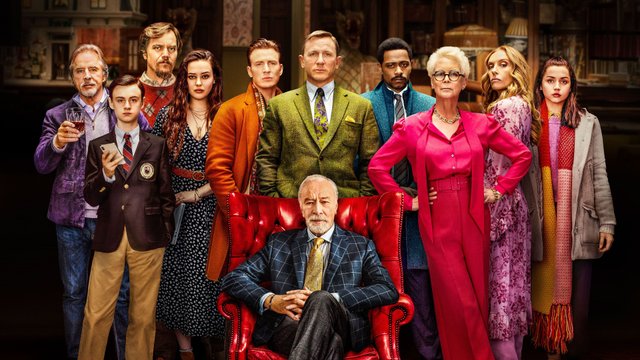
To understand the cultural positioning of Rian Johnson’s 2019 film Knives Out, one must first acknowledge the director’s own contentious place in contemporary popular cinema. By 2019, Johnson had become the focus of a visceral, often toxic dislike among a significant segment of Star Wars fandom, owing to what they perceived as an over-creative and disrespectful mishandling of 2017’s Star Wars: The Last Jedi. For many, that film is interpreted as the blow from which the franchise has never truly recovered, a catalyst for its subsequent creative and commercial stumbles. Yet, for all the fans’ vitriol, Johnson maintained—and indeed, cultivated—a reputation as a distinctive author in his own right, established by the clever neo-noir Brick and later reinforced by the time-travel thriller Looper. Knives Out arrived at a right moment, allowing Johnson to step away from galactic opera and return to grounded, genre-driven storytelling. The film’s remarkable success is now seen as the start of one of the rare, truly original film series in our era of endless sequels and reboots.
The plot unfolds primarily within the cavernous Gothic Revival mansion of the eponymous 85-year-old crime fiction magnate Harlan Thrombey (Christopher Plummer). Following a family gathering for his birthday, Harlan is discovered with his throat slit, the initial investigation leaning towards a straightforward suicide. The local police, perhaps out of their depth amidst such opulence, invite the famed private investigator Benoit Blanc (Daniel Craig) to assist. Unbeknownst to them, Blanc has been anonymously hired, a detail that immediately signals foul play. The Thrombey clan, a gallery of dysfunction and entitlement, provides a rich seam of suspicion. Yet, the initial focus settles on Harlan’s devoted nurse, Marta Cabrera (Ana de Armas). Johnson’s first major narrative feint is revealed through a mid-film flashback: Harlan’s death was the result of a tragic pharmacological accident. In a grand, novelistic gesture, Harlan improvises an elaborate deception and takes his own life to shield Marta from blame. This apparent resolution is spectacularly upended by the reading of Harlan’s will, which bequeaths his entire fortune to Marta, disinheriting his bloodline. The film then pivots into a second act of escalating peril, as Marta becomes entangled in a web of apparent blackmail, arson, and murder, forcing Blanc to deduce that the initial “accident” was perhaps not so accidental after all.
Johnson is no stranger to the crime genre. His feature debut, 2005’s Brick, was a slightly bizarre and memorable modern-day homage to hardboiled film noir, transposing Dashiell Hammett-esque dialogue to a Californian high school. Knives Out, which he began conceiving a few years later, is an equally deliberate, if far more conventional, homage to the “whodunnit” mysteries of Agatha Christie. The script dutifully checks every box of the genre’s classic tropes: the isolated country estate as the locked-room crime scene, a large set of possible suspects drawn from a monied, upper-class milieu, and, crucially, an eccentric, perceptive detective who gathers everyone for a dramatic, parlour-room denouement. Johnson’s affection for the form is evident, but it is an affection that borders on pastiche. The framework is not so much reinvented as it is polished and repackaged for a modern audience, with the structural mechanics remaining faithfully, perhaps too faithfully, intact.
Where Johnson does inject a sense of contemporary relevance is in the film’s political subtext. Knives Out pays conspicuous tribute to the content demands of modern Hollywood, namely its progressive politics, which in turn undoubtedly aided its reception among the largely left-leaning critical establishment. The Thrombey family is depicted with a palpable, almost cartoonish antipathy, serving as a collective villain: the embodiment of a decaying WASP elite that, in the popular discourse of the late 2010s, was deemed responsible for a host of societal ills. They are portrayed as uniformly greedy, hypocritical, and ruthless in their efforts to preserve unearned privilege, their wealth attributed to the mere chance of birth. Harlan, possessing a late-in-life conscience, seeks to correct this injustice through radical wealth redistribution, placing his fortune in the hands of the “deserving” poor—in this case, Marta, a Hispanic woman from a modest, working-class background. She functions as a telling example of modern Hollywood’s DEI (Diversity, Equity, and Inclusion) character standards: inherently virtuous, hardworking, and morally spotless. Johnson’s script also takes explicit shots at the contemporary US political landscape of Trump’s first term. This is most bluntly illustrated through the Thrombeys’ threats to report Marta’s undocumented immigrant mother to ICE, a tactic of intimidation that implicitly equates the Trump administration’s immigration policies with the horrors of 1930s Nazi Germany. Further, the character of Harlan’s teenage grandson, Jacob (Jaeden Martell), is described by his liberal cousin Meg (Katherine Langford) as an “alt-right troll” and “Nazi child,” a crude shorthand for the era’s online political radicalisation. This political embroidery is less a subtle thematic thread and more a garish patch sewn onto the classic mystery fabric, ensuring the film resonated with a specific cultural moment.
As a pure murder mystery, Knives Out is competently constructed but ultimately unremarkable. The plotting is clever enough, with a couple of genuinely satisfying twists—most notably the early revelation of the “accident” which reframes the entire investigation. However, for aficionados of the genre, there is little here that feels truly original or intellectually taxing. The clues are planted with due diligence, the red herrings are suitably distracting, but the solution, once arrived at, lacks the breathtaking, paradigm-shifting elegance of Christie’s best works. Johnson should be commended for the structural gamble of revealing the truth behind the death halfway through, but the subsequent mystery—who is manipulating events around that truth—proves to be a more conventional, and less compelling, affair. One struggles to find a narrative beat or deductive leap that hasn’t been executed with equal or greater skill in a myriad of other mystery films, particularly the countless adaptations that have emanated from British television over the past half-century.
Johnson’s direction is solid, workmanlike, and effective. He uses the Massachusetts locations to good effect, establishing a suitably autumnal, New England atmosphere that contrasts with the sharp, modern tensions within the Thrombey house. The film’s relatively high budget of $40 million, however, isn’t particularly visible on screen, save for one key area: production design. Harlan’s mansion is a character in itself, a labyrinth of wood-panelled rooms, hidden passages, and arcane curios. The centrepiece is the infamous chair made of countless knives, an obvious and somewhat on-the-nose homage to the Iron Throne from Game of Thrones. It functions as a perfect Chekhov’s gun—a menacing art object that loudly announces its narrative purpose from its first appearance. Beyond this striking element, the film has the crisp, slightly anonymous look of a high-end streaming production, competent but lacking in directorial flair or distinctive visual personality.
A significant portion of the budget was clearly allocated to securing its stellar ensemble cast, which stands as the film’s most immediate commercial and artistic asset. It features a roll-call of notable names spanning generations: from Hollywood royalty like Jamie Lee Curtis, to reliable character actors such as Toni Collette and Michael Shannon, to marquee star Chris Evans. Evans, in particular, seems to relish the opportunity to shed the heroic altruism of Captain America, playing Harlan’s grandson, Hugh “Ransom” Drysdale, with a delicious, sweater-clad cynicism. The film also marked one of the final major roles for Christopher Plummer, who delivers a performance of twinkling intelligence and poignant melancholy, a fitting capstone to a legendary career. The cast uniformly understands the assignment, playing their broadly sketched, venal characters with just the right blend of sincerity and slight caricature.
Yet, the film’s greatest and most memorable asset is unquestionably Daniel Craig. Seizing the chance to distance himself definitively from the stoic intensity of James Bond, Craig crafts the Hercule Poirot-like Benoit Blanc into a marvellous creation. He is mildly eccentric, with hints of possible villainy and a hidden personal agenda that adds a layer of intriguing ambiguity. The best feature of his performance is the deep, honeyed Southern accent. Craig prepared meticulously for the role, not only working extensively with a dialect coach but also studying historian Shelby Foote’s cadences in Ken Burns’ The Civil War documentary series to capture authentic, almost anachronistic speech patterns. The result is a performance that is both theatrical and utterly compelling; Blanc’s drawling monologues and folksy aphorisms (“The donut hole in the donut’s hole…”) become the film’s rhythmic and comic heartbeat. Craig’s commitment and charisma are so potent that they, in many ways, inadvertently unbalance the film.
This imbalance is most evident in the treatment of Ana de Armas’s Marta. Despite being endowed with a unique physiological trait—a vomiting reflex whenever she tells a lie—Marta emerges as a frustratingly passive and saintly figure. She is the moral centre, but her perfection renders her somewhat inert as a dramatic entity. Whilst de Armas performs with warmth and vulnerability, the character is written as an idealised symbol of immigrant virtue rather than a complex, flawed human being. Craig’s Blanc, all fascinating quirks and active deduction, easily overshadows her, making the film feel at times like it has two protagonists vying for focus, with the more compelling one winning out.
Johnson also benefited from a solid, if unspectacular, orchestral score composed by his cousin, Nathan Johnson. The music effectively underscores the suspense and the genre homage without ever becoming truly iconic or memorable, much like the film’s visual style—it serves its purpose without drawing attention to itself.
Knives Out was released in November 2019, fortuitously becoming one of the last major traditional cinematic blockbusters before the COVID-19 pandemic irrevocably altered the landscape of film distribution. Its commercial success—grossing over $300 million worldwide against its $40 million budget—can be attributed to its stellar cast, the clever marketing that sold it as both a sophisticated mystery and a witty, star-driven comedy, and a genuine audience appetite for original, mid-budget studio fare. It proved that such films could still thrive in a marketplace dominated by superhero franchises.
In the end, Knives Out is a good film, but not a particularly original one. Apart from its mid-point structural twist and its overt, of-the-moment political commentary, it delivers little that audiences could not find in a plethora of other mystery narratives, especially those produced by British television over the past several decades. Nevertheless, its quality and popularity undeniable proved the launchpad for a successful franchise, with the instantly iconic Benoit Blanc returning for the more ostentatious Glass Onion: A Knives Out Mystery in 2022 and Wake Up Dead Man in 2025. Johnson, in crafting Knives Out, did not so much solve a murder as he did a commercial equation, producing a crowd-pleaser that cleverly masks its conventional core with a veneer of topicality and star power.
Today I had a 30 min train ride before I head home, had to run an errant so decided to watch something on the way and pick up "Good Luck Have Fun Dont Die (2026)" , a movie that didnt get my attention because so much was going on with it when it came up, look strange, lots of opinion flying around and it was weird that nobody at work have seen it, probably too sci fi crazy drama for their taste. The opening scene is very strage but at the same time got me locked in right away with Sam Rockwell crashes into a diner in Los Angeles wearing this strange clear trenchcoat, he looks homeless ngl and probably why people didnt even bother with him, he had some device strapped, strats talking about the end of the world and explains to a room full of phone zombies that this is his 117th attempt to stop a catastrophe nobody around him gave a shit. It shows that he has been putting a lot of effort considering this was the 117 attempt, there must be a serious commitment or reason to keep going and shows his desperation in every word, like a guy who has explained the same emergency to the same group of strangers over a hundred times and somehow keeps finding the energy to do it again. Gore Verbinski is back behind the camera after years away and you can tell immediately because that diner scene is shot with real personality, creative angles, the kind of visual choices that remind you someone with a genuine point of view is running the show. The movie drops you straight into the madness without holding your hand or walking you through a slow backstory and I was completely locked in twenty minutes in telling myself this might be a hidden gem for me that I somehow let fly by. That first part of the movie just keeps feeding that feeling without letting upand the whole setup around the phone zombie angle is something we dont see that often in movies, almost like someone dont want to be mention because you look around at the real world and you know exactly what the movie is pointing at without it having to explain itself.
The diner sequence is where this movie probably earns its bars and the chemistry between the actors in that room is something you cannot fake in editing, its almost like the dinner is a character itself. Rockwell is doing this thing where he bounces off every person in the room with this frantic table stomping energy and Michael Peña brings his whole nervous teacher character in as Mark which creates the perfect contrast because Peña knows how to play that specific brand of awkward without going over the top. Zazie Beetz plays Janet and she and Peña share this backstory showing their lives as high school teachers, the whole thing feeling like its own little subplot of the movie about the slow death of the classroom at the hands of technology, which is very clever writing and they just keep doing this through the movie connecting dots this way, it gives the movie something to actually say beyond just the chaos and how fucked up part of humanity is because of tech, tech that makes things so easy for us. Haley Lu Richardson plays the role of Ingrid who is a young woman allergic to technology and she brings something completely different to the group energy. Juno Temple plays Susan and the way the movie builds up each of these characters through their own separate flashback sections makes you care about a group of strangers and this is one of the strongest aspects of the movie how it displays and interconects their personal lifes. From the start it makes you think you are going to love all these weirdos, I want to watch these people save the world together and for the most part of the movie that feeling is justified because everyone is clicking and the dialogue is smooth, nothing over the top, nothing force, you actually believe each one of them is a real character and not an actor you have seen playing a different or better role.
So far I have been just praising this movie but out of nowhere the movie just falls off the edge of a damn cliff. The whole thing runs two hours and change, and you feel every single one of those extra minutes from about the ninety minute mark because the pacing goes completely sideways and what starts as this tight character driven comedy turns into a sequence where the group has to deal with a siege by AI controlled teenagers that clearly somehow look hypnotized or controlled through their phones, I didnt get this clear though but the movies connects the story to a larger threat. They got the house surrounded and eventually start breaking in but the whole scene feels fake, dull and motionless, with actors sometimes looking like they are waiting for their cue instead of actually reacting to each other. I simply dont get why every time somebody tries to put AI into a movie it feels like nobody has cracked the code yet on how to make it matter or like there is some kind of stigma around AI on major role and not necesarly as a character itself, because the human interaction immediately starts feeling less human. Then they throw in this giant catcentaur creature, and I understand that it is supposed to look like the result of a terrible AI prompt. The characters basically throw random ideas into the air and the AI produces this giant nightmare made out of cats, so the ugliness is clearly part of the joke. Still, intentional or not, I thought it looked absolutely terrible. It is the kind of CGI creature that takes you completely out of whatever tension the movie had been building, and instead of feeling like a clever piece of AI satire, it felt like the production could no longer keep up with the visual quality of the first half. It totally threw me off. The actual climax then shifts through a hidden passage into the room where the nine year old boy is developing the AI and this is where the real sauce of the movie is supposed to hit. The AI connects nearly everything we have seen, including the phonecontrolled students, Susan hearing the voice of her dead son and Ingrid losing her boyfriend to virtual reality, while also revealing the connection between Ingrid and the Man from the Future. That should hit hard but by that point the movie has burned through so much sloppy action and random chaos that there is almost no emotional payback left. For a movie to have some kind of impact I need to care about something, I need to love or hate the character, the idea or whatever the hell it is trying to develop, but this one just did not hit it just falls flat between Ai and the weirdness, fells like those confusing maze movies. That is what makes it so frustrating, because at first it looked like it had a lot of potential, you cannot simply write the whole thing off as garbage because there is plenty here that works. Instead, you have to sit there and watch something you liked slowly undo itself and what started as a 9 for me gradually started shutting down. Do not get me wrong, this is not a bad movie but there are parts of it where it drags so hard that you are going to notice yourself reaching for your phone, and considering what the movie is saying about screen addiction, becoming a phone zombie during the movie is probably the worst possible sign.
During those early scenes the whole thing was giving me strong Everything Everywhere All at Once from 2022 with the same kind of weird energy that works, Im not trying to make a direct comparison but just in terms of the tone, that specific mix of dark maniac comedy mixed with something that actually matters underneath all the action and guffy stuff. You can also see Black Mirror all over the place because the movie weaves in these separate flashback chapters showing what happened to each character before the diner scene, I love flashbacks on any story because its probably the perfect way to provide context and the best part is that you can do it at a slow pace without getting the audience confuse and each one on the story work almost like its own short episode with its own little satirical angle on where technology is taking the world little by little at multiple angles. That trick that the movie use to build structure actually works and it gives the movie a scope that feels much bigger than a single diner location would allow, because the limitation of space to develop a story. The problem is that the pacing issue starts to feel exactly like what happened with Mickey 17 on those scenes inside the ship creating more and more clones that keep failing, its almost like a loop like a trap, I remember epxlaining it the other day, talking about time traps like when Neo gets trap on the train station, feels boring, nothing happes its confusing and makes you desperate, here you have this really clever setup that gets buried through all this and you start feeling like there was a lot that was unncessary. The references and the ambitions are all there, Verbinski is clearly swinging for something smart and funny and timely all at once, and the movie lands two out of those three more often than not, which is not bad but also not enough to make it what it could have been.
Look, I liked Good Luck Have Fun Do Not Die, I know I rant a good bit about but its because I enjoy it and could be so much better, it just got me exhausted because I was waiting for something to happen and that gap between liking something and loving it is more disappointing than just hating something clean. Rockwell is an absolute blast to watch from start to finish and he is the main reason I stay hooked even when the movie starts losing its grip, Peña is funny without overdoing it and the whole cast is doing their absolute best with a script that lets them down more than they did because its clear the cast is good enough and more for this movie. This movie came out a while ago so I doubt I spoil anything although if you havent watch it yet just dont go with the expections of any crazy action scenes, you are going to have a good time laught, a good slow time and that is probably a good one time watch for a lazy Saturday where you are not expecting a masterpiece and you just want something weird and funny with a few actually sharp ideas. You will have a good time for the first hour, you will start checking the time somewhere around the ninety minute mark and you will probably finish it anyway because you are already invest some time it and also they do build up properly most of the characters. I am giving Good Luck Have Fun Do Not Die a 8 out of 10, because the diner alone is worth watching, its just a shame that this movie becomes a one trick movie, almost like those movies where there is this one single race or action sequence that eveyone knows about but thats it, sorry if my comments might not be as possitive as most people, I know many are going to love it from start to finish.
Buenos días, buenas tardes o buenas noches, damas y caballeros. ¿Cómo están? ¿Cómo se encuentran el día de hoy? Espero que muy bien. Hace unas dos semanas aproximadamente vi una película que me habían recomendado antes mediante TikTok; lo que me había llamado la atención para verla era el hecho de que el mismo director hizo la misma película dos veces, la segunda vez para alcanzar al público americano. Pero cuando me refiero a que la volvió a hacer es que es un calco exacto, plano por plano; más que un remake, incluso se podría confundir con una versión remasterizada de la original si no tuvieran actores totalmente nuevos. El género de la película es el clásico home invasion, donde un individuo o varios azotan la casa de una familia y ellos tienen que sobrevivir a ello. Usualmente los invasores torturan y llegan a matar a los habitantes en el peor de los casos, pero aquí, en este caso en particular, nos encontramos con que algo no cuadra después de todo. Así que sin más dilación, hablemos un poco acerca de Funny Games.
Good morning, good afternoon or good evening, ladies and gentlemen. How are you? How are you doing today? I hope very well. About two weeks ago, I watched a film that had been recommended to me before on TikTok; what caught my attention about it was the fact that the same director made the same film twice, the second time to reach an American audience. But when I say he made it again, I mean it's an exact copy, shot for shot; more than a remake, you could even mistake it for a remastered version of the original if it didn't have completely new actors. The film's genre is classic home invasion, where one or more individuals break into a family's house and they have to survive it. Usually the invaders torture and sometimes kill the inhabitants in the worst cases, but here, in this particular case, we find that something doesn't add up after all. So without further ado, let's talk a little about Funny Games.
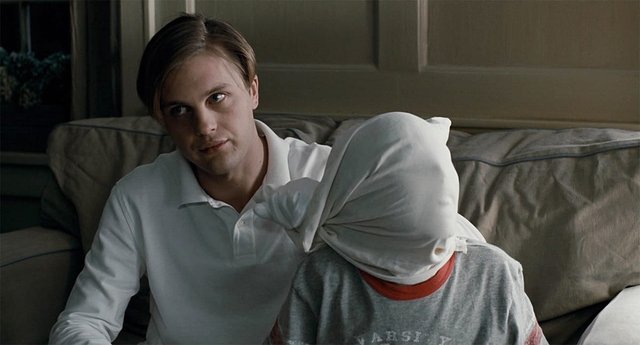
La película nos pone en la piel de una familia neoyorquina (o austriaca si estás viendo la primera versión), la cual se va a su casa de verano para tener unas pequeñas vacaciones. Todo parece ir bien hasta que unos jóvenes aparecen ante la familia solicitando una cantidad de huevos de parte de los vecinos. La esposa, sin problemas, los dará, pero algo parece ir mal, ya que los jóvenes no parecen querer dejar la propiedad. El esposo tratará de mediar con ellos, pero la situación escala hasta el hecho de que él le da una bofetada a uno de los jóvenes, y estos responden partiéndole una rodilla con un palo de golf; su brazo también queda herido, quedando prácticamente inhabilitado. Los jóvenes parecen gozar con todo esto y lo consideran nada más un juego, donde les apuestan que al amanecer ninguno de ellos quedará con vida, por lo que la familia deberá soportar la tortura física y psicológica (teniendo que cumplir órdenes que no serán del agrado de ninguno de los tres integrantes de la familia) de parte de los invasores, tratando también de no ser asesinados por los psicópatas que se ríen enfrente de ellos por su situación.
The film puts us in the shoes of a New York family (or an Austrian one if you're watching the first version), who go to their summer house for a small holiday. Everything seems to be going well until some young men show up at the family's door asking for some eggs from the neighbours. The wife gives them without any trouble, but something seems wrong, as the young men don't seem to want to leave the property. The husband tries to mediate with them, but the situation escalates to the point where he slaps one of the young men, and they respond by smashing his knee with a golf club; his arm is also injured, leaving him practically disabled. The young men seem to enjoy all of this and consider it just a game, where they bet that by dawn none of the family will be alive. So the family must endure physical and psychological torture (having to obey orders that none of the three family members will like) at the hands of the invaders, while also trying not to be killed by the psychopaths who laugh in their faces at their situation.
Funny Games durante todo el visionado se siente como una película que no deberías estar viendo. Podría decir incluso que no se siente como una película; es como si estuviéramos viendo durante todo el tiempo un metraje de tortura real, ya que solo hay sonido ambiente mientras todo ocurre, siendo también que todo transcurre con mucha quietud, tanta que llega a inquietar y puede llegar a provocarte desesperación. Luego, si estás viendo la cinta con varias personas, llegan los comentarios sobre qué haríamos y por qué no tiene sentido que esos dos jóvenes puedan salirse con la suya, pero todos estos pensamientos son como si la película los tuviera en cuenta, ya que todo está creado para aquel momento en el que la familia por fin actúa y contraataca, pero todo es en vano por un gran giro en el guion que te va a dejar boquiabierto. Aquí no vas a tener recompensa; no es la típica película con final feliz, más bien esto es una burla y un castigo hacia ti por querer ver algo que está relacionado con el sufrimiento humano. No podría decir que es 100 % inesperado porque durante ciertos momentos vemos a uno de los invasores hablarnos directamente a cámara, rompiendo la cuarta pared, como si estuviera consciente de que todo esto es una película que va a seguir en un bucle donde ellos siguen cobrándose víctimas. Luego se te deja la pregunta de si esto realmente importa, solo es ciencia ficción o quizás todo lo que viste podría considerarse como realidad, lo cual evidentemente te dejará pensativo, cerrando la obra con un final que te dejará inquieto y frustrado porque nunca hubo posibilidad.
Throughout the viewing, Funny Games feels like a film you shouldn't be watching. I could even say it doesn't feel like a film; it's as if we're watching real torture footage the whole time, because there's only ambient sound while everything happens, and also everything unfolds very quietly, so quietly that it becomes unsettling and can drive you to desperation. Then, if you're watching the film with several people, the comments come about what we would do and why it doesn't make sense that those two young men could get away with it, but it's as if the film takes all these thoughts into account, because everything is created for that moment when the family finally acts and fights back, but it's all in vain due to a great twist in the script that will leave you speechless. Here you won't get a reward; it's not the typical film with a happy ending. Rather, this is a mockery and a punishment towards you for wanting to see something related to human suffering. I couldn't say it's 100% unexpected, because at certain moments we see one of the invaders speaking directly to the camera, breaking the fourth wall, as if he's aware that this is all a film that will continue in a loop where they keep claiming victims. Then you're left with the question of whether any of this really matters, if it's just science fiction, or if perhaps everything you saw could be considered real, which will evidently leave you thoughtful, closing the work with an ending that will leave you unsettled and frustrated because there was never any chance.
Die Hard With A Vengeance Brought New Life To The Franchise. With Bruce Willis And Samuel L. Jackson Forming One Of The Best Action Movie Duos Of The 1990s, It Delivered Bigger Stakes And Smarter Action. More Than Thirty Years Later, It Remains A True Nineties Classic.
After the mixed reception of Die Hard 2, the franchise came roaring back in 1995 with Die Hard With A Vengeance. Many fans, myself included, consider it the best sequel in the series. While the original Die Hard will probably always hold the top spot, this third installment comes very close and succeeds by doing something different rather than simply repeating the same formula.
The film was directed by John McTiernan, who also directed the original Die Hard. Bringing McTiernan back turned out to be a smart move because he understood exactly what made the first movie work. Instead of trapping John McClane inside another building, he expanded the story into a citywide game of cat and mouse that keeps the action moving from beginning to end.
Bruce Willis returns as John McClane, but this version of the character is in rough shape. He’s suspended from the police force, dealing with personal problems, and far from being at the top of his game. That makes him even more relatable and entertaining because he’s forced to overcome his own struggles while trying to stop a dangerous criminal mastermind.
The biggest addition to the cast is Samuel L. Jackson as Zeus Carver. What starts as an accidental partnership quickly develops into one of the most entertaining buddy pairings in action movie history. Jackson brings energy, humor, and intelligence to the role, and his chemistry with Willis is fantastic throughout the film.
Jeremy Irons plays the villain Simon Gruber, the brother of Hans Gruber from the original movie. Rather than trying to copy Alan Rickman’s performance, Irons creates his own memorable villain. Simon is clever, manipulative, and always seems to be one step ahead of everyone else, making him a worthy opponent for McClane.
The plot begins when Simon contacts the New York Police Department and demands that John McClane participate in a series of dangerous games and riddles scattered across New York City. If McClane refuses, innocent people will die. With Zeus reluctantly dragged into the situation, the two race across the city trying to solve clues before time runs out.
One thing I love about this movie is how it constantly keeps viewers guessing. Every time McClane and Zeus think they understand Simon’s plan, another twist appears. The film feels as much like a thriller as it does an action movie, which helps separate it from many of its competitors.
The New York City setting works perfectly. The crowded streets, subway stations, schools, parks, and landmarks give the movie a much larger scope than the previous entries. The city itself almost becomes another character in the story.
The action scenes are outstanding and still hold up remarkably well today. Car chases, explosions, shootouts, and tense foot pursuits are all handled with skill and precision. McTiernan keeps the action grounded enough to feel exciting without turning it into pure fantasy.
What really elevates the movie for me is the relationship between McClane and Zeus. Their constant arguments, sarcastic exchanges, and growing respect for one another provide some of the film’s best moments. The humor feels natural and never takes away from the tension.
Another strength is the pacing. The movie wastes very little time and constantly moves forward. There is always another clue to solve, another location to reach, or another challenge to overcome. That momentum makes the film incredibly rewatchable.
Like the original Die Hard, this movie understands that great action films need memorable characters. It’s not just about explosions and gunfire. Viewers care about McClane and Zeus, which makes the danger feel more meaningful.
For me, Die Hard With A Vengeance is a great film because it takes everything that worked in the earlier movies and adds something fresh. The cast is excellent, the direction is sharp, the action is exciting, and the story keeps you engaged from start to finish. It never feels like a sequel simply trying to cash in on a popular name.
More than thirty years after its release, Die Hard With A Vengeance remains a true nineties classic. It captures everything that made action movies so much fun during that decade while delivering memorable characters, great performances, and nonstop entertainment. Every time I revisit it, I’m reminded why it remains one of my favorite action films of the era.


 All images above are screenshots from the movie
 [Source](https://tv.apple.com/us/show/for-all-mankind/umc.cmc.6wsi780sz5tdbqcf11k76mkp7)


 [Source](https://tv.apple.com/us/show/for-all-mankind/umc.cmc.6wsi780sz5tdbqcf11k76mkp7)
 [Source](https://tv.apple.com/us/show/for-all-mankind/umc.cmc.6wsi780sz5tdbqcf11k76mkp7)
 [Source](https://tv.apple.com/us/show/for-all-mankind/umc.cmc.6wsi780sz5tdbqcf11k76mkp7)
 [Source](https://tv.apple.com/us/show/for-all-mankind/umc.cmc.6wsi780sz5tdbqcf11k76mkp7)
 [Source](https://tv.apple.com/us/show/for-all-mankind/umc.cmc.6wsi780sz5tdbqcf11k76mkp7)


 While all the wish granting is a major theme in the movie, the emotional core of the film is the disintegration of Kate and Matt’s relationship. Played by Olga Kurylenko and Kevin Janssens, the couple initially appears grounded but it slowly loses it's stability. But the room doesn't create these problems it just amplifies it. It exposes a relationship that hides layers of grief, untamed desire, want, obsession and insecurities. The more you watch the more you realize that the room doesn't punish you for your wishes but you are confronted with the consequences of the wish you think you want. The room doesn't interpret intention, it only execute the desire, this means each wish reveals the inate personality that might be unknown to even the character itself.



 [Source](https://www.amazon.com/gp/video/detail/0NI37SD67NQ8OZ88ZMVR04Z81K/ref=atv_dp)
 [Source](https://www.amazon.com/gp/video/detail/0NI37SD67NQ8OZ88ZMVR04Z81K/ref=atv_dp)
 [Source](https://www.amazon.com/gp/video/detail/0NI37SD67NQ8OZ88ZMVR04Z81K/ref=atv_dp)
 [Source](https://www.amazon.com/gp/video/detail/0NI37SD67NQ8OZ88ZMVR04Z81K/ref=atv_dp)
 [Source](https://www.amazon.com/gp/video/detail/0NI37SD67NQ8OZ88ZMVR04Z81K/ref=atv_dp)
 [Source](https://www.amazon.com/gp/video/detail/0NI37SD67NQ8OZ88ZMVR04Z81K/ref=atv_dp)
 [_Source_](https://mubi.com/es/ve/films/funny-games-us)
 [_Source_](https://www.rakuten.tv/es?content_type=movies&content_id=funny-games-2007)
 [_Source_](https://medium.com/the-unwatchables/funny-games-2007-what-we-talk-about-when-we-call-a-film-pretentious-6c6ae9f32883)