


Longform reviews of films, TV, anime, books, and audiobooks, written by the scrobble.life community and published to the Hive blockchain, so each one is owned by its author and can earn rewards from readers. 60,674 reviews and counting.

Madre, amante y estudiante del arte y la reposterÃÂÃÂa. AdemÃÂás, una eterna aprendiz y con un lado salvaje pero reservado...

My Names Matt & I Mostly Talk Movies & Television! #Movies #Film #Freedom
There are certain movies that instantly transport me back to a different time whenever I watch them, and E.T. the Extra-Terrestrial is definitely one of them. Released in 1982, the film became a worldwide phenomenon and remains one of the most beloved family movies ever made. Even after countless viewings, it still manages to capture that sense of wonder that made audiences fall in love with it in the first place.

The film was directed by Steven Spielberg, who was already becoming one of Hollywood’s biggest filmmakers at the time. Spielberg had a remarkable ability to tell stories through the eyes of children, and that talent is on full display here. He takes what could have been a simple science-fiction story and turns it into something deeply emotional and personal.
The cast is led by Henry Thomas, who plays Elliott, a young boy struggling with the recent separation of his parents. Thomas delivers an incredibly natural performance and carries much of the film’s emotional weight. His connection with E.T. feels genuine, which is one of the reasons the movie works so well.
The supporting cast includes Dee Wallace as Elliott’s mother Mary, Robert MacNaughton as his older brother Michael, and a very young Drew Barrymore as his little sister Gertie. Barrymore in particular steals several scenes with her charm and energy. The family dynamic feels authentic and helps ground the story in reality.
The plot begins when a group of extraterrestrials visits Earth to study plant life. During a hurried escape from government agents, one of the aliens is accidentally left behind. Alone and frightened, the creature eventually encounters Elliott, who decides to hide him inside the family home.
As Elliott and E.T. spend more time together, they form a unique bond. Elliott discovers that E.T. possesses extraordinary abilities, including healing powers and a psychic connection with him. At the same time, the alien simply wants to find a way to contact his people and return home.
What makes E.T. so effective is that the story is told primarily from the children’s perspective. Adults often remain in the background, allowing viewers to experience the adventure through the eyes of Elliott and his siblings. This approach gives the movie a sense of innocence and wonder that few films have ever matched.
The special effects were groundbreaking for their time and still hold up surprisingly well today. E.T. himself feels like a real character rather than a special effect. Through a combination of puppetry, animatronics, and excellent filmmaking, Spielberg creates an alien that audiences genuinely care about.
Of course, no discussion of E.T. would be complete without mentioning John Williams’ incredible score. The music elevates every emotional moment and helps create some of the most iconic scenes in movie history. The famous flying bicycle sequence remains magical largely because of Williams’ unforgettable music.
One reason I think the film has endured for so long is because it isn’t really about science fiction. At its heart, E.T. is about loneliness, friendship, and belonging. Elliott feels isolated because of changes within his family, while E.T. is literally stranded on another world. Their friendship helps both characters overcome that loneliness.
The movie also understands how children think and feel. Spielberg captures the excitement, fear, imagination, and emotional intensity of childhood better than almost any filmmaker. Watching the film feels like seeing the world through a child’s eyes again.
There are certainly movies with more advanced special effects, bigger action sequences, and more complex stories. Yet very few films have the emotional sincerity of E.T.. It never feels cynical or calculated. Every scene is focused on telling a heartfelt story about connection and compassion.
For me, E.T. remains a great film because it balances fantasy and emotion so perfectly. The cast is wonderful, Spielberg’s direction is masterful, and the story continues to resonate with audiences of all ages. It is funny, touching, exciting, and occasionally heartbreaking all at the same time.

More than four decades after its release, E.T. the Extra-Terrestrial is still considered a classic for good reason. It captures the magic of childhood, delivers unforgettable characters, and tells a story that continues to move viewers around the world. That’s why it remains one of my favorite films and one of the greatest family movies ever made.

Venezolana, Creativa, soñadora, amante del cine, y del arte
Stories that, despite the passage of time, still linger in our memories—those movies or TV shows that shaped our childhood and still evoke the same feeling, as if it were the first time. Doesn't that happen to you...

🎬 LETHAL WEAPON 🎬
This time I’m bringing you this series—I’m sure many of you will recognize it, especially because of these two great characters, top-notch actors like Mel Gibson and Danny Glover. It’s a movie full of action, drama, and humor—a little bit of everything— and you definitely won’t get bored, because in every scene, you’ll see that serious yet funny side of these characters.

To tell you a little bit about this movie, for those who haven’t seen it yet, the story is about two cops who are forced to work together. They’re total opposites, but putting their differences aside, they team up to bring justice, catch the bad guys, and do their job—doing good.
As I mentioned, this film is part of a series consisting of four installments, each with a completely different story and new villains to catch. Yet these two men remain dedicated to their work as good cops, seeking to apprehend the criminals and murderers who want to kill them and their families. Their sole objective is to protect their loved ones and uphold the law.

They are undoubtedly completely different, with distinct personalities—one with a somewhat crazy, unbalanced, reckless nature, and the other, of course, serving as the counterbalance: more mature, centered, and serious. Both share a desire to do good, protect and care for their city from villains, save their family, and maintain order amid the chaos.

This review doesn’t do it justice—this movie has so much to tell and show, but I’ll let you discover it for yourselves. You won’t regret it; it features charismatic, rebellious characters and scenes packed with action.
 |
 |
 |
 |
|---|
Historias que a pesar del tiempo aun se mantienen en nuestros recuerdos, esas películas o series que marcaron nuestra infancia, y que sigue causando la misma sensación, como si fuera la primera vez, no les pasa...
🎬 LETHAL WEAPON 🎬
En esta oportunidad les traigo esta saga, seguro muchos la reconocerán, sobre todo por estos dos grandes personajes, actores de primera, como lo son Mel Gibson y Danny Glover, una película, llena de acción, drama, humor, una mezcla de todo un poco, eso si, no te vas a aburrir, porque en cada escena, veras ese toque serio, pero a la vez gracioso, de estos personajes.
Para contarles un poco sobre esta película, a quienes aun no la han visto, la historia se basa en dos policías, que son obligados a trabajar juntos, son totalmente opuestos, sin embargo, dejando a un lado sus diferencias, se unen para hacer justicia, atrapar a los malos, y cumplir con su trabajo, haciendo el bien.
Dicho film, como mencione es una saga, la cual consta de 4 versiones, historias totalmente diferentes, otros chicos malos que atrapar pero estos dos hombres se mantienen fieles, en su trabajo, como buenos policías, en busca de atrapar a los delincuentes, asesinos, que quieren acabar con ellos, y a su vez a su familia, es por ende que su único objetivo es proteger a sus seres queridos y hacer cumplir la ley.
Sin duda son totalmente distintos, con personalidades diferentes, uno con un carácter algo loco, desequilibrado, imprudente, y el otro por supuesto, tiene que ser el balance, mas maduro, centrado, serio. Ambos coinciden en querer hacer el bien, proteger y cuidar a su ciudad de los malos, salvar a su familia, manteniendo el orden, en tanto caos.
Me quedo corta con esta reseña, esta película tiene mucho que contar y mostrar, pero dejare que ustedes indaguen sobre ella, no se van arrepentir, la misma cuenta con personajes y escenas carismáticas, rebeldes, y llenas de mucha acción.
RECURSO / RESOURCE: Pictures: www.imdb.com Translation/Traducción:👉 DeepL Traductor **Edition/Edición:**Cover and banner with Canva /Portada y banner con Canva **Edition/Edición :**Canva Separator/Separador Canva
Rating: 90/100


I just watched the film Black Panther, and I can positively state that it is one of the most thrilling superhero films that I have ever seen. There is a lot of action, emotion, culture, and lessons to be learned in the film. It was captivating from start to finish and I wanted to learn more about the world of Wakanda.
This tale is about T'Challa, the king of the secret African kingdom, Wakanda, which is much more technologically advanced than the rest of the world. When T'Challa's father is killed, he returns home to rule over his people and to protect them. But his leadership is tested when an enemy from his past emerges to threaten more than his throne, it threatens the future of Wakanda.
The one thing I really liked about this movie was the unique setting. Wakanda is a technologically advanced, rich and beautiful place. The filmmakers have made a world that is real and inspirational. The buildings, costumes, traditions, and technology all combine to make Wakanda unique in super hero films. Looking as I did, I was amazed at the extent of detail which I saw.
Another thing that makes a strong impression on the viewers is the characters of the film. T'Challa is a peaceful, wise, and responsible leader, who desires to do what is right. I liked that he wasn't presented as some kind of hero. Throughout the story, he must make some decisions and he learns some lessons. The ladies in the film are also very impressive. They are smart, courageous and are in charge of protecting Wakanda, much more than anyone would think. They bring a lot of strength to the story.
One of the most interesting villains I've seen in a superhero movie. He isn't just evil because he's evil. He has good reasons for acting this way, and some of his arguments force the viewers to contemplate on justice, power, and responsibility. I disagreed with him in his approach, but I was able to see why he felt the way he does. This injected a great deal of significance into his confrontation with T'Challa.
Exciting action scenes and well done. Numerous battles, chases and moments of suspense. The action-packed scenes are thrilling and fun to watch, yet not overly complicated. I particularly loved the Black Panther outfit and Wakanda's high tech. They brought in a lot of excitement and creativity in the film.
Another aspect that I liked was the film's message. It is about leading, family, identity, responsibility and others. The film depicts that leadership is not only about the exercise of power, but also about how we use it. I really liked this message; it's inspiring and relevant to life situations.
The acting in the film is overall superb. The cast delivers emotion and authenticity in their roles. The performances helped me to feel like I was in the story, and to feel sorry for the characters. The music and effects are also very significant in the experience, and are memorable for many scenes.
But no film is without its flaws. In a couple of action scenes, some of the computer-generated effects seemed more unnatural than the rest of the film. Also, there were portions of the story that were predictable. But all of these minor problems didn't diminish my enjoyment of the film.
On the whole I really enjoyed watching Black Panther. This isn't your typical superhero film. It is a tale of courage, leadership, culture and making the right choices when they are hard to make. It is an amalgamation of action, emotions and lessons that resonate with many different viewers. I would definitely recommend it to anyone who loves adventure, superheros or motivational tales.
My Rating: 9/10
Black Panther is a powerful and entertaining movie that leaves a lasting impression. It is a thrilling and inspiring and a great thing to watch more than once!
Video link
Posted Using INLEO

Blogger, film critic, columnist (writes in Croatian and English)

Aquiel (S06E13)
Airdate: 1 February 1993
Written by: Brannon Braga & Ronald D. Moore Directed by: Cliff Bole
Running Time: 46 minutes
It is a curious footnote in Star Trek history that the series’ televised journey began not with a bang but with a somewhat creaky monster-of-the-week tale. The Man Trap, the first episode of The Original Series to be broadcast, is nowadays regarded as one of its weaker instalments—a serviceable but forgettable shape-shifter story hampered by the budgetary and narrative limitations of 1960s television. The episode feels rather theatrical and its plot too reminiscent of B-grade horror films. Yet, as often happens in this franchise, a modest premise can be revisited and refined. Decades later, The Next Generation seized the opportunity to recycle that basic formula—a remote outpost, a missing crew, a mysterious alien entity—and fashioned “Aquiel”, a sixth-season episode that, while far from classic, stands as one of the more solid and professionally executed instalments of that year. It is an episode that exemplifies how competent craftsmanship can elevate derivative material, even as it ultimately fails to escape a sense of squandered potential.
The plot unfolds with the USS Enterprise-D responding to a loss of communication with Relay Station 47, a Starfleet facility situated disconcertingly close to the Klingon border. Upon arrival, an away team led by Dr. Crusher and Chief Engineer Geordi La Forge discovers the station abandoned, with clear signs of violence and unidentified DNA remains that appear to have been partially vaporised by a phaser. The station’s two assigned officers—Lieutenant Aquiel Uhnari (Renée Jones), a humanoid of the Haliian race, and Lieutenant Keith Rocha—are missing, as is a shuttlecraft. Subspace messages have been obviously tampered with, deepening the mystery. The investigation quickly bifurcates: Crusher analyses the forensic evidence, while La Forge immerses himself in Aquiel’s extensive personal logs. These videos present Uhnari as an intensely likeable, vibrant young woman, and they also reveal a deep personal enmity with the officious Rocha, as well as her fears about harassment from a Klingon commander named Morag (Reg E. Cathay). Captain Picard, wary of diplomatic incidents, summons Morag’s superior, Governor Torak (Wayne Grace), to account for the situation. Meanwhile, La Forge, spending hours studying Aquiel’s recorded persona, falls for the image of a woman who may well be dead—a poignant, if slightly contrived, emotional hook.
The question of Aquiel’s fate is resolved when Torak arrives at the Enterprise with Uhnari in custody, claiming she was apprehended in Klingon space. Morag, also brought aboard, admits to spying on the station but insists he found it already deserted. With Aquiel now present and cleared of immediate suspicion, La Forge pursues a romantic relationship with her, a development the episode portrays with earnest, if not entirely convincing, sincerity. The mystery’s solution arrives when Dr. Crusher observes the strange DNA residue reforming into a hand. She deduces the presence of a “coalescent organism”—a shape-shifting entity that had killed the real Lieutenant Rocha during a previous mission, assumed his form, and lived alongside Aquiel on the station. The creature, discovered to have taken the shape of Aquiel’s pet dog, Maura, is eliminated. Aquiel is fully exonerated and departs the Enterprise for a new posting, leaving Geordi with another brief, failed romance to add to his catalogue.
“Aquiel” was conceived with a specific, somewhat pragmatic, purpose in mind. With the series’ only established couple, Miles O’Brien and Keiko, having departed for Deep Space Nine, the producers sought to introduce a more permanent romantic interest for one of the core cast. Showrunner Michael Piller later acknowledged the direct inspiration of Otto Preminger’s 1944 film Laura, a classic thriller in which a detective becomes infatuated with the portrait of a murdered woman. This dynamic is transposed neatly onto La Forge, who falls for Aquiel through her video logs before ever meeting her. The reference is apt and intellectually respectable, but herein lies one of the episode’s core problems: the execution lacks the psychological depth and atmospheric tension of its source material. What worked as a noir-tinged mystery in 1940s New York feels somewhat procedural and sanitised in the bright, orderly world of the Enterprise.
Indeed, “Aquiel” is often cited among the least-liked episodes of TNG by the franchise’s dedicated fanbase. This disapprobation is particularly striking given the pedigree involved: director Cliff Bole was a reliable hand for action-driven episodes, and writers Brannon Braga and Ronald D. Moore were responsible for some of the series’ most ambitious and celebrated instalments. The sense of disappointment is palpable; compared to the complex moral puzzles and character-driven dramas that preceded it in Season Six, Aquiel can feel like a step backward—a competently assembled but ultimately hollow piece of genre fare.
The criticisms are multifaceted. Firstly, the plot is undeniably derivative, not only of Laura but of countless “isolated outpost” mysteries within and beyond Star Trek. Secondly, and perhaps most damagingly, the episode suffers from a fatal piece of miscasting. Renée Jones, while a capable actress, lacks the necessary chemistry with LeVar Burton to sell the central romance. Their interactions feel stilted and obligatory, failing to generate the spark or emotional vulnerability required to make Geordi’s investment believable. Consequently, the romantic subplot—the very heart of the episode—rings hollow, undermining its primary narrative ambition.
Furthermore, several minor but nagging plot holes dent the episode’s credibility. The conspicuous absence of Counsellor Troi is baffling; an empathic counsellor would be an invaluable asset in an investigation involving suspected deception and hidden alien entities, yet she is sidelined. Geordi’s conduct also borders on the unprofessional; his immediate infatuation based on log entries, followed by his rapid pursuit of a relationship with a material witness in a serious criminal investigation, feels at odds with his character’s usual disciplined demeanour.
Yet, taken purely on its own terms, Aquiel is not a bad episode. It is a solid, professionally crafted piece of television. The mystery is structured coherently, the pacing is steady, and the scientific solution—while involving a somewhat convenient alien dog—follows the internal logic of the Trek universe. The scenes with the Klingons, featuring a nicely gruff performance by Reg E. Cathey as Morag, add welcome diplomatic tension. The episode’s failing is not that it is incompetently made, but that it does not fulfil its potential. It aims for a poignant romance infused with mystery and instead delivers a passable, somewhat forgettable, procedural. The shadow of Laura looms too large, and the attempt to graft that film’s psychological complexity onto a TNG framework results in something that feels more like a homage than an organic story.
At the end, Aquiel represents the kind of episode that every long-running series produces: a piece of reliable, mid-tier filler. It is disliked less for being outright terrible and more for being unremarkable—for showcasing a talented team operating below their capacity. It demonstrates that even a recycled premise from a less-remembered Original Series episode can be fashioned into something watchable and coherent. But in the rich tapestry of The Next Generation, Aquiel remains a minor thread, a sketch of a better story that never quite materialised. For the completist, it offers a decent, if uninspiring, instalment. For the critic, it serves as a case study in how strong foundations—a classic film inspiration, a veteran crew—can still result in a construction that is merely adequate, rather than exceptional.
RATING: 5/10 (++)
Blog in Croatian https://draxblog.com Blog in English https://draxreview.wordpress.com/ InLeo blog https://inleo.io/@drax.leo
LeoDex: https://leodex.io/?ref=drax InLeo: https://inleo.io/signup?referral=drax.leo Hiveonboard: https://hiveonboard.com?ref=drax 1Inch: https://1inch.exchange/#/r/0x83823d8CCB74F828148258BB4457642124b1328e
BTC donations: 1EWxiMiP6iiG9rger3NuUSd6HByaxQWafG ETH donations: 0xB305F144323b99e6f8b1d66f5D7DE78B498C32A7 BCH donations: qpvxw0jax79lhmvlgcldkzpqanf03r9cjv8y6gtmk9

Weaving Craftswoman, Cook and baker.

Recently, we witnessed the end of one of the most beloved series of all time. With high expectations, we awaited the long-awaited finale, but something left most of us unsatisfied. Obviously, I should start with the usual routine of explaining what this series is about, which has a plot that turned out to be extremely unpredictable.
Recientemente, presenciamos el final de una de las series más queridas de todos los tiempos. Con expectativas altas, esperamos el tan anunciado final de esta serie, pero hubo algo que no me dio satisfacción a la mayoría. Obviamente, debo empezar con la rutina de contar de qué va esta serie, la cual tiene una trama que resultó sumamente cambiante.


The Boys is a satire of the superhero world that tells the story of Butcher, Homelander, and other characters who gradually become important both to the story and to us, the viewers. It portrays the corruption within superhero companies as a reflection of current politics, which is the series' strength and what kept everyone admiring this production for years.
The Boys es una sátira del mundo de los superhéroes que nos cuenta la historia de Butcher, Homelander y otros personajes que poco a poco se vuelven importantes tanto en la historia, como para nosotros los televidentes. En sí esta cuenta la corrupción dentro de las compañías de superhéroes, como una ilusión de la política actual, siendo esto el fuerte de la serie, y lo que mantuvo a todos por varios años admirando esta producción.

It all begins with an "accident" that unleashes the fury of a group who dare to challenge extremely dangerous beings, leading them to do things that, if we consider them, could be worse, but for the greater good. The point is that the group sets out to put an end to the industry that protects the supes, since these supes are highly corrupt. This is the simplest plot, but what characterizes the series is how controversial it has been since its inception.
Todo comienza con un "accidente" que desató la furia de un grupo que se animó a desafiar a seres muy peligrosos, llevándolos a hacer cosas que si medimos pueden ser peores, pero por un bien mayor. La cuestión está en que los muchachos se proponen darle fin a la industria que encubre a los súper, ya que estos son altamente corruptos. Sin más esta es la trama más sencilla, pero lo que caracteriza a la serie es lo polémica que ha sido desde sus inicios.

I'm not here to recount the satire, much less the references that made us laugh and surprised us for years, but I do want to discuss why this series changed so much. A few days ago, I saw a YouTube video that explained the situation very well, as it pointed out that the show went from being a series that mocked and criticized superhero franchises to simply being another superhero series. Mind you, this doesn't mean it ruined the story; rather, it strengthened it, but it didn't improve it in any way.
Yo no vengo a contar las sátiras, menos las referencias que nos hicieron reír y sorprendernos por años, pero si quiero comentar el porqué esta serie cambió mucho. Hace unos días vi un video en YouTube que explico muy bien la situación, ya que explican que esta pasó de ser una serie que burlaba y criticaba aquellas franquicia de superhéroes, a ser una serie más de superhéroes y ya. Ojo, esto no quiere decir que esto arruinó la historia, más bien le dio fuerza, pero en nada la mejoró.

Starting with season 3, the show sought to expand the plot, introducing characters who were well-received, but it was from this point onward that things began to feel different. Homelander was given a cruel backstory, even though it had been hinted at in earlier episodes of the first seasons, which made it easier for viewers to empathize with the villain. The madness of the most powerful superhero in this universe was justified, making everything he did all the more perverse and satisfying.
A partir de la temporada 3 se buscó extender la trama, trayendo personajes que fueron bien recibidos, pero fue desde aquí que se empezó a sentir diferente. Le dieron un pasado cruel a Homelander, aunque ya se venía hablando en episodios anteriores de las primeras temporadas, esto hizo que empatizáramos con el villano. Locamente, se justificó la locura del súper más poderoso de este universo, e hizo que fuera más perverso y satisfactorio todo lo que este venía haciendo.

Then came what we call "selling smoke," since it was necessary to start showing how to face Homelander. The Gen V series arrived, introducing a group of supers who proved their worth for the final war. The Boys featured Gen V, but they were discarded for the final season and reduced to "inexperienced," and their series was subsequently canceled.
Luego, viene lo que llamamos "vender humo", ya que era necesario empezar a dar a conocer el cómo enfrentar a Homelander, llegó la serie Gen V, presentado un grupo de súper que dieron la talla para la guerra final. En The Boys mostraron a los Gen V, pero fueron desechados para la última temporada y los rebajaron a que son "inexpertos", y posteriormente cancelada su serie.

To conclude, the last season promised a lot, and here's why I didn't like the ending. Homelander was the most powerful superhero, and as a huge fan, I expected him to win. I've been called crazy for this, because I shouldn't justify or glorify Homelander, and they're wrong. It's simple logic: Homelander got a power boost, which was useless, because in a simple fight with a trio of superheroes, they neutralized him, absorbed his power, and that was it. The most powerful superhero died like a mere mortal.
Para finalizar, la última temporada prometía muchas cosas, y aquí voy en por qué a mí no me gusto su final. Homelander era el súper más poderoso, y yo como una gran fan, esperaba que este ganara, y me han catalogado de loca, porque yo no debo justificar ni glorificar a Homelander, y están equivocados, la cuestión es simple lógica, Homelander obtuvo una mejora de sus poderes, lo cual no sirvió de nada, porque en una simple lucha con un trío de súper lo neutralizaron, le absorbieron su poder y ya, a golpe como un simple mortal murió el súper más poderoso.

And yes, narratively it makes sense, I won't deny it. But they tried to do this in the third season, in the sixth episode, and Homelander did face real dangers, like Soldier Boy, who also has the ability to remove powers. Anyway, some people liked seeing Homelander suffer because he was truly evil, but I expected that narratively this time he would actually achieve mass destruction. To each their own.
Y si, narrativamente tiene lógica, no lo niego. Pero, esto lo trataron de hacer en la tercera temporada en su sexto episodio, y Homelander si se enfrentó a verdaderos peligros como Soldier Boy que también tiene la habilidad de eliminar los poderes. Bueno en fin, hubo quienes les gustó ver a Homelander sufrir porque de verdad era muy malvado, pero yo esperaba que narrativamente este si lograra la destrucción masiva. En fin las perspectivas.
Considera unirte a nuestro trail de curación en HIVEVOTE haciendo clic en la imagen inferior, Les agradecemos todo el apoyo.

A todos los artistas ahí afuera en HIVE, si alguna vez se sienten solos y perdidos, únanse al canal de Discord de Bokura No Digital World


Amante de los perros y gatos. Ilustradora. Creativa. Investigadora. Escritora aficionada. Licenciada en Artes Plásticas


Images were captured from the IMDb website. Cover designed in Canva. Text translated using Google Translate.


FACEBOOK / INSTAGRAM / TWITTER
Las imágenes fueron capturadas de la página IMDb. Portada diseñada en CANVA. Texto traducido en Google Translated.
FACEBOOK / INSTAGRAM / TWITTER

Movie & music reviewer. I write simple, honest thoughts about films, songs, stories, nostalgia, and the emotions that stay after watching or listening.

I finished watching Dune: Part Two with a strange feeling. On one side, I was amazed by how big and beautiful the film looks. On the other side, the story feels quite heavy because it is not only about war, revenge, or desert survival. It is also about belief, politics, and how dangerous a “chosen one” figure can become.
For me, this sequel feels stronger than the first movie. The first Dune was more like an introduction to Arrakis, the families, the spice, and the conflict. This second part feels like the story finally starts moving with real force.
The most interesting thing for me is Paul. At first, it is easy to see him as the hero who lost everything and must rise again. But the longer the movie goes, the more uncomfortable his journey becomes.
He is brave, smart, and powerful, but his rise among the Fremen also feels dangerous. People begin to see him as a savior, and that kind of faith can be beautiful but also frightening.
That is what makes the film different from many blockbuster stories. It does not just say, “Here is the hero, follow him.” Instead, it makes us ask whether following one powerful person too blindly can lead to something worse.
Visually, this movie is amazing. Arrakis does not feel like just a background. It feels like a living world with its own rules, danger, and beauty.
The sandworms are incredible, but what impressed me more was the atmosphere. The silence, the wide desert shots, the costumes, and the music make everything feel almost religious. Some scenes feel less like action scenes and more like rituals.
Hans Zimmer’s music also helps a lot. It gives the movie a heavy and mysterious feeling, like something ancient is always watching from behind the sand.
I also liked Chani’s role more in this movie. She is not just there to support Paul or become a love interest. She has her own doubts and emotions, especially when the people around her start believing in prophecy too much.
Her reaction makes the story feel more human. Without her, the film might become too focused on Paul’s destiny. Chani reminds us that not everyone sees him as a savior, and maybe that is important.
Even though I liked the movie, I understand if some people find it slow or too serious. This is not a light sci-fi adventure. The pacing takes time, and the mood is often cold and heavy.
Some viewers may also want more emotional warmth between the characters. The movie is powerful, but it is not always intimate. It cares more about destiny, politics, and atmosphere than simple personal drama.
Dune: Part Two is a beautiful and powerful sci-fi film. It has huge visuals, strong music, memorable performances, and themes that stay in the mind after the movie ends.
For me, the best part is that it does not treat power as something simple. Paul’s journey is exciting, but also worrying. That makes the movie more interesting than a normal hero story.
I would give Dune: Part Two an 8.8 out of 10. It is not the easiest film to watch, but it is one of the most impressive sci-fi movies in recent years.


I have not been the biggest fan of romantic movies because I feel the stories could be overly exaggerated to some extent, which is not entirely realistic. This is what I think, they are not actually practical, and that is fine, because sometimes we all love some form of fantasy to escape the harsh reality and live in a world of fairy tales and unicorns. Well, with the long speech and quite intriguing opening, I got hooked on a romantic series on Netflix. Oh boy, the non-believer of romance movies got stuck in a romance series. The series is no other than Nobody wants this.
As the title suggests, I think nobody actually wants this, and yet I could not take my eyes off the series when I started. I think they used some reverse psychology where they market something to you with the concept that it is not for you, and just like that, you wonder why you think it is not for you, and who made you the judge of that. Suddenly, you are interested, asking questions, pondering on why they would say such a thing, and mixed with the feeling that you can do something different to prove it is for you. When you give a series a title of Nobody wants this. Want what? Who wants it, and what exactly is it they think I do not want? This got me hooked on the series just from the title. I wanted to know more and what it all means.
As a fan of comedy movies and series, it was not a deal breaker that I watched the series, but what was even more surprising to me was the fact that this series is really funny, with practical romantic stories. In some sense, it is relatable, and they did not go overboard when it came to laying the groundwork for the plot. There was nothing overly exaggerated, rather simple people living their lives,s dealing with adulthood and their individual differences. Just like every other series, there has to be a simple point that serves as the genesis of the series that expands into other stories.
The simple start of the series centers on Joanne and Noah, played by Kristen Bell and Adam Brod,y respectively. They are both from different backgrounds, with Noah being a rabbi and Joanne being a shitska, that is, a non-Jewishish woman. How do you explain the fact that these are two different individuals on different paths, but they share chemistry? This makes it exciting as they are both funny characters in their different ways, Noah being a rabbi in a Jewish community who has to live up to certain standards set in place for the role you has taken. Instead of going on with the arranged marriage already in play, he decides to do things differently. That is what makes it interesting, and what is even better is the fact that he meets a lady who respects his religion,n but she is not entirely moved by the concept of the religion serving as a barrier.
The best part of the series that makes it work so well is the chemistry between the lead characters and all the other funny characters as well. At one moment you are laughing hard, and the next you ar watching them go through some serious life issues.


♟♟♟♟♟♟♟♟♟
Thanks For Reading!

Blogger, film critic, columnist (writes in Croatian and English)

Souvenir (S3x08)
Airdate: 4 October 2009
Written by: Lisa Albert & Matthew Weiner Directed by: Phil Abraham
Running Time: 48 minutes
Following the contractual and psychological “wham” event of the previous episode, Seven Twenty Three, wherein Don Draper is forcibly signed to a three-year contract, the eighth episode of Mad Men’s third season, Souvenir, takes a characteristically deliberate approach to storytelling. True to the series’ foundational ethos, it sacrifices forward plot momentum almost entirely for the sake of slow-burn character development. The episode functions as a narrative holiday, both for the characters desperate to escape their various stifling realities and for an audience granted a respite from high-stakes agency politics. In doing so, it delivers a piece that is arguably slight and occasionally unoriginal, yet one that provides rich psychological texture and, not unimportantly, a measure of deliberate fan service to those invested in the show’s meticulous period aesthetics and the personal tribulations of its cast.
The script, by Lisa Gilbert and Matthew Weiner, is notably less precise about its temporal framing than is typical for the series. While established as occurring over a few sweltering days in August 1963, the exact chronology feels diffuse, mirroring the languid, aimless mood of a city in seasonal stasis. This vagueness is not necessarily a flaw but a deliberate stylistic choice, reinforcing the episode’s core theme: the summer hiatus as a liminal space where normal rules and routines are suspended, with consequences that are both liberating and perilous.
The oppressive heat of a New York summer is established as the primary antagonist in the opening scene. As Hildy informs Pete Campbell and his colleagues of her weekend beach plans, the dialogue underscores a mass exodus. Trudy, Pete’s wife, has also departed, leaving him ostensibly to work. His claim that he “loves New York in August, when everyone is out” is a telling piece of self-deception, a fragile boast masking a profound loneliness. The reality of Pete’s solitude is far less glamorous. He indulges in regressive, childlike comforts—eating cereal and watching cartoons—behaviour that reveals the stunted adolescent beneath the accounts executive’s veneer. His encounter with his neighbour’s au pair, Gudrun (Nina Rausch), crying over a ruined borrowed dress, provides a catalyst for a more adult, yet equally immature, fantasy. His chivalrous mission to replace the garment at the upscale Bonwit Teller department store becomes a cringe-inducing exercise in humiliation, first upon discovering Joan Holloway—the embodiment of Sterling Cooper’s former glamour—reduced to working as a shop manager, and second in the awkward transaction itself, highlighting his marital disconnect. The scene brilliantly displays quiet embarrassment, mining discomfort from the gap between intention and perception.
Pete’s narrative arc descends from awkwardness into outright venality. After resolving the dress crisis, he returns drunk to Gudrun’s apartment, demanding sexual payment for his services—a stark, ugly moment that lays bare the transactional nature he perceives in all relationships. The subsequent confrontation by her employer, Ed Lawrence (Ned Vaughn), who coldly warns Pete to take his adulterous business elsewhere, is a brutal dose of reality. The true emotional climax, however, arrives with Trudy’s return. Pete’s inability to perform sexually culminates in a tearful breakdown that all but confesses his infidelity. Trudy’s silent, devastated comprehension is more powerful than any outburst. In a poignant, if ultimately hollow, coda, Pete promises never to let them be apart during holidays again—a vow that speaks more to his desperate, cloying love for her than to any genuine reform. It is a devastating portrait of a man who wants to be good but lacks the moral fortitude, a theme Vince Kartheiser portrays with pitiable precision.
Parallel to Pete’s sordid drama, the episode follows Betty Draper’s own summer restlessness. Her involvement with the Junior League of Tarrytown and the controversial reservoir project brings her into further contact with Henry Francis. His intervention at the Board of Trustees, using his political authority to postpone the project, is a clear display of power that both attracts and intimidates her. Their brief, charged kiss in the car park is a silent agreement to continue their clandestine dance, a mutual grasping for an escape route from their respective gilded cages.
The most visually sumptuous escape is granted to Don and Betty themselves. With Conrad Hilton dispatching Don to inspect his European hotels, Don surprisingly invites Betty to join him in Rome. This interlude is the episode’s centrepiece, a sun-drenched fantasy of marital rekindling. In the Eternal City, they shed their American skins: Don is playful and attentive, Betty is radiant and adventurous, even participating in a mildly risqué charade where she pretends not to be Don’s wife to tease two local men. It is a perfect, self-contained holiday idyll, beautifully shot and performed, offering a tantalising glimpse of what their marriage could be without the weight of secrets, boredom, and suburban conformity. This plot device allowed the audience to experience Betty as an early 1960s fashion icon, a function Souvenir fulfils with aplomb.
Yet, the title itself—Souvenir—is deeply ironic. A souvenir is a token of a past experience, often kitschy and divorced from the reality of the place it represents. The episode argues that this is all such escapes can ultimately provide. The Draper’s Roman holiday is just that: a fleeting keepsake. Upon returning to Ossining, the illusion shatters instantly. Francine reveals the reservoir project is back on, Carla reports that the children have been fighting, and the crushing monotony of domestic life reasserts itself. Betty’s declaration to Don—“I hate this place”—and her subsequent retreat into frosty detachment is the inevitable crash after the European high. The holiday has changed nothing; it has only made the return more unbearable.
This structural critique leads to the episode’s most significant weakness: its lack of originality and narrative thrust. The central premise—wives and families fleeing the city heat while husbands remain behind, tempted by the proximity of other women—is borrowed wholesale from Billy Wilder’s 1955 film The Seven Year Itch. In that film Jake Sherman, a middle-aged publishing executive has sent his wife and young son on vacation while he stays in the city because of work, leaving him tempted by a glamorous neighbour. The parallels to Pete’s storyline are unmistakable. While Mad Men often engages in sophisticated cultural reference, here it feels less like homage and more like a straightforward appropriation of a classic premise without substantially subverting or deepening it. Pete is a more pathetic and less likable protagonist than Tom Ewell’s Sherman, but the narrative skeleton is identical, rendering this strand of the episode predictable and slightly derivative.
Where “Souvenir” seeks to compensate is in its dedicated fan service. This operates on two levels. Firstly, for a certain segment of the audience, there is the sheer visual appeal of January Jones in period underwear and, most memorably, in the Rome sequences adorned with a flawless beehive hairdo and glamorous evening wear. This look, for which the episode won an Emmy, is not merely decorative. It serves as a potent visual symbol, signalling Betty’s—and by extension, America’s—tentative, glamorous step away from the conservative 1950s and into the more adventurous spirit of the nascent 1960s. Secondly, the episode caters to history and retail archaeology buffs with its use of Bonwit Teller. As noted, this was a legendary New York department store, a temple of mid-century consumerism whose controversial demolition in the early 1980s to make way for Trump Tower became a notorious footnote in the city’s development history. Its inclusion is a deeply resonant period detail, a ghost of a vanished New York that underscores the show’s commitment to a specific, fading world.
Souvenir is an episode that embodies both the strengths and the indulgences of Mad Men’s narrative style. As a piece of character study, it is profoundly effective, offering nuanced, painful insights into Pete Campbell’s fragile masculinity and Betty Draper’s desperate yearning for meaning beyond motherhood. The Roman interlude remains one of the series’ most beautifully realised sequences. However, its reliance on a recycled cinematic premise, its deliberate lack of plot progression, and its occasional descent into aesthetic pandering prevent it from ranking among the season’s finest hours. It is, like the trinket it is named for, an attractive, well-crafted, but ultimately insubstantial piece—enjoyable in the moment, yet revealing its limitations upon closer, more critical inspection. It serves as a perfect holiday postcard from the world of Mad Men, capturing a mood and a moment with picture-postcard beauty, but offering little in the way of forward momentum or groundbreaking narrative insight.
RATING: 6/10 (++)
==
Blog in Croatian https://draxblog.com Blog in English https://draxreview.wordpress.com/ InLeo blog https://inleo.io/@drax.leo
LeoDex: https://leodex.io/?ref=drax InLeo: https://inleo.io/signup?referral=drax.leo Hiveonboard: https://hiveonboard.com?ref=drax 1Inch: https://1inch.exchange/#/r/0x83823d8CCB74F828148258BB4457642124b1328e
BTC donations: 1EWxiMiP6iiG9rger3NuUSd6HByaxQWafG ETH donations: 0xB305F144323b99e6f8b1d66f5D7DE78B498C32A7 BCH donations: qpvxw0jax79lhmvlgcldkzpqanf03r9cjv8y6gtmk9

Madre, amante y estudiante del arte y la reposterÃÂÃÂa. AdemÃÂás, una eterna aprendiz y con un lado salvaje pero reservado...

https://youtube.com/shorts/hU3zpAjLbQw?si=VoIxKwBDslchHrC8

If you want to see an intense and unsettling film, you can't miss "The Skin I Live In." In this work, Pedro Almodóvar—as usual—delivers a film imbued with an atmosphere of tense calm where mystery is ever-present, leaving loose clues that compel the viewer to piece together the story.
The mystery and suspense make you wonder: who is the real villain? Who is that woman? And why is she there? This makes the plot increasingly compelling as it unfolds.
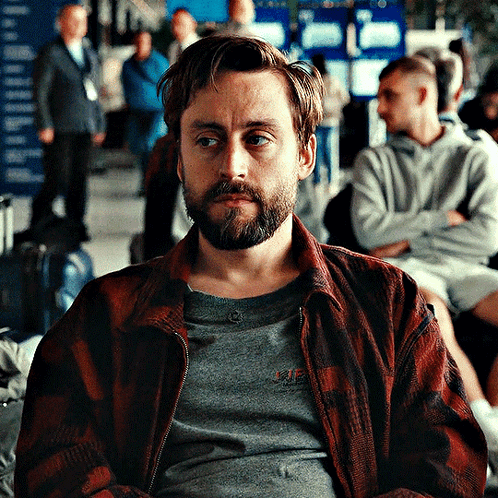
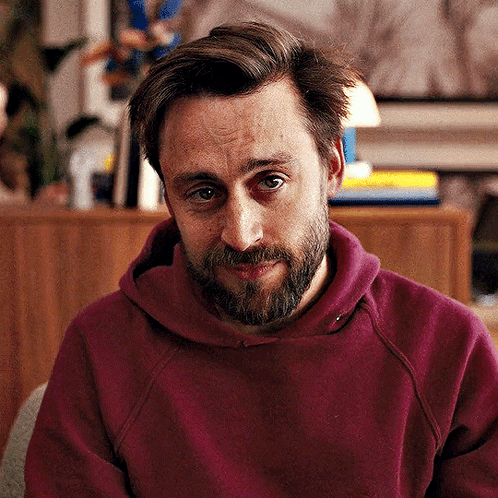
The protagonist, played by Antonio Banderas, is a brilliant plastic surgeon with a tragic past who harbors many secrets and is capable of acting with chilling composure.
On the other hand, the female lead, Elena Anaya, portrays an enigmatic woman who, during the film's opening scenes, appears to be merely someone confined to a room as part of a consensual experiment, and whom the audience deeply distrusts.
Likewise, the other woman who lives in the mansion, the housekeeper played by actress Marisa Paredes, embodies a character who guards her employer's darkest secrets.
I won't reveal the plot, as I think that, like me, you'll have to watch it several times to draw your own conclusions. The truth is, in these stories of powerful and wealthy people, it seems the law doesn't reach them; however, what does reach them is a fatal destiny from which no one can escape.
I invite you to enjoy this film, which will keep you on the edge of your seat until the very end. I give it 70/100, not because I'm a big fan of suspense, but because it kept me engaged and sparked a great debate, to the point that I had to watch it again more closely.
Fuentes Screenshots from: imdb.com I used Google Translate
Saludos querida comunidad de @scrobble.life aquí les traigo una nueva reseña, espero les despierte el interés de ir a verla.
Si quieres ver una película intensa e inquietante, no puedes perderte “La piel que habito”. En esta obra, Pedro Almodóvar —como de costumbre— nos trae un film cargado de una atmósfera de tensa calma donde el misterio está siempre presente, dejando pistas sueltas que obligan al espectador a reconstruir la historia.
El misterio y el suspenso te hacen preguntarte: ¿Quién es el verdadero villano?, ¿Quién es esa mujer? y ¿por qué está allí? Esto hace que la trama cobre más interés a medida que transcurre.
El protagonista, interpretado por el actor Antonio Banderas, es un brillante cirujano plástico con una vida trágica que guarda muchos misterios y es capaz de actuar con gran frialdad.
Por otro lado, la protagonista, Elena Anaya, interpreta a una mujer enigmática que, durante los primeros momentos de la película, parece ser solo alguien recluida en una habitación que forma parte de un experimento consensuado y en quien se tiene una tremenda desconfianza.
Asimismo, la otra mujer que vive en la mansión, el ama de llaves interpretada por la actriz Marisa Paredes, encarna a un personaje que custodia los secretos más oscuros de su empleador.
No contaré la película, pues pienso que, al igual que yo, tendrán que verla varias veces para sacar sus propias conclusiones. La verdad es que, en estas historias de personas poderosas y adineradas, pareciera que la ley no los alcanza; sin embargo, lo que sí los alcanza es un destino fatal del que nadie puede escapar.
Los invito a disfrutar de este film que los mantendrá sentados en la silla hasta el final. Yo le doy un 70/100, y no porque sea muy amante del suspenso, sino porque me mantuvo atenta y creó un gran debate, al punto de tener que volverla a ver con más detenimiento.
Imagenes de captura de: imdb.com He utilizado Google Traductor
Rating: 70/100


